Why Industrial Liquidation Often Prioritizes Expediency Over Asset Value Recovery

Industrial liquidation often happens when a company needs to exit a facility, dispose of equipment, or complete a shutdown within a limited timeframe. In these situations, the process is shaped by practical business pressures rather than the goal of extracting the highest possible value from every asset.
That is why expediency often becomes a central part of industrial liquidation. Companies may place more weight on speed, certainty, and completion than on pursuing the maximum recovery value for each piece of equipment.
This tension between timely execution and asset value recovery shapes how liquidation decisions are made and why maximizing recovery is not always the primary objective.
Why Industrial Liquidation Prioritizes Expediency
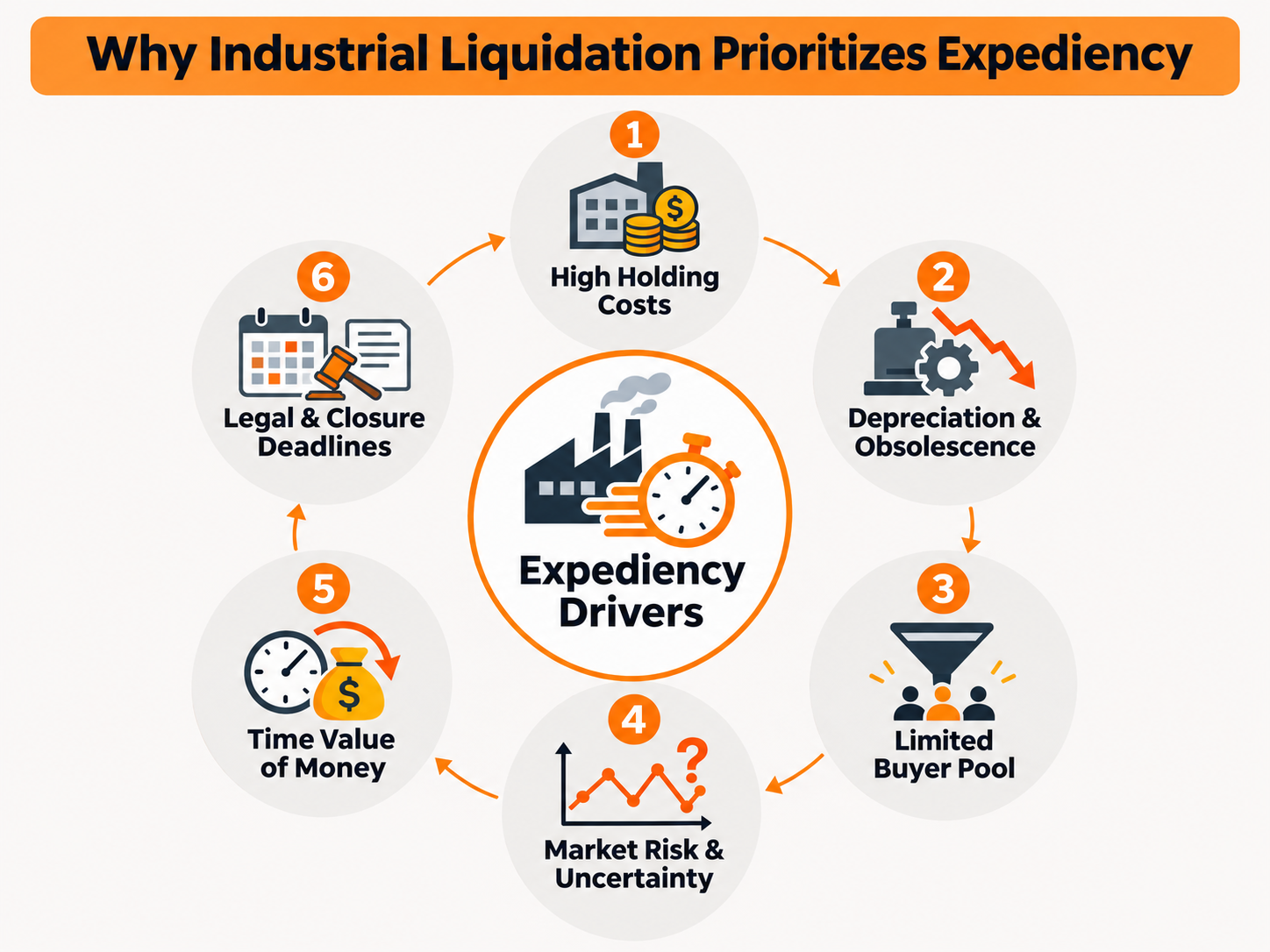
Industrial liquidation involves several pressures that influence how quickly assets need to be sold or removed. Below are the main factors that can lead companies to move assets faster rather than wait for maximum recovery.
1. High Holding and Carrying Costs
Industrial assets continue to generate costs even after they are no longer in use. During liquidation, a company may still need to pay facility rent or lease costs, utilities, insurance, security, maintenance, labor, and other property-related expenses.
According to the Association for Supply Chain Management, inventory carrying costs can range from 10% to 35% of inventory value annually, depending on the industry. These costs increase the longer assets remain on site. In some cases, the added expense of waiting for a higher offer can reduce the financial benefit of that higher sale price.
2. Asset Depreciation and Obsolescence
Industrial equipment loses value while it remains unsold. Physical deterioration, long idle periods, and reduced maintenance can affect machinery condition and make older assets less attractive to buyers.
Technological obsolescence also reduces demand for older equipment. Newer models often offer better efficiency, automation, or compatibility, which can lower the resale value of outdated assets over time.
3. Limited Buyer Pool for Specialized Equipment
Specialized industrial equipment often serves a specific process, production line, or industry. This limits the number of buyers who can use the asset without making significant changes to their operations.
A suitable buyer also needs the right technical setup, available capital, and the ability to manage transportation and installation. These requirements extend the sales process, making faster disposition more attractive during industrial liquidation.
4. Market Risk and Value Uncertainty
The resale market for industrial equipment can change while assets remain unsold. Buyer demand can weaken, equipment prices can shift, and similar used machines can enter the market, increasing competition.
Potential buyers can also delay purchases or withdraw before a sale is completed. Waiting longer does not guarantee a better offer and can expose the seller to greater uncertainty during the liquidation process.
5. Time Value of Money
Money tied up in unsold industrial assets cannot be used elsewhere in the business. A faster sale converts those assets into cash sooner and reduces the amount of capital tied up in the liquidation process.
Earlier recovery can reduce financial exposure and give the company more certainty over the outcome. The recovered capital can then be redirected toward operating needs, debt repayment, or other business priorities.
6. Legal, Contractual, and Closure Deadlines
Industrial liquidation often has to fit within deadlines that are difficult to extend. Lease termination dates, property handover requirements, facility shutdown schedules, and equipment removal deadlines limit how long assets remain on site.
Legal and regulatory obligations create further time pressure, especially during bankruptcy, restructuring, or formal closure processes. These deadlines require companies to complete asset sales and removal within a fixed period instead of waiting for a stronger recovery opportunity.
Expediency vs. Recovery in Industrial Liquidation
How Expediency By Liquidation Companies Also Affects Asset Value Recovery
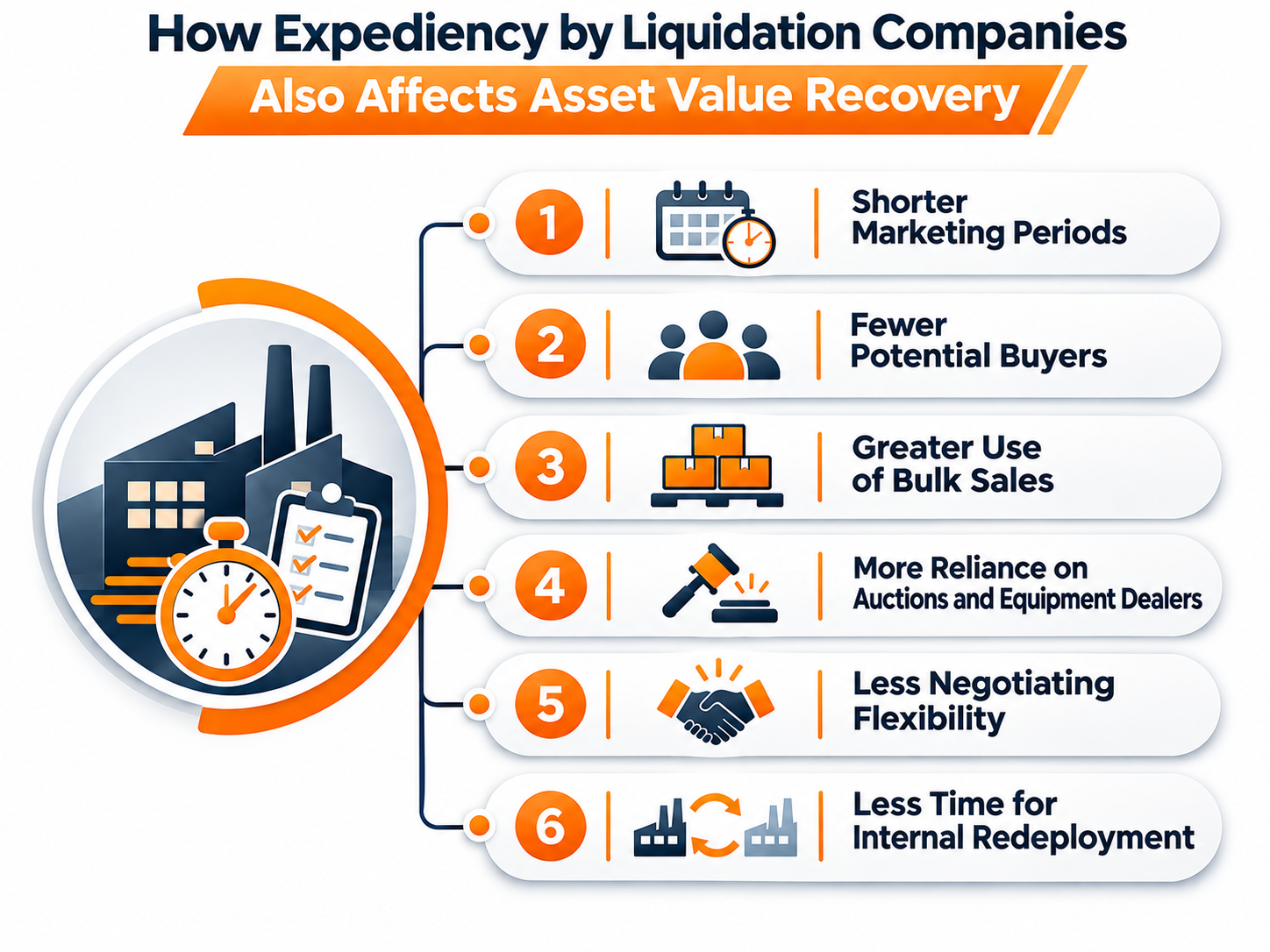
Liquidation companies often structure sales around speed, removal deadlines, and transaction certainty. Below are the main ways this approach affects the value recovered from industrial assets.
1. Shorter Marketing Periods
Liquidation companies working within tight timelines market industrial assets for shorter periods. This gives them less time to generate buyer interest, answer questions, and create competition around the equipment.
Specialized machinery often needs more time because buyers need to review specifications, condition, removal requirements, and capital approval before making an offer. When the marketing window is compressed, the asset has fewer opportunities to reach buyers willing to pay a higher price.
2. Fewer Potential Buyers
A faster liquidation process gives liquidation companies less time to identify and reach buyers that match the asset’s specifications, condition, and intended use. This is especially important for specialized equipment with a narrow end-user market.
With fewer qualified buyers involved, competition can decrease, and liquidation companies receive fewer offers to compare. This can reduce the value recovered from the asset, even when the equipment still has strong demand in the right market.
3. Greater Use of Bulk Sales
When speed becomes the priority, liquidation companies may choose to sell multiple assets together rather than market each one separately. Bulk sales can simplify the disposition of inventory and reduce the time needed to complete the liquidation.
The downside is that higher-value equipment can be grouped with lower-value assets. When buyers price the package as a whole, the value recovered from individual assets can be lower.
4. More Reliance on Auctions and Equipment Dealers
When speed becomes the priority, liquidation companies often rely more on liquidation auctions and equipment dealers because these channels can shorten the sales process and provide access to active buyers.
The trade-off is that specialized or high-value equipment may not receive enough exposure to the end users most likely to pay more. This can limit price discovery and reduce the value recovered from certain assets.
5. Less Negotiating Flexibility
A shorter liquidation timeline gives liquidation companies less room to reject weak offers or wait for better terms. If assets need to be sold or removed by a fixed date, buyers can have more influence over price and transaction conditions.
This can reduce their ability to negotiate price, payment terms, removal schedules, or other deal requirements, which can lower the final value recovered from the asset.
6. Less Time for Internal Redeployment
When liquidation companies work within compressed timelines, there is less time to determine if equipment should be used elsewhere within the business. Identifying equipment redeployment opportunities often requires coordination between facilities, operations teams, and asset managers before liquidation moves forward.
When those reviews are rushed or skipped, usable equipment can be sold even when another facility still needs it. This can reduce the value retained by the company and lead to future replacement costs.
How Amplio Helps Balance Liquidation Speed and Asset Value Recovery
Amplio helps manufacturers manage industrial asset disposition without treating speed and recovery as opposing goals. We combine asset visibility, valuation, buyer outreach, and removal planning so companies can make faster decisions without losing sight of recovery.
Identify and Organize Surplus Assets Early
We help manufacturers build a clearer view of surplus and idle equipment across facilities. Earlier visibility gives teams more time to decide which assets should be redeployed, sold, or removed.
Use AI-Supported Valuation and Expert Review
Our AI-supported cataloging and valuation process helps organize large asset inventories faster. Our experts then review the results against asset condition, market demand, and resale potential before making disposition decisions.
Provide Warehouse Space for Assets
We move equipment out of the facility and store it in our warehouse while the sales process continues. This gives manufacturers more flexibility to meet closure or removal deadlines without forcing assets into a rushed sale before the right buyers are reached.
Match Assets With the Right Recovery Path
We evaluate each asset based on its condition, market demand, resale potential, and internal-use opportunities to determine the best path, including redeployment, targeted resale, bulk disposition, or another recovery option.
Coordinate Buyer Outreach and Removal
We combine buyer outreach with removal and logistics planning. This helps manufacturers work toward facility deadlines while giving assets enough market exposure to reach relevant buyers.
Focus on Net Recovery
Our goal is to balance sale proceeds with the time and costs required to complete the liquidation. This helps manufacturers protect more value while still moving assets within operational and closure constraints.
If you need to liquidate industrial assets without sacrificing more recovery than necessary, our surplus asset management services can help you evaluate your inventory, identify the right disposition paths, reach qualified buyers, and coordinate removal around your timeline.
Contact us to build a liquidation strategy that balances speed, certainty, and asset recovery.