Used Equipment Sourcing: A Complete Guide for Smart Buyers
Used equipment sourcing is a structured approach to acquiring pre-owned machinery that meets operational requirements without the cost and delays associated with new equipment. It involves evaluating available assets, verifying condition and history, and selecting the right machines to support production needs while keeping capital use under control as part of a broader strategic procurement effort.
The scale of investment shows why this discipline matters. According to the U.S. Census Bureau’s Annual Capital Expenditures Survey, U.S. nonfarm employer businesses spent $61.8 billion on used equipment in 2022, up from $55.0 billion in 2021. That year-over-year increase highlights how central used equipment has become in capital planning and how quickly risk compounds when sourcing decisions rely on surface-level checks rather than structured evaluation.
By the end of this guide, you will understand how the used equipment market works in practice. You will know how to find equipment that fits your process, verify critical details, and assess price with confidence before you purchase.
When Used Equipment Sourcing Makes Sense
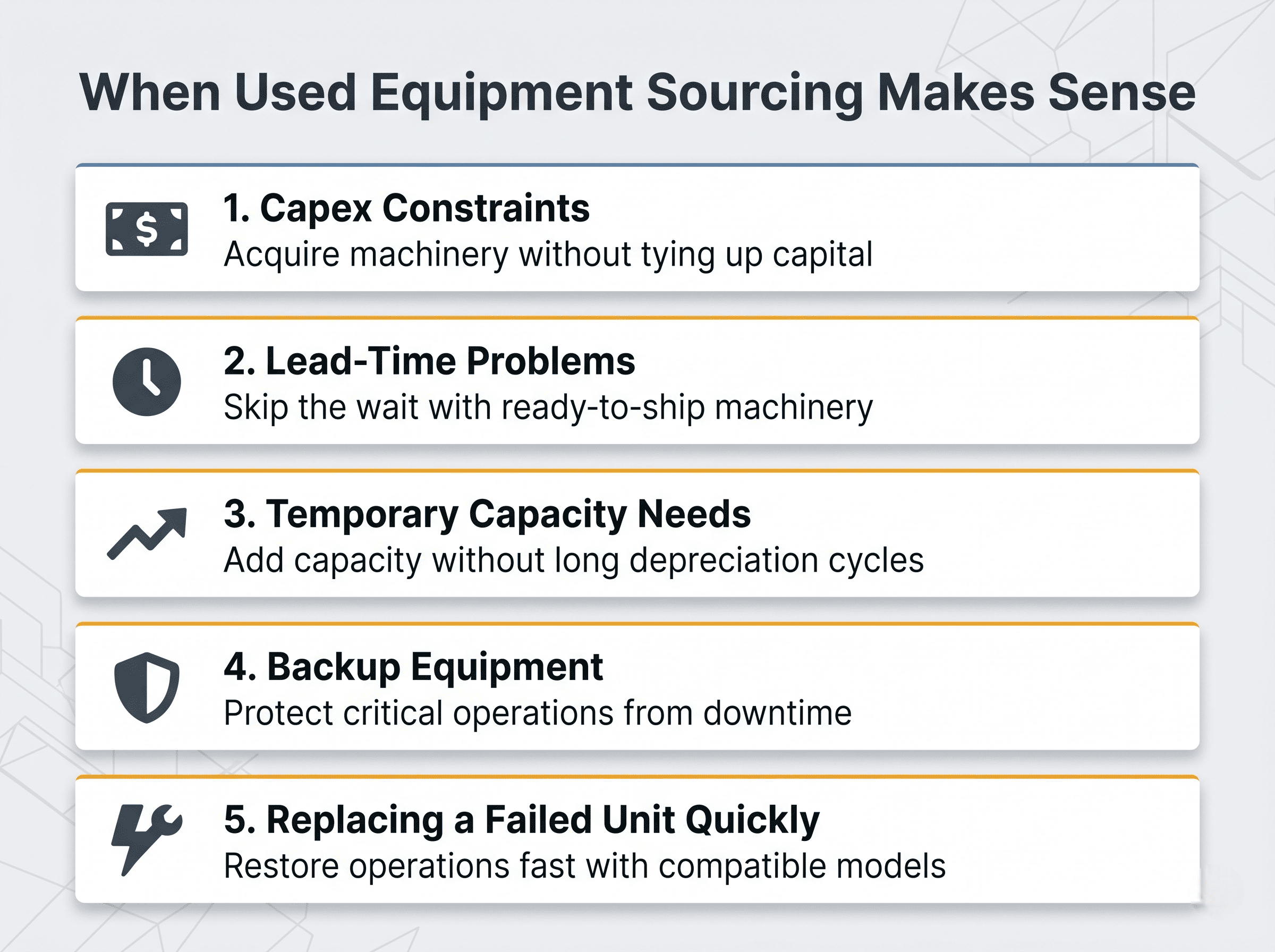
Used equipment sourcing is appropriate when a specific equipment requirement does not align with a standard new equipment purchase. In these situations, industrial equipment buyers assess alternatives within the used equipment market to meet operational needs without disrupting broader planning or asset strategy. Below are the most common situations where used equipment delivers clear value for buyers.
1. Capex Constraints
Capital budgets are often fixed long before equipment fails or demand changes. Used equipment gives you a way to acquire machinery without tying up the same level of capital as new equipment. Many buyers use surplus equipment or refurbished machines to stay within budget while still meeting production requirements, supporting efforts to reduce capital spend. This approach ensures cash availability for other business needs while maintaining operational continuity.
2. Lead-Time Problems
New equipment lead times can stretch for months, sometimes longer, depending on the brand, model, or original equipment manufacturer (OEM). Used machinery reduces that delay by offering options that already exist in the market rather than waiting for new production. For industries that cannot pause production, the used equipment market provides a faster path to start operations and get machines on the floor. This supports teams trying to improve procurement efficiency under tight timelines.
3. Temporary Capacity Needs
Short-term demand spikes do not always justify buying new equipment. Used equipment sourcing allows you to add capacity for a defined period without committing to long depreciation cycles. Many companies use used machines to support seasonal production, pilot runs, or contract work, then resell or redeploy the assets for future use once demand stabilizes.
4. Backup Equipment
Downtime carries real cost. Some buyers source used equipment as backup to protect critical operations. A secondary machine can sit idle until needed, then step in during maintenance or unexpected failure to secure continuity. This strategy is common in process-driven industries where even short interruptions impact revenue, delivery schedules, or customer commitments.
5. Replacing a Failed Unit Quickly
Unexpected failures force fast decisions. When a key machine goes down, waiting for new equipment is rarely an option. Used equipment sourcing helps you replace a failed unit quickly with a compatible model that meets immediate requirements. Buyers often prioritize availability, condition, and fit over brand upgrades in these situations to restore operations as fast as possible.
Where to Source Used Equipment
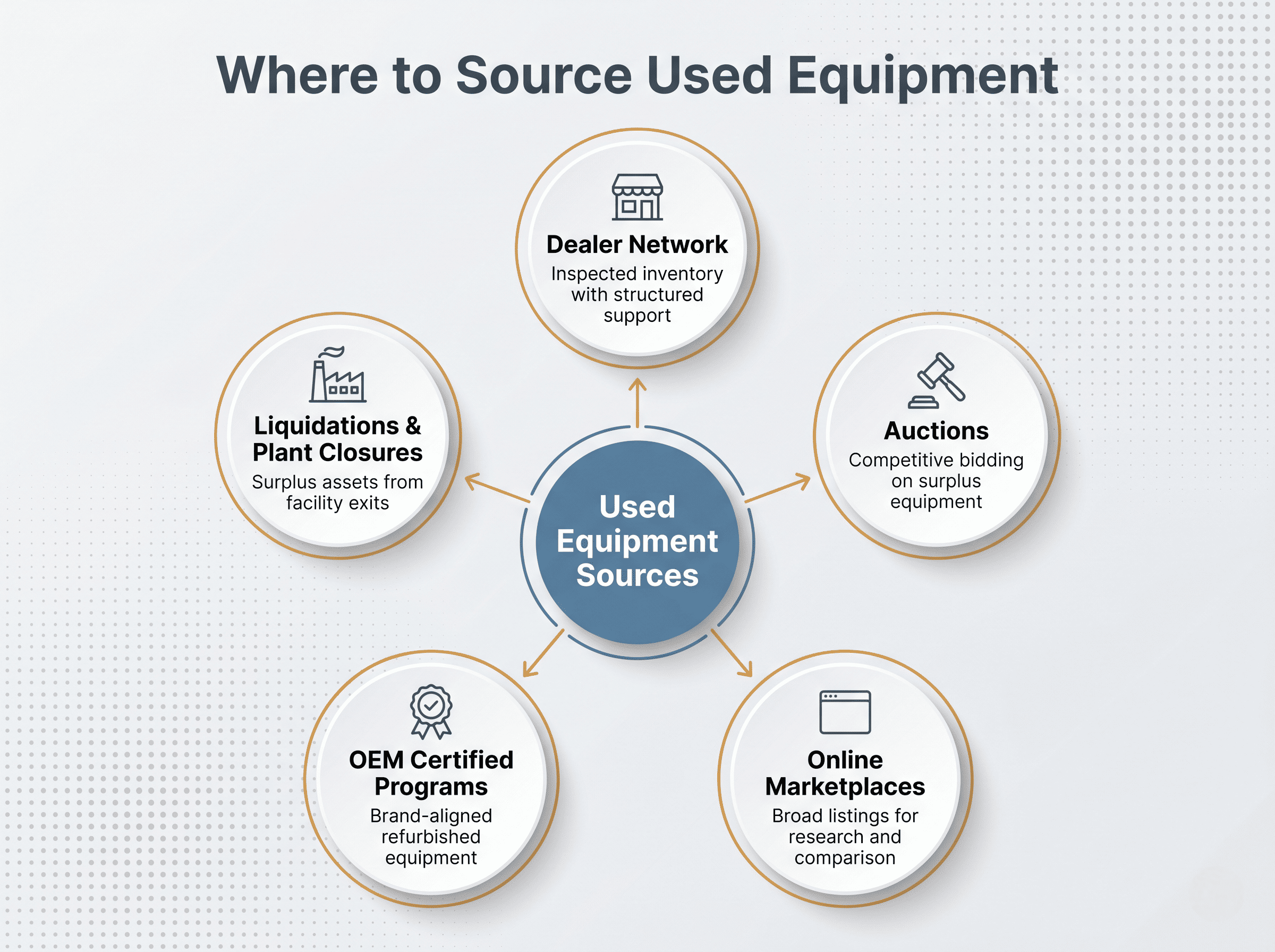
Used equipment sourcing depends on the reliability and structure of the source. Different channels influence pricing, condition visibility, transaction control, and post-purchase support in different ways. Buyers who understand this aspect make sourcing decisions that align with their operational requirements rather than reacting to availability alone.
1. Dealer network
Used equipment dealers act as intermediaries between sellers and buyers. They usually hold inventory, manage listings, and handle transactions directly. Many specialize in specific machinery types, brands, or industries, which gives buyers clearer visibility into what they are purchasing.
Pros:
- Equipment is often inspected before sale
- Condition details and service history are easier to verify
- Clear point of contact for questions and requests
- Some dealers offer limited warranties or refurbishment services
- Better support during packaging, logistics, and delivery
Cons:
- Prices are usually higher than those in private or auction sales
- Inventory may be limited to certain brands or models
- Condition standards vary by dealer
- Buyers still need to verify details before purchase
Best-Fit Scenarios:
- Replacing a critical machine with minimal risk
- Buying refurbished equipment for ongoing operations
- Businesses that need documentation and post-sale support
- Buyers who prefer a structured and organized purchase process
2. Auctions
Auctions offer access to a wide range of used equipment through time-bound sales. Inventory often comes from surplus equipment, decommissioned assets, or business closures. Buyers participate by placing bids in competitive environments, including live auctions, where pricing is driven by demand rather than list values and overseen by an auctioneer.
Pros:
- Access to a high volume of machines in a short time window
- Price discovery through competitive bidding
- Can surface surplus equipment and hard-to-find models
- The purchase cycle can move fast once the auction closes
Cons:
- Condition verification is limited compared to a dealer sale
- Most lots sell as-is/where-is, with limited recourse and limited warranty coverage
- Final cost can increase due to buyer’s premium, fees, and taxes
- Bidding can push the price above the market when multiple buyers compete
- Buyer handles removal, packaging, and logistics under tight timelines
Best-Fit Scenarios:
- Buyers with strong equipment knowledge and inspection experience
- Businesses comfortable assessing conditions with limited information
- Situations where price flexibility matters more than support
- Purchasing non-critical machines or secondary equipment
- Buyers who can manage logistics and risk internally
3. Online marketplaces
Online marketplaces aggregate used equipment listings from dealers, sellers, and businesses across regions and countries. Buyers search, compare, and contact sellers directly through a website or platform. These marketplaces can be helpful for visibility and initial comparison, but they prioritize volume over control of condition or transaction terms.
Pros:
- Broad access to machines across brands, models, and industries
- Easy to search and compare listings by price, location, and specifications
- A quick way to identify availability in the used equipment market
- Useful for market pricing reference and benchmarking
- Direct contact with sellers through the platform
Cons:
- Listing quality and accuracy vary by seller
- Condition details may be limited or inconsistent
- No standard inspection or verification process
- Post-purchase support is uncommon
- Risk increases if buyers rely only on listing information
Best-Fit Scenarios:
- Early-stage research and market comparison
- Buyers who already know the exact machine or model they need
- Situations where price discovery matters more than transaction support
- Businesses with internal teams to inspect, verify, and manage logistics
- Non-critical equipment purchases where flexibility is acceptable
4. OEM Used and Certified Programs
OEMs run used and certified programs to resell equipment that meets defined standards. These programs usually include inspection criteria, refurbishment steps, and documentation tied to the OEM’s specifications. For buyers operating within a single brand environment, this consistency is a clear advantage, as it supports traceability and predictable fit across the OEM ecosystem.
Pros:
- Inspection and refurbishment aligned with OEM standards
- Clear documentation tied to the model and serial number
- Higher confidence in compatibility, software, and controls
- Access to OEM parts, tools, and technical support
- Some programs include limited warranties or service coverage
Cons:
- Higher price compared to non-certified used equipment
- Narrower selection limited to the OEM’s brand and models
- Less flexibility for modifications or third-party components
- Availability depends on trade-ins, fleet rotations, or returns
Best-Fit Scenarios:
- Buyers standardizing fleets around a single brand
- Operations that rely on OEM software, controls, or tooling
- Situations where documentation and support matter more than price
- Purchasing used equipment for core production or long service life
- Businesses that want lower risk without moving to new equipment
5. Liquidations and plant closures
Liquidations and plant closures introduce used equipment into the market through asset exits rather than routine resale. Equipment usually comes from operating facilities that shut down or from businesses reducing or ending operations. For buyers, this source can present an opportunity, but it requires careful verification and disciplined evaluation to assist sound purchasing decisions.
Pros:
- Access to surplus equipment released in concentrated volumes
- Machines often come from known production environments
- Potential for a favourable price compared to dealer listings
- Opportunity to acquire complete lines or matched equipment sets
- Useful for buyers familiar with specific industries or processes
Cons:
- Equipment is commonly sold as-is, with limited support
- Documentation and maintenance history may be incomplete
- Inspection windows can be short
- Removal, packaging, and logistics often fall entirely on the buyer
- Sales timelines are fixed and leave little room for negotiation
Best-Fit Scenarios:
- Buyers with technical teams who can verify the condition quickly
- Businesses seeking value-driven purchases rather than warranties
- Situations where equipment fit matters more than cosmetic condition
- Companies comfortable managing logistics and post-purchase setup
- Experienced buyers operating within the used equipment market
Factors for Selecting a Reliable Used Machine Supplier

Selecting a reliable supplier requires a structured evaluation. Supplier capability shapes equipment accuracy, risk exposure, and outcomes after purchase. Each factor below helps you shortlist suppliers before you submit to a sourcing decision that could introduce avoidable uncertainty.
1. Supplier Experience and Industry Focus
Experience matters when it matches your machinery and industry. Suppliers who focus on specific equipment categories understand how machines are used, where wear develops, and which models fit certain applications. This improves guidance during selection and reduces mismatches after purchase.
Look for suppliers who work regularly with your machine type and can discuss use cases, limitations, and common issues without relying on generic claims.
2. Reliability and Reputation Signals
Reputation reflects how a supplier performs over time. Consistent delivery, accurate listings, and follow-through matter more than marketing claims. Reliable suppliers show a pattern of repeat customers, clear communication, and predictable outcomes.
Check references, customer feedback, and how the supplier handles questions or concerns. These signals often reveal reliability before any transaction begins.
3. Inventory Transparency and Documentation
Transparent inventory supports informed decisions. Suppliers should present clear specifications, serial numbers, model details, and condition disclosures. In the used equipment market, missing or vague information increases risk and slows the purchase process.
Prioritize suppliers who provide organized documentation that allows you to verify details without repeated follow-ups.
4. Inspection and Testing Process
A defined inspection and testing process shows discipline. Suppliers should explain what checks are performed, what is verified, and what limits apply. This helps buyers compare machines consistently.
Clear inspection practices reduce surprises and signal that the supplier treats used equipment as managed assets rather than unmanaged stock.
5. Maintenance History and Asset Origin
Maintenance history adds context beyond visual condition. Knowing how equipment was used, serviced, and stored helps you assess remaining life and fit. Asset origin also matters, especially for surplus equipment or machines released from closed facilities.
Suppliers who can explain asset history give buyers a stronger basis for evaluating price and long-term performance.
6. Technical Support and Parts Access
Technical support influences uptime after purchase. Suppliers with access to parts, manuals, and technical guidance help buyers resolve issues faster. This matters when sourcing used machinery tied to specific controls, software, or OEM components.
Confirm how support requests are handled and what level of assistance is available after delivery.
7. Communication and Responsiveness
Clear communication reduces friction throughout the process. Responsive suppliers answer questions directly, provide timely updates, and set expectations early. This helps buyers manage internal timelines and approvals.
Consistent communication is often the difference between a controlled purchase and one that creates delays or rework.
How Amplio Helps You Source Used Equipment
Amplio supports used equipment sourcing by focusing on enterprise surplus rather than fragmented resale channels. The platform works directly with global manufacturers to surface surplus equipment that already exists inside active businesses. This gives buyers access to used equipment that rarely appears in public marketplaces or dealer inventories.
Access to Enterprise Surplus Inventory
Amplio connects buyers with surplus equipment released from large manufacturers as part of structured asset management programs. These assets typically come from plant closures, network optimization, capacity changes, or process upgrades, not forced liquidations. As a buyer, you gain access to used machinery that was maintained for production use and managed within formal operational environments.
AI-Powered Equipment Discovery
Amplio uses AI agents to analyze large volumes of enterprise equipment data and identify assets that match buyer requirements. This reduces manual search across multiple websites and sellers. You can find equipment based on specifications, model, application, and industry fit, which improves efficiency during used equipment sourcing.
Verified Asset Data
Each asset surfaced through Amplio includes structured information that supports verification. Equipment data covers specifications, condition context, asset origin, and supporting documentation where available. This allows buyers to assess price, risk, and fit early in the process without relying on incomplete listings or assumptions common in the used equipment market.
Contact us to see how Amplio helps buyers access verified enterprise surplus and source used equipment with greater control and clarity.