MRO Supply Chain: What It Is and How to Manage It

In the fast-paced world of manufacturing and industrial operations, success is built on more than just raw materials and finished products. Behind the scenes, the MRO (Maintenance, Repair, and Operations) supply chain ensures that equipment runs smoothly and facilities remain safe. While these materials and services may not make it into the final product, they are crucial to keeping operations up and running.
The costs of poorly managed MRO inventory—such as unplanned downtime and emergency repairs—often go unnoticed until they disrupt production and impact profitability. Unplanned downtime alone costs industries an estimated $50 billion annually, highlighting the need for efficient MRO management to avoid costly production stoppages.
In this blog, we’ll break down the key components of an MRO supply chain, highlight its importance for operational efficiency, and explore the best practices for managing it effectively.
What Is an MRO Supply Chain?

An MRO supply chain is the system that ensures all materials, parts, and tools needed for the maintenance, repair, and operation of equipment are readily available. While it doesn't directly contribute to the final product, it supports operations by keeping machinery, infrastructure, and facilities running smoothly and safely.
Unlike the production supply chain, which focuses on raw materials and components for creating the final product, the MRO supply chain deals specifically with resources required for maintaining and repairing equipment to minimize downtime and improve asset reliability.
Some common MRO items include:
- Spare parts: Essential components for repairing or replacing damaged machinery parts.
- Safety equipment: Items like helmets, gloves, and goggles that protect workers during operations and maintenance tasks.
- Lubricants: Oils and greases used to maintain machinery, reducing friction and wear.
- Tools: Equipment such as wrenches, drills, and screwdrivers used for maintenance and repairs.
- Consumables: Items like cleaning supplies, tapes, and adhesives that are regularly used and replaced in the maintenance process.
Why the MRO Supply Chain Is Important
A well-managed MRO supply chain is essential for maintaining smooth operations in any manufacturing or industrial setting. From ensuring that spare parts are always available to managing safety equipment and lubricants, the efficiency of your MRO processes directly impacts multiple aspects of your business.
1. Impact on Equipment Uptime
The availability of MRO inventory is critical for keeping machinery running and preventing downtime. Efficient MRO management ensures that essential repair supplies, such as spare parts and lubricants, are in stock when needed. With predictive maintenance and accurate forecasting, businesses can minimize machine breakdowns, maintain equipment reliability, and focus on protecting uptime, keeping production lines running smoothly.
2. Effect on Maintenance Costs
When MRO processes are optimized, businesses can achieve significant cost savings by improving inventory control. Proper inventory control and good MRO inventory management help avoid overstocking and excess inventory while ensuring the right parts are available. This reduces the need for emergency repairs and costly rush shipping, leading to more cost-effective maintenance operations.
3. Role in Operational Efficiency
MRO supply chain management is a critical aspect of operational efficiency. By streamlining procurement processes, businesses can avoid maintenance delays and ensure smoother production cycles. When maintenance teams have access to the right safety equipment and tools, they can resolve issues more quickly, minimizing downtime in both production machinery and other equipment, keeping operations on track.
4. Risk of Stockouts and Unplanned Downtime
Stockouts and unplanned downtime present significant risks to any business. A shortage of critical MRO items—whether it's personal protective equipment or replacement parts—can lead to production halts, delayed deliveries, and costly downtime. By implementing effective sourcing strategies alongside asset criticality analysis and accurate demand forecasting, businesses can secure reliable supplier support, prevent these disruptions, and ensure quicker recovery from unexpected equipment failures.
Core Components of an Effective MRO Supply Chain
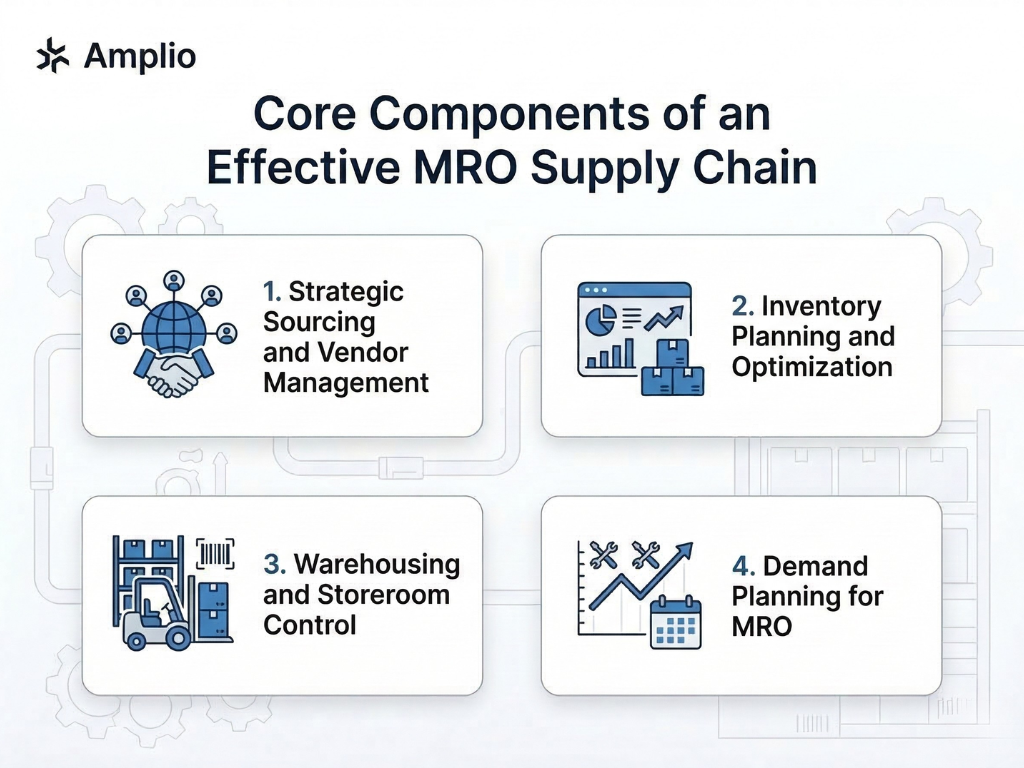
To optimize your MRO supply chain and drive operational efficiency, it's essential to focus on key components. These elements strike the right balance between supply availability, cost control, and performance.
1. Strategic Sourcing and Vendor Management
Strategic sourcing and vendor management are critical to improving MRO supply chain efficiency. By consolidating suppliers, businesses can simplify MRO procurement and reduce costs. Fewer vendors mean better pricing, more reliable delivery, and streamlined inventory management.
Long-term contracts with vendors provide stability, ensuring consistent supply and predictable pricing for critical MRO items. These agreements help avoid price fluctuations and ensure businesses always have the parts and materials needed to keep operations running smoothly.
Effective vendor management also includes tracking supplier performance through scorecards. By regularly evaluating factors like delivery reliability and quality, businesses can identify areas for improvement and mitigate risks. This ensures that suppliers meet expectations and contribute to minimizing downtime and maintenance costs.
2. Inventory Planning and Optimization
Effective inventory planning and optimization are essential for maintaining a balanced MRO supply chain. By understanding which items are critical and frequently used, businesses can ensure that essential materials are always available while avoiding the costs associated with overstocking and accumulating excess inventory.
ABC analysis helps categorize MRO items based on their value and usage frequency, ensuring that high-priority items are always in stock. Similarly, criticality analysis helps businesses identify which items have the most impact on production, allowing for more focused inventory management of mission-critical parts.
To prevent stockouts, businesses rely on tools like safety stock calculation and the reorder point formula. These methods ensure that essential items are available even during demand fluctuations or supply delays, reducing the risk of unplanned downtime and improving overall operational efficiency. In addition, effective asset disposition for slow-moving or obsolete inventory allows businesses to free up valuable resources and storage space, ensuring that inventory remains lean and aligned with production needs.
3. Warehousing and Storeroom Control
Effective warehousing and storeroom control are essential for maintaining an organized and efficient MRO supply chain. By streamlining the storage of materials and ensuring easy access to essential items, businesses can reduce delays and improve inventory management.
SKU standardization is a key practice that simplifies inventory control. By assigning consistent codes to MRO items, businesses can eliminate confusion and improve accuracy in tracking and ordering. This process ensures that materials are properly categorized and easy to locate when needed.
To further enhance control, barcode and Radio Frequency Identification (RFID) tracking technologies provide real-time visibility into inventory levels. These systems allow businesses to monitor stock movements, reducing discrepancies and ensuring that materials are always available. Additionally, cycle counting helps maintain inventory accuracy by regularly checking stock, preventing errors, and ensuring items are always available when needed.
4. Demand Planning for MRO
Effective MRO demand planning ensures the right materials are available when needed, reducing downtime and preventing stockouts. By analyzing past usage history, businesses can forecast future needs and maintain optimal stock levels through risk-based planning, prioritizing inventory and resources based on the potential impact of shortages.
Failure rate data helps identify which parts are likely to fail and need replacing. Integrating this data with a Computerized Maintenance Management System (CMMS) ensures more accurate demand forecasting and streamlined inventory management.
Using forecasting tools alongside historical usage and failure rate data helps companies create more accurate demand plans. This approach reduces the risk of stockouts and ensures that MRO inventory aligns with operational needs.
Common Challenges in the MRO Supply Chain
Despite the importance of a well-managed MRO supply chain, businesses often face a range of challenges that hinder efficiency and increase costs. Below are some of the most common obstacles businesses encounter in managing their MRO supply chain effectively.
1. Fragmented Data Across ERP and Maintenance Systems
One of the biggest challenges in MRO supply chain management is fragmented data. When Enterprise Resource Planning (ERP) and maintenance systems are not integrated and do not share the same data, businesses struggle to maintain accurate, up-to-date records of MRO inventory. This misalignment creates partial visibility into inventory levels, usage patterns, and procurement activity, leading to discrepancies, poor decision-making, and difficulty forecasting demand—ultimately increasing the risk of downtime.
2. Vendor Sprawl
Vendor sprawl occurs when businesses rely on too many suppliers for their MRO needs, leading to inefficiencies in procurement and inventory management. Managing a large number of suppliers increases complexity, making it difficult to track orders, negotiate favorable terms, and consolidate shipments. By consolidating vendors, businesses can reduce costs, streamline procurement, and improve the reliability of their MRO supply.
3. Static Stocking Policies
Static stocking policies are another barrier to efficient MRO supply chain management. Without dynamic policies for inventory management, businesses often overstock low-demand items or run out of critical components. Overstocking can create excess and obsolete (E&O) inventory, tying up working capital and occupying valuable storage space. Adopting data-driven approaches like demand forecasting and criticality analysis helps optimize stocking levels, minimize E&O inventory, and ensure critical parts are always available.
4. Site-Level Optimization Instead of Network-Level
Many businesses focus on optimizing inventory at individual sites rather than looking at the broader network-level optimization. This siloed approach can cause multiple locations to experience the same problems, such as excess stock at one site and shortages at another. A network-wide approach to MRO management ensures that inventory is shared effectively across all sites, minimizing waste and ensuring timely access to critical parts.
5. Emergency Purchase Orders
Relying on emergency purchase orders is a sign of poor MRO inventory management. These last-minute buys often come with higher costs, longer lead times, and less favorable terms from suppliers. By improving demand planning, businesses can reduce the need for emergency orders, leading to better cost control, minimizing the risk of production delays, and helping prevent situations where they might lose revenue.
Key Steps For An Effective MRO Supply Chain Management

Managing an efficient MRO supply chain requires a strategic approach that balances inventory, procurement, and maintenance processes. By following key steps, businesses can reduce costs, improve operational efficiency, and minimize downtime.
Step 1: Inventory Management
Maintaining optimal stock levels is crucial for effective MRO supply chain management. Overstocking ties up resources, while understocking can lead to critical parts being unavailable when needed, causing production delays. Proper inventory management helps businesses strike the right balance, ensuring essential items are always on hand.
Key practices in effective inventory management include:
- RFID: Enables real-time tracking of MRO inventory, improving visibility and reducing errors in stock levels.
- Predictive analytics: Uses historical data to forecast demand, ensuring businesses can plan ahead and avoid stockouts or overstocking.
- Inventory control: Optimizes stock levels, reducing holding costs and ensuring the timely availability of critical MRO items like spare parts and safety equipment.
Step 2: Vendor and Supplier Relationships
Strong vendor and supplier relationships are essential for an efficient MRO supply chain. Building reliable partnerships ensures consistent supply, better pricing, and improved service—all of which contribute to operational efficiency and guarantee that the equipment needed for maintenance and operations is always available.
Key considerations when choosing MRO suppliers include:
- Reliability: Ensuring suppliers can deliver the required MRO supply consistently and on time, reducing downtime risk.
- Cost competitiveness: Selecting suppliers that offer competitive pricing without compromising on quality, helping to control maintenance costs and improve overall MRO management.
- Quality assurance: Choosing suppliers that provide high-quality parts, tools, and materials, such as safety equipment and spare parts, to ensure long-lasting and effective maintenance solutions.
- Lead times and flexibility: Suppliers that can meet tight delivery deadlines and adapt to changes in demand help maintain inventory levels and reduce the need for emergency purchase orders.
- Vendor-Managed Inventory (VMI): A strategy where suppliers monitor and manage stock levels, ensuring that critical MRO items are always available when needed, improving inventory control.
Step 3: Process Optimization
Optimizing MRO processes is key to improving efficiency and reducing costs in the supply chain. By adopting lean practices and focusing on proactive maintenance, businesses can streamline operations, minimize waste, and ensure that critical assets are always available when needed.
Key strategies for process optimization in MRO include:
- Lean practices: Applying lean principles to MRO helps businesses eliminate waste and reduce unnecessary steps in procurement and maintenance. This increases overall supply chain efficiency.
- Proactive maintenance: Moving from reactive to proactive maintenance helps minimize downtime. By regularly monitoring equipment and performing preventative maintenance, businesses can identify issues early and prevent costly breakdowns, ensuring production processes run smoothly without interruptions.
- Predictive maintenance: Predictive tools forecast potential equipment failures, allowing businesses to plan maintenance before issues occur. This extends the lifespan of industrial equipment and reduces downtime risk.
Step 4: Data-Driven Decisions
Using data is essential for making informed decisions in managing the MRO supply chain. By using historical data and predictive analytics, businesses can forecast their MRO needs, optimize inventory levels, and avoid costly emergency purchase orders.
Key tools for improving decision-making in MRO management include:
- Demand forecasting: Uses data to predict the future need for critical MRO items, such as spare parts and safety equipment, ensuring that inventory levels are optimized and stockouts are minimized.
- Real-time data tracking: Integrating RFID and other tracking technologies into MRO management systems enables businesses to monitor inventory and asset performance in real time. This improves decision-making and ensures materials are available when needed.
How Amplio Helps You Optimize Your MRO Supply Chain
At Amplio, we help businesses optimize their MRO supply chain using AI-powered solutions that enhance efficiency, reduce costs, and improve procurement processes. Our focus is on ensuring that critical MRO items are always available, minimizing waste, and improving overall operational performance.
Seamless Data Analysis for Better Decisions
Amplio uses AI to ingest fragmented MRO inventory data, organize it, and identify underused or excess items across operations. This enables businesses to quickly identify surplus MRO inventory, evaluate internal redeployment opportunities, and make informed decisions on excess disposition without requiring teams to analyze large volumes of inventory data manually.
Effective Disposition of Excess MRO Inventory
Amplio specializes in the disposition of excess MRO inventory. Using our AI-powered platform, we help businesses identify surplus or obsolete MRO items, including spare parts, tools, and other materials no longer needed, and make informed decisions about their disposal. This prevents waste, frees up valuable storage space, recovers capital, and optimizes overall inventory usage, supporting lean operations and better resource management.
Get in touch with Amplio to optimize your MRO supply chain and streamline your operations with our AI-driven solutions.