Excess Inventory: Advantages and Disadvantages

Excess inventory can significantly undermine an enterprise’s financial agility and operational performance. According to NetSuite, carrying costs can account for up to 25% of the total inventory value. In practical terms, this means that for every $1 million of surplus stock or unsold inventory, as much as $250,000 may be incurred in holding expenses.
For industrial manufacturers, excess inventory is not merely a storage concern. It indicates a critical mismatch between production needs, sales forecasts, and procurement practices, leading to inefficient resource allocation and increased risk.
In today’s dynamic supply chain landscape, where operational pressures and global uncertainties are constant, understanding and managing excess inventory is paramount. Excess stock reduces the cash flow available for growth and innovation while disrupting efficient production by tying up vital capital in non-performing assets.
This blog will define excess inventory and detail its advantages and disadvantages. The insights presented here are designed to empower you to refine your procurement efficiency, avoid excess inventory, and improve overall business performance.
What Is Excess Inventory?

Excess inventory is the extra stock a business holds beyond its immediate or forecasted demand. It results when production or purchasing volumes exceed what the market and operation require, typically due to overstock inventory, inaccurate demand forecasting, or slow sales.
It is important to distinguish excess inventory from safety or buffer stock. Safety stock is deliberately maintained to cover demand fluctuations or supply disruptions and to respond to changes in market demand. In contrast, excess inventory stems from a misaligned procurement strategy and inefficient planning. Purchasing decisions and sales forecasts do not align with actual customer demand. This discrepancy affects liquidity and operational performance, making it essential for you to manage inventory levels with precision through accurate demand forecasting.
Different Types of Excess Inventories
Excess inventory manifests in several distinct forms in industrial operations. Here are the various types:
- Overproduction Excess: Occurs when production volumes exceed the forecasted demand due to planning errors, weaknesses in demand forecasting models, or overly aggressive capacity utilization. This type of surplus arises when the cost of underproduction is weighed higher than the risk of overproduction.
- Ordering Excess: Results from procurement practices that favor bulk purchases for volume discounts or to meet supplier minimums. This approach, aimed at short-term cost reduction, often leads to inventory levels that surpass actual operational requirements.
- Seasonal or Style-Related Excess: Develops in industries with seasonal trends or rapidly changing market demand. Overstocking during peak periods can leave manufacturers with excess inventory that loses value once demand shifts. Over time, these products become slow-selling items, causing unsold stock to accumulate.
- Obsolescence Excess: This comprises items that are no longer required or have been phased out. These components rapidly lose their market and operational relevance as shifting market trends or product updates reduce demand. Over time, this type of unsold inventory imposes financial strain as it occupies valuable warehouse space and contributes to increased storage costs.
- MRO Inventory Excess: In some cases, maintenance, repair, and operations (MRO) inventory is held beyond what is necessary. While a certain level of MRO stock ensures smooth day-to-day operations, excess MRO items can create additional storage costs and tie up capital. Holding excess inventory in MRO supplies highlights a misalignment between stocking levels and actual demand.
What Is The Difference Between Excess and Surplus Inventory?
In enterprise manufacturing, the terms "excess" and "surplus" inventory are frequently used interchangeably, but they represent distinct concepts with important operational implications.
Excess inventory refers to extra stock that exceeds the needs of a particular site or department, yet it might still be used elsewhere in the organization. In contrast, surplus inventory refers to overstock that cannot be redeployed internally and must be liquidated, donated, or discarded. Some experts also view surplus as an intentional or seasonal overage linked to seasonal trends, while excess inventory typically reflects unplanned overproduction or inaccurate demand forecasting that leaves companies with unsold inventory.
A practical solution to managing unwanted industrial excess is excess inventory liquidation. By implementing proven strategies to reduce excess inventory, you can convert unwanted inventory into working capital, reduce surplus inventory, and avoid ongoing storage costs.
Advantages of Excess Inventory

Below are the key advantages of managing excess inventory:
1. Buffer Against Demand Fluctuations
Excess inventory acts as a safeguard during unexpected spikes in demand. Maintaining additional stock on hand enables you to fulfill sudden orders and avoid stockouts.
This buffer allows supply chain teams to respond quickly to shifts in actual customer demand and maintain production continuity. As a result, businesses avoid disruptions that occur when the inventory on hand runs too low.
2. Bulk Purchasing and Cost Benefits
Over-ordering can yield significant financial advantages in certain situations. When you purchase surplus inventory, you often secure bulk purchasing discounts and obtain materials at a lower price per unit. This approach strengthens supplier relationships in B2B contexts and helps reduce procurement costs over time.
While this strategy can lower procurement costs in the short term, it requires careful inventory control to ensure purchasing decisions remain aligned with actual demand and do not create unnecessary excess inventory.
3. Operational Continuity
A well-managed surplus ensures that your operations continue uninterrupted during supply chain disruptions. In the event of late shipments or raw material shortages, maintaining excess inventory helps you maintain steady production and safeguard revenue streams.
This allows supply chain teams to respond to disruptions and continue operations without delays. In essence, having a controlled level of extra inventory on hand provides a critical safety net that supports both operational stability and financial performance.
4. Faster Order Processing and Delivery
Maintaining excess inventory enables faster order processing and delivery. When sufficient inventory is on hand, warehouse teams can fulfill orders immediately without waiting for production or replenishment.
This improves response time, helps businesses meet actual customer demand, and reduces delays during periods of increased market demand.
Disadvantages of Excess Inventory
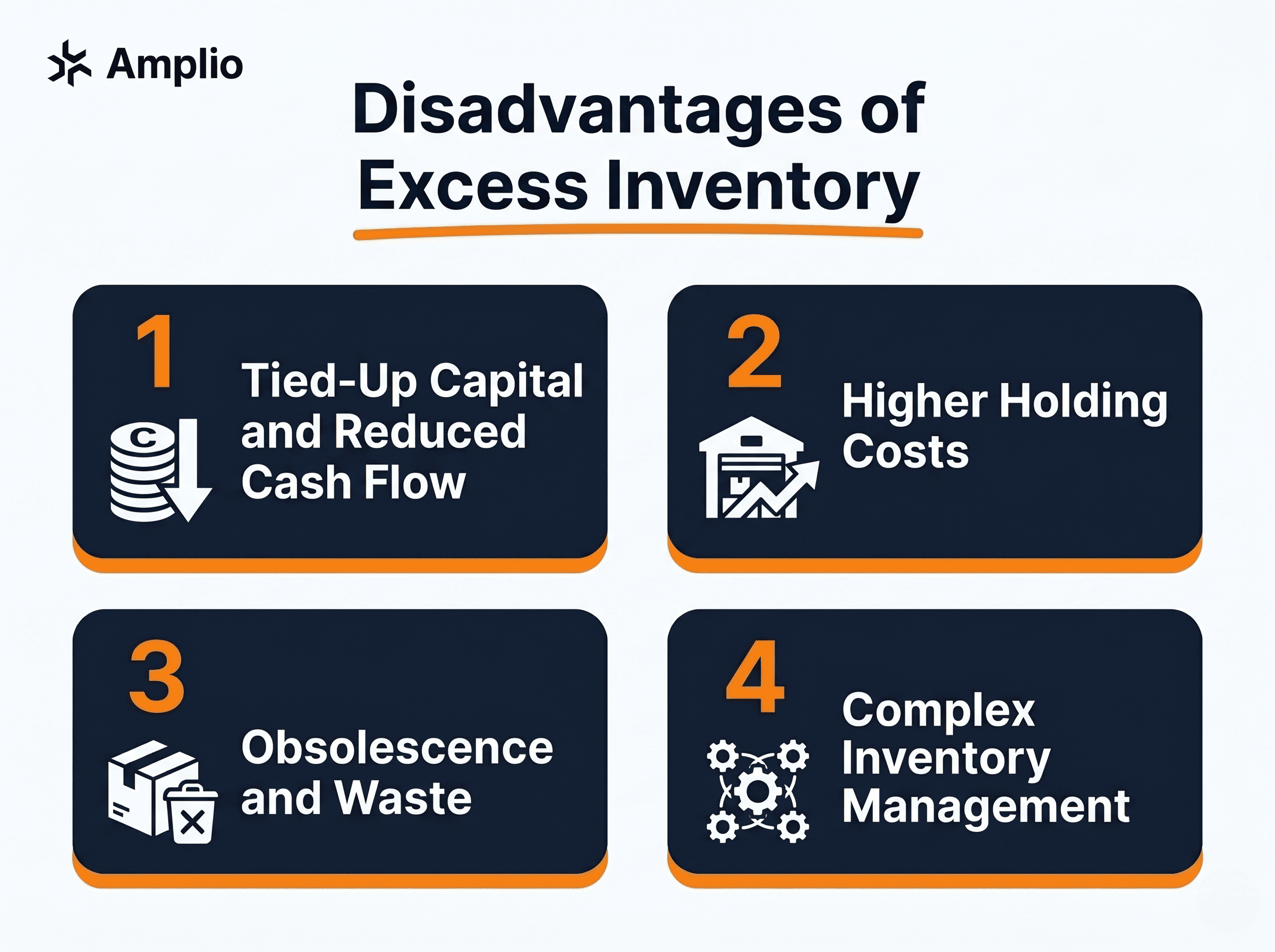
There are advantages to controlling excess inventory, but if it is not managed properly, it can lead to significant drawbacks. Below are the significant disadvantages and the consequences of carrying too much inventory:
1. Tied-Up Capital and Reduced Cash Flow
Excess inventory immobilizes a significant portion of your working capital, preventing it from being deployed for strategic initiatives or operational improvements.
This locked capital diminishes your financial flexibility, forcing you to allocate funds to non-performing assets instead of growth opportunities. Consequently, the inability to invest in innovation or process optimization can further deteriorate your enterprise’s competitive position over time.
2. Higher Holding Costs
Carrying excess stock generates continuous expenses that accumulate over time, including warehouse rent, insurance premiums, and routine maintenance fees. Holding surplus inventory further increases these costs and creates unnecessary expenses, impacting overall profitability and often leading to reduced profit margins.
Moreover, managing higher inventory levels often requires additional labor and improved stock visibility and tracking systems to maintain accurate records and efficient operations.
3. Obsolescence and Waste
Excess inventory can quickly lead to inventory obsolescence when product demand shifts, technology evolves, or market trends change, leaving businesses with items that rapidly lose value. The depreciation of these goods often forces companies to write down inventory or sell remaining items at a discounted price to minimize financial losses before disposing of unsellable stock.
Additionally, the process of disposing of or recycling obsolete inventory introduces further operational challenges and increased costs, disrupting smooth production schedules and reducing overall efficiency.
4. Complex Inventory Management
Handling excess inventory increases the complexity of operations, as larger stock volumes require stronger inventory control and more reliable inventory tracking systems to avoid errors. When companies hold too much stock or overstock inventory, the risk of mismanagement increases. This leads to inaccurate stock counts, higher administrative workloads, and potential shrinkage.
As inventory levels grow, businesses often face greater inventory challenges, requiring additional investments in technology and training to maintain accurate records and operational efficiency.
Final Thoughts
The advantages and disadvantages of excess industrial inventory highlight the critical need for disciplined inventory management in enterprise manufacturing.
Enterprise manufacturers should perform regular procurement audits and employ strategic inventory management practices to reduce excess inventory and maintain optimal stock levels. Aligning your inventory with production requirements not only prevents waste but also safeguards your liquidity and operational agility.
To reduce inventory overhead, free up capital, and help reduce storage costs while maintaining a lean, resilient supply chain, consider structured industrial liquidation solutions. Amplio’s AI-powered, data-driven, compliant platform helps you evaluate existing excess inventory and connect with qualified buyers so you can sell excess inventory and recover value from surplus industrial assets through a streamlined liquidation process.
Contact us today to drive efficiency and get rid of excess industrial inventory.