5 Strategic MRO Sourcing Moves to Mitigate Supply Chain Risks

Introduction
MRO sourcing plays a direct role in keeping equipment available, maintenance teams productive, and plant operations running. When critical parts are delayed, unavailable, or tied to a single supplier, even a small sourcing issue can create wider supply chain risks.
A strong MRO sourcing strategy helps you improve part availability, reduce emergency purchases, manage supplier risk, and protect equipment uptime.
In this article, you’ll learn five practical MRO sourcing strategies to mitigate supply chain risks and reduce the impact of supplier disruptions.
What Is MRO Sourcing?
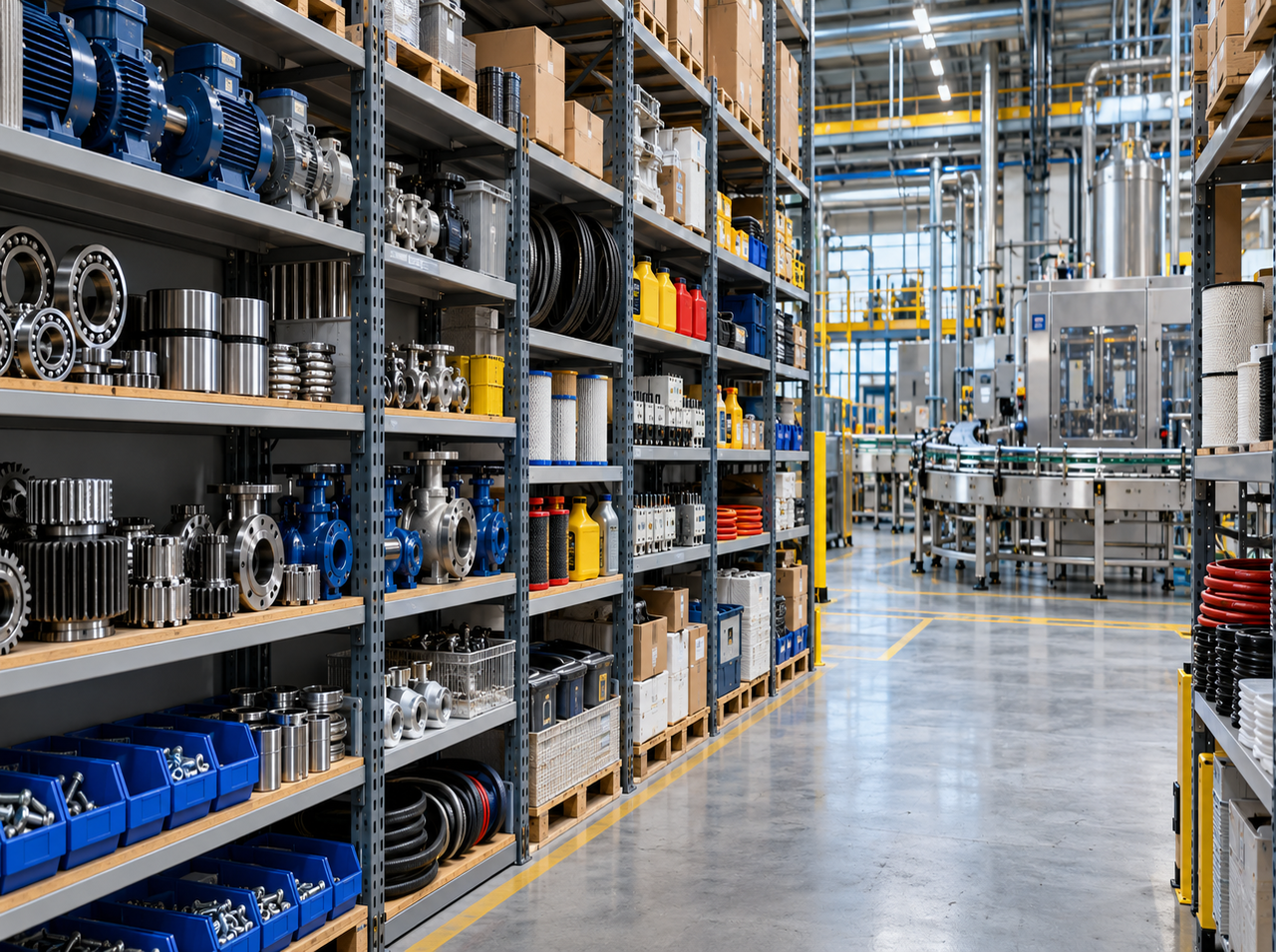
MRO sourcing refers to the process of procuring Maintenance, Repair, and Operations materials, parts, and services that keep your industrial equipment and operations running. It covers everything from spare parts and consumables to service agreements and technical support.
MRO purchases can include spare parts, tools, lubricants, safety supplies, replacement components, maintenance equipment, and repair services. These items do not become part of the final product. Instead, they help you maintain equipment and support ongoing plant operations.
Effective MRO sourcing supports a stronger MRO procurement strategy by helping you keep critical parts available, control maintenance costs, manage inventory, and reduce delays caused by shortages or supplier disruptions. It also supports equipment uptime and strengthens supply chain resilience.
MRO Sourcing vs. Direct Sourcing
MRO sourcing focuses on the parts, supplies, and services needed to maintain equipment and support daily operations. Direct sourcing focuses on raw materials and components that become part of the final product.
The key difference is purpose. MRO sourcing supports maintenance and equipment uptime, while direct sourcing supports production.
Common MRO Supply-Chain Risks
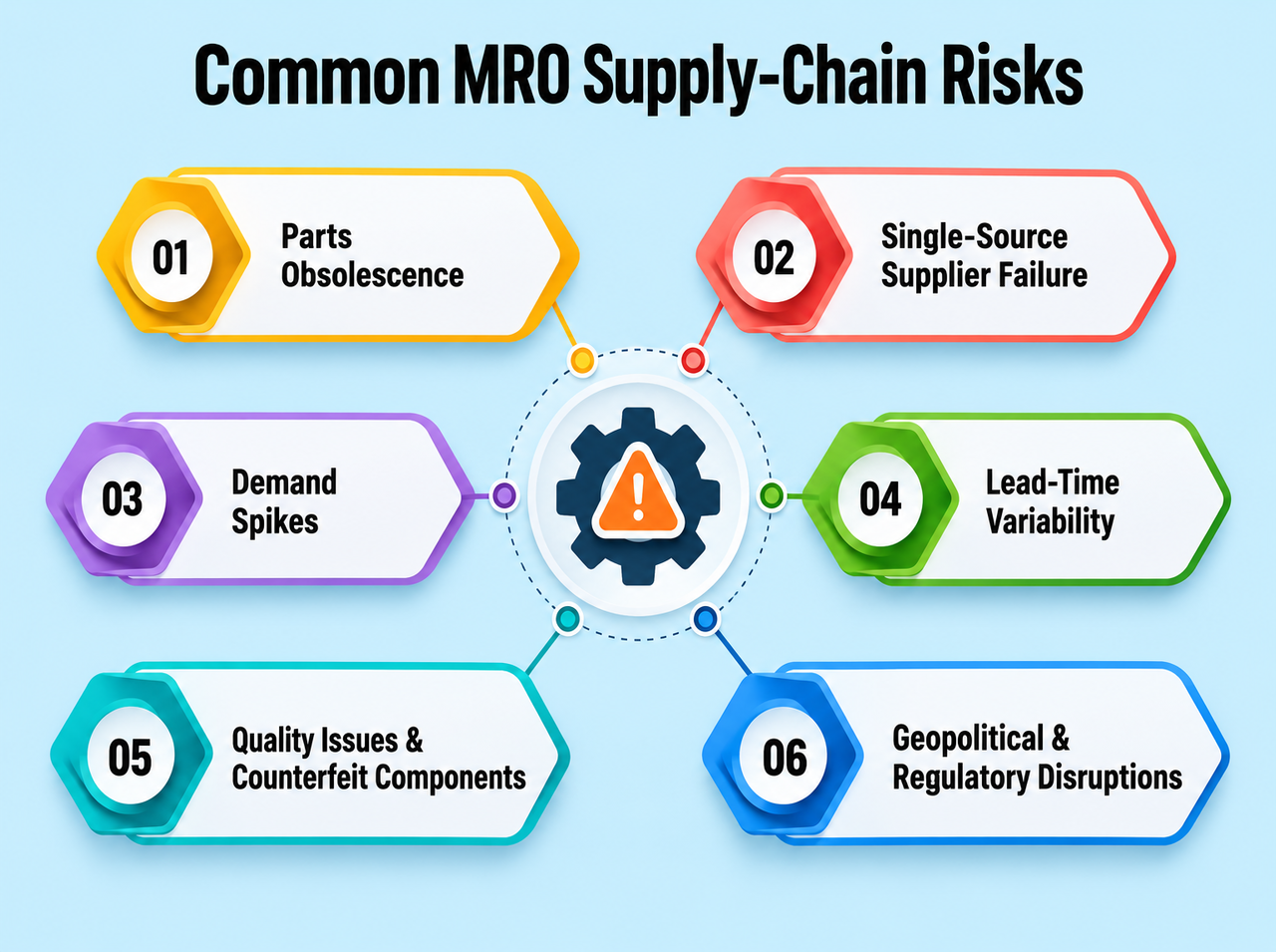
MRO supply chain disruptions can halt production, inflate costs, and compromise equipment reliability. Effective MRO supply chain management starts with understanding the risks that can limit access to critical parts and disrupt maintenance operations.
Here are the major risks associated with your MRO supply chain:
1. Parts Obsolescence
When a component reaches end-of-life, production stops and genuine replacement parts can become difficult to source. You then face the risk of equipment obsolescence and need to rely on rebuilt or aftermarket parts that may not meet original specifications. This gap can lead to repeat breakdowns, unplanned design changes, longer repair times, and higher maintenance costs.
2. Single-Source Supplier Failure
Relying on one vendor for a critical part creates a single point of failure. If that supplier halts production—due to a plant shutdown, product recall, or financial distress—you lose your only replenishment channel. Maintenance work can stall, leading to longer equipment downtime and wider operational disruptions.
3. Demand Spikes
Unexpected equipment breakdowns or last-minute production orders can drive parts demand well beyond forecast levels. You can quickly deplete safety stock, forcing emergency purchases at higher prices. The result is rushed maintenance, overtime labor, higher costs, and increased risk of operational delays.
4. Lead-Time Variability
Even when demand remains steady, unpredictable supplier lead times can disrupt your maintenance plans. A part you have ordered for routine service can shift from a two-week delivery to six weeks without warning. This uncertainty can delay planned maintenance and increase the risk of unplanned downtime.
5. Quality Issues & Counterfeit Components
A single defective or counterfeit component can halt an entire line. You might install a part that fits but fails under load, leading to repeat failures and safety incidents. Tracing suspect batches, replacing affected parts, and managing recalls can drain resources and increase operational costs.
6. Geopolitical & Regulatory Disruptions
Trade embargoes, new tariffs, or sudden regulatory changes can disrupt cross-border shipments. Sanctions or customs holds can delay established supply routes, leaving critical spare parts in transit. Such disruptions can force you to use costly emergency freight or face extended downtime while you establish alternative sourcing and logistics options.
Five MRO Sourcing Strategies for Supply Chain Resilience
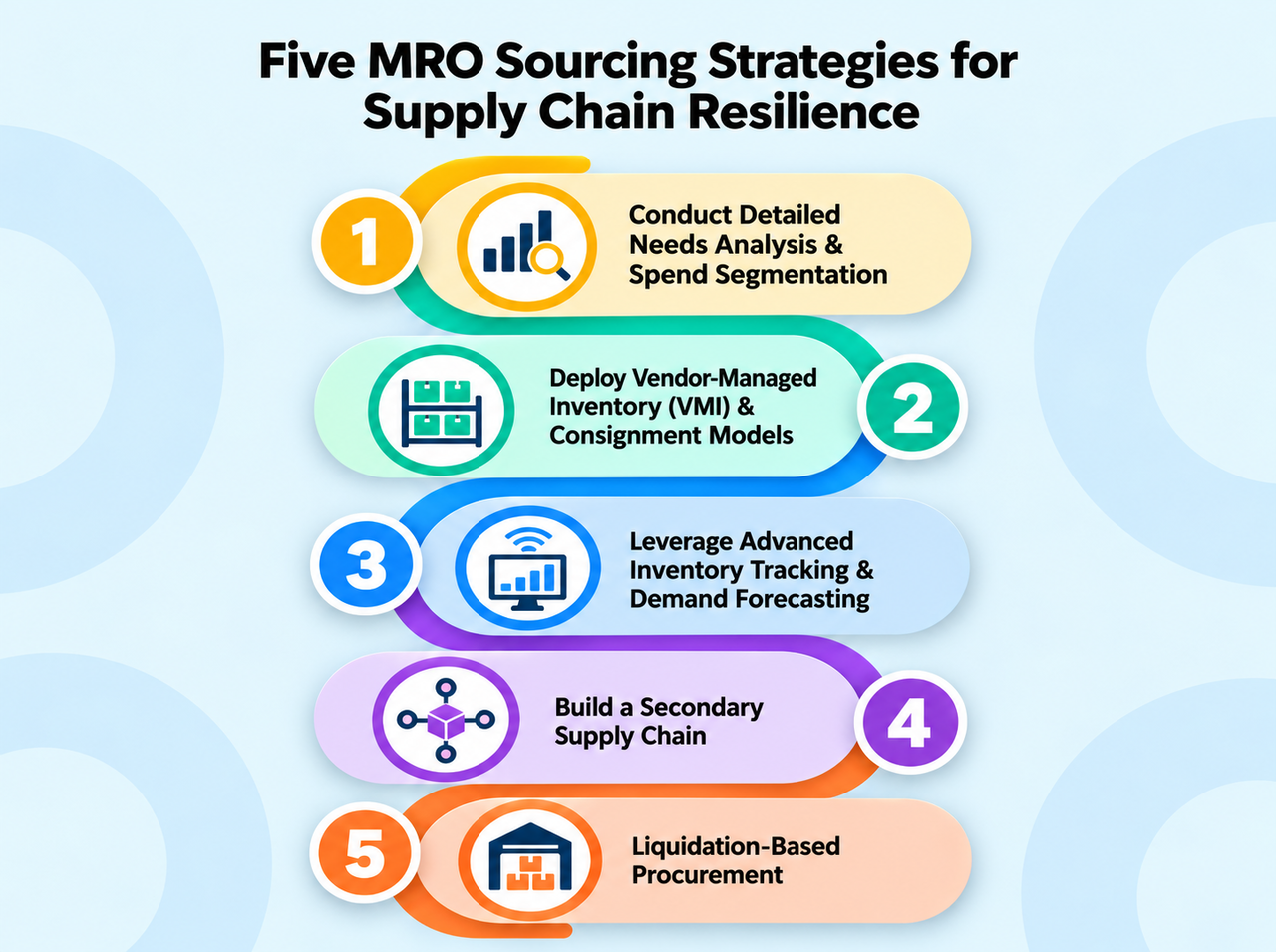
The right MRO sourcing strategies help you reduce supply risk, improve part availability, and make procurement decisions based on operational needs rather than reacting to shortages.
Below are five practical MRO procurement strategies you can use when sourcing MRO inventory to strengthen supply chain resilience and improve access to critical parts.
1. Conduct Detailed Needs Analysis & Spend Segmentation
You can’t mitigate supply-chain risk if you don’t know which parts matter most. Start by capturing your historical MRO spend and usage data in your ERP (Enterprise Resource Planning) or CMMS (Computerized Maintenance Management System). This gives you a stronger foundation for your MRO category strategy and helps you prioritize parts based on demand, spend, and operational criticality.
Focus on the following:
- Benchmark demand by category and criticality
Map each part to its impact on uptime. High-criticality SKUs, such as those whose failure causes line stoppages, deserve priority in your sourcing strategy and risk-mitigation plans.
- Use ABC/FSN classification to focus on high-impact SKUs
Apply ABC analysis (A-items represent the top 70–80 % of spend, B-items the next 15–20 %, and C-items the remainder) alongside FSN analysis (Fast-, Slow-, and Non-moving items) to rank inventory.
2. Deploy Vendor-Managed Inventory (VMI) & Consignment Models
VMI and consignment agreements are proven ways to reduce your exposure to MRO supply disruptions and stockouts. By making your suppliers responsible for monitoring and replenishing critical spare parts, you lower the risk of running out of essential inventory, especially during periods of demand fluctuation or unpredictable lead times.
Under a B2B consignment model, suppliers retain ownership of high-risk, high-value items until use. This can reduce working capital tied up in inventory while maintaining access to critical parts if shortages or transit delays occur.
Automated replenishment systems, driven by real-time consumption data, further minimize manual errors and help make sure your maintenance teams have access to the spares needed to avoid downtime while improving procurement efficiency.
3. Leverage Advanced Inventory Tracking & Demand Forecasting
Real-time inventory visibility into your MRO inventory is critical for risk mitigation. Equip high-value parts with IoT (Internet of Things) sensors or RFID (Radio-Frequency Identification) tags to monitor inventory levels, movement, and consumption across multiple locations.
Automated alerts notify your team when stock reaches reorder thresholds, helping you manage MRO inventory more effectively, reduce unexpected shortages, and improve inventory control.
Pairing this visibility with predictive analytics lets you forecast demand based on historical usage, seasonal trends, and maintenance schedules. Early warning of potential part shortages gives you time to adjust orders, negotiate with suppliers, or shift resources to avoid unplanned downtime.
This proactive approach helps you move from reactive replenishment to better inventory planning and risk control.
4. Build a Secondary Supply Chain
Relying solely on a primary supplier exposes your operation to significant disruption risk. To strengthen resilience, establish a secondary supply chain for your most critical MRO components.
This means identifying and pre-qualifying backup suppliers who can deliver on short notice if your primary source faces delays, quality issues, or other constraints.
Maintaining active relationships and agreements with these alternate suppliers reduces your exposure to single-source failures. It also helps you respond faster to market shifts or emergencies and keep critical maintenance activities moving during supplier disruptions.
5. Liquidation-Based Procurement
While secondary sourcing provides backup in case of primary supplier disruptions, you can further increase your supply flexibility with liquidation-based procurement.
Sourcing through industrial liquidation channels gives you direct access to surplus and excess MRO inventory from other enterprises. This can help you procure spare parts, components, and equipment outside traditional supplier networks.
Liquidation-based procurement can also help you source hard-to-find or obsolete MRO parts that are no longer available through standard channels.
By integrating surplus marketplaces and asset disposition platforms into your sourcing strategy, you can strengthen supply chain resilience, reduce lead times, improve cost efficiency, and expand access to mission-critical inventory.
How Amplio Supports Your Strategic MRO Sourcing Strategy
- Access Enterprise Surplus MRO Inventory
Amplio gives you access to surplus MRO inventory from enterprise sellers, including spare parts, components, and industrial equipment. This helps you explore additional sourcing options outside traditional supplier channels.
- Source Through a Trusted Buyer Network
Amplio connects you with a network of industrial sellers, helping you identify relevant inventory from trusted sources. This gives your team more options when sourcing critical MRO components.
- Simplify Logistics and Procurement Coordination
Amplio supports the coordination required to source industrial inventory, including transaction and logistics management. This helps reduce procurement complexity and allows your team to focus on maintaining equipment availability.
Partner with Amplio to expand your sourcing options, strengthen supply chain resilience, and support reliable MRO procurement.
FAQs
What are the key components of an MRO sourcing strategy?
The key components of an MRO sourcing strategy include needs analysis, spend segmentation, inventory management, supplier diversification, demand forecasting, and alternative sourcing options. These approaches help you improve part availability, manage supplier risks, control costs, and support reliable maintenance operations.
How can MRO sourcing help reduce downtime?
MRO sourcing helps reduce downtime by improving access to critical parts, consumables, and maintenance supplies when your team needs them. By using inventory tracking, demand forecasting, supplier diversification, and alternative sourcing channels, you can reduce shortages, avoid emergency purchases, and keep maintenance activities on schedule.
What makes MRO sourcing different from direct procurement?
MRO sourcing focuses on the parts, supplies, and services needed to maintain equipment and support daily operations. Direct procurement focuses on raw materials and components that become part of the final product. The main difference is that MRO sourcing supports equipment reliability and uptime, while direct procurement supports production.