How to Sell Your Surplus MRO & Spare Parts for Maximum Value

Introduction
Surplus MRO inventory can create avoidable costs across your operation. GEP estimates that 40% to 60% of MRO inventory in a manufacturing company is excess, obsolete, or tied up in infrequently used critical spare parts. When spare parts, industrial components, and other MRO equipment sit unused, they lock up working capital, take up warehouse space, and increase carrying costs.
To recover value from that inventory, you need more than ad hoc disposal. A defined selling process helps you evaluate what to sell, assess resale potential, identify the right buyers, and set pricing that reflects market conditions. When handled strategically, surplus MRO and spare parts can become a source of recovered cash instead of an ongoing operational burden.
In this blog, you will learn how to sell your surplus MRO and spare parts in a way that supports both inventory efficiency and financial return.
What Are Surplus MRO and Spare Parts?
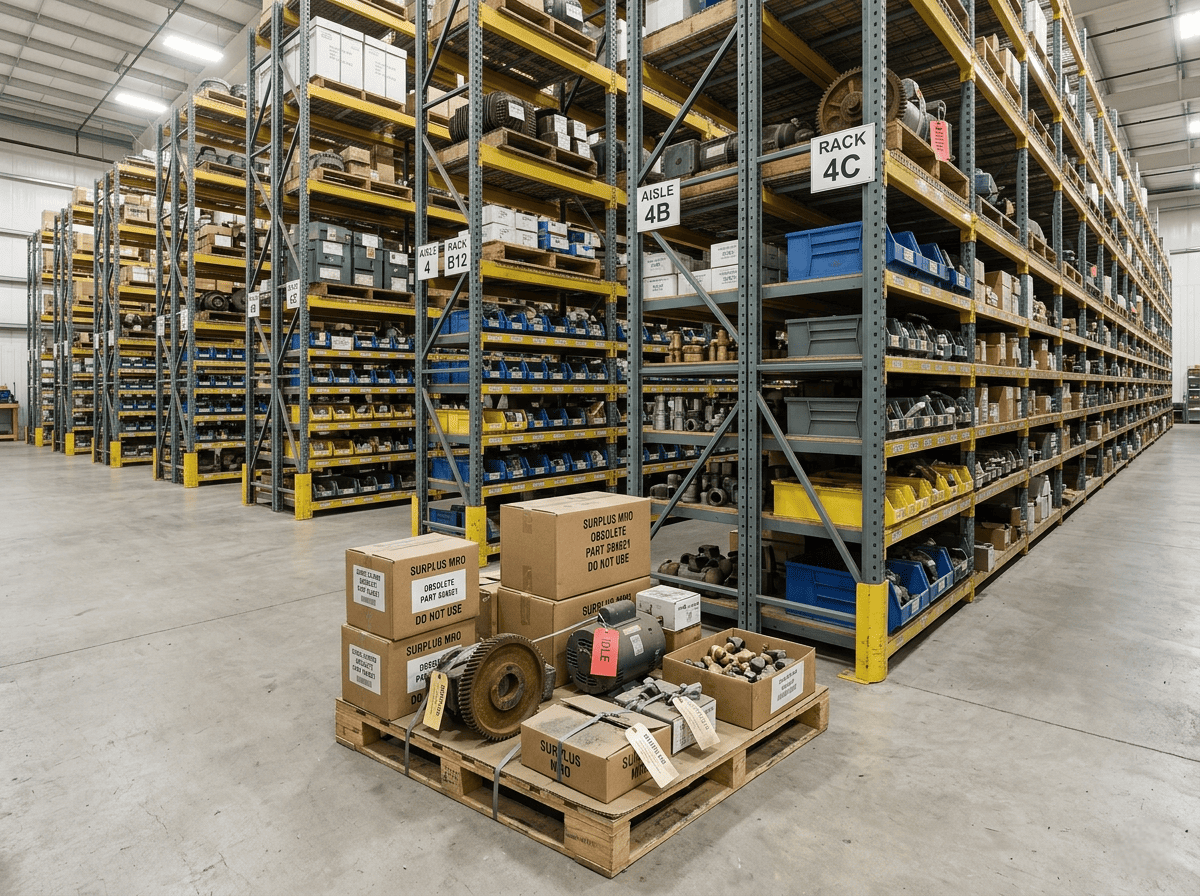
Surplus MRO and spare parts are maintenance, repair, and operations items that a business owns but no longer needs for current equipment support, maintenance activity, or operational requirements.
How Does Surplus MRO and Spare Parts Accumulate
Below are the main causes of surplus MRO and spare parts:
- Overstocking to avoid equipment downtime or supply delays
- Equipment upgrades that make older spare parts unnecessary
- Production line changes that leave certain components unused
- Facility shutdowns or consolidations
- Obsolete parts linked to machinery that is no longer in service
- Inaccurate demand forecasting or weak inventory visibility
- Duplicate purchasing across teams or locations
How to Identify Which Surplus MRO & Spare Parts You Should Sell
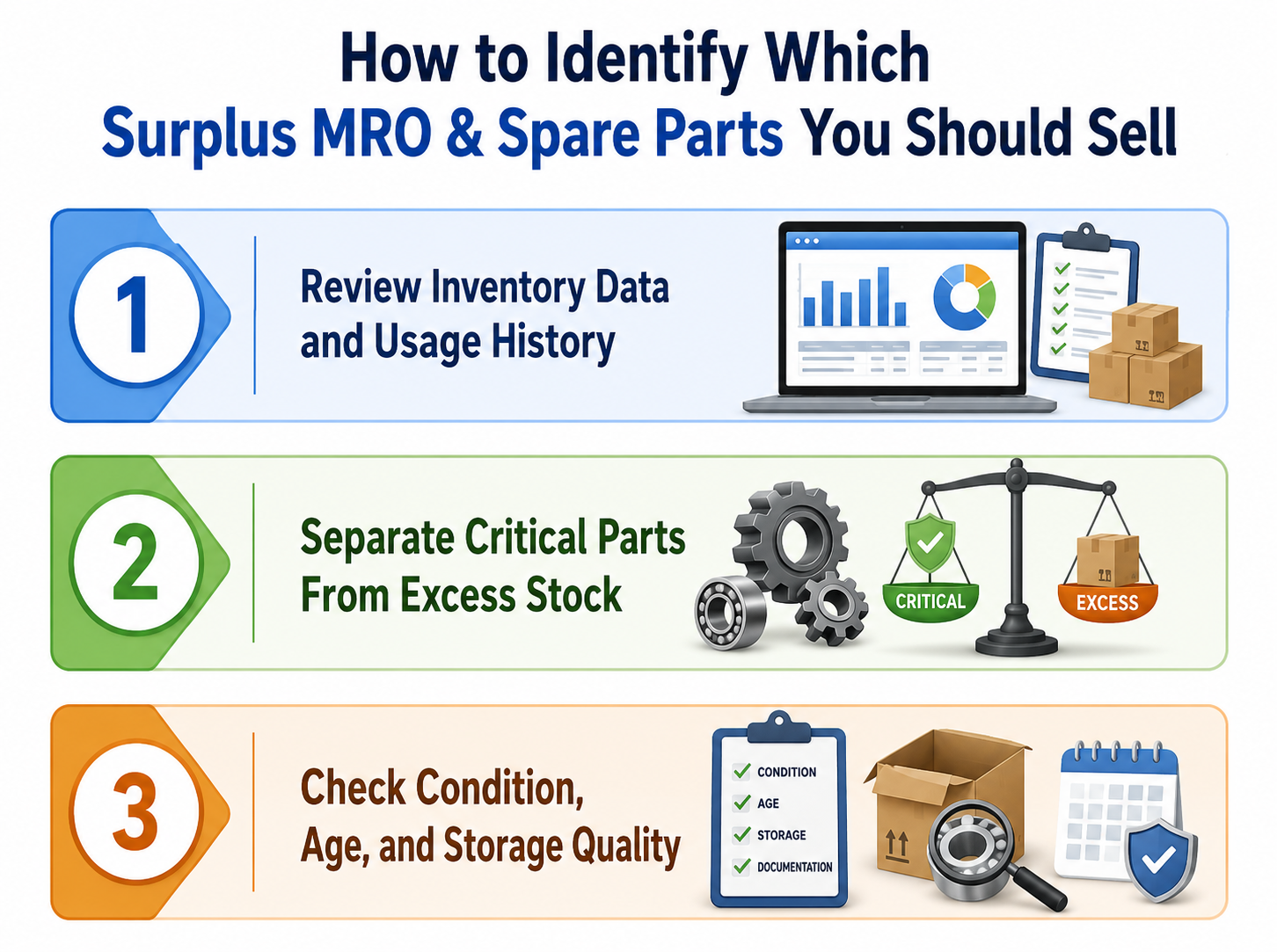
Before selling any surplus MRO and spare parts, you need to determine what is truly excess and what still supports maintenance and operations. That decision should be based on inventory data, operational risk, and part condition rather than assumptions.
1. Review Inventory Data and Usage History
Start with your inventory records.
Review demand patterns, stock movements, and purchase history to identify which spare parts still support maintenance activities and which items have seen little or no recent use. Parts with no movement, duplicate stock, or no clear link to current equipment should be reviewed as potential surplus.
This helps you identify excess stock based on actual inventory behavior rather than guesswork.
2. Separate Critical Parts From Excess Stock
Low usage does not always mean a part should be sold.
Some parts move infrequently but remain critical to equipment uptime, repair response, and operational continuity. If the loss of a part could increase downtime, delay maintenance, or create supply risk, it should not be treated as surplus without further review.
That review should include both maintenance and procurement. Maintenance can confirm operational importance, while procurement can assess lead times, suppliers' availability, sourcing difficulty, and replacement risk.
3. Check Condition, Age, and Storage Quality
After identifying potential surplus, assess each part based on its physical condition and storage history.
Separate new, unused, open-box, used, and obsolete parts. Check for damaged packaging, corrosion, missing labels, incomplete documentation, and any storage issues that could reduce resale value. Age should also be carefully reviewed, especially for electrical components, seals, and parts associated with older or discontinued equipment.
Resale value depends on more than system records. Buyers will assess the actual condition, usability, sale readiness, and any documentation that helps confirm ownership before making a purchase decision.
Step-by-Step Guide to Selling Surplus MRO and Spare Parts
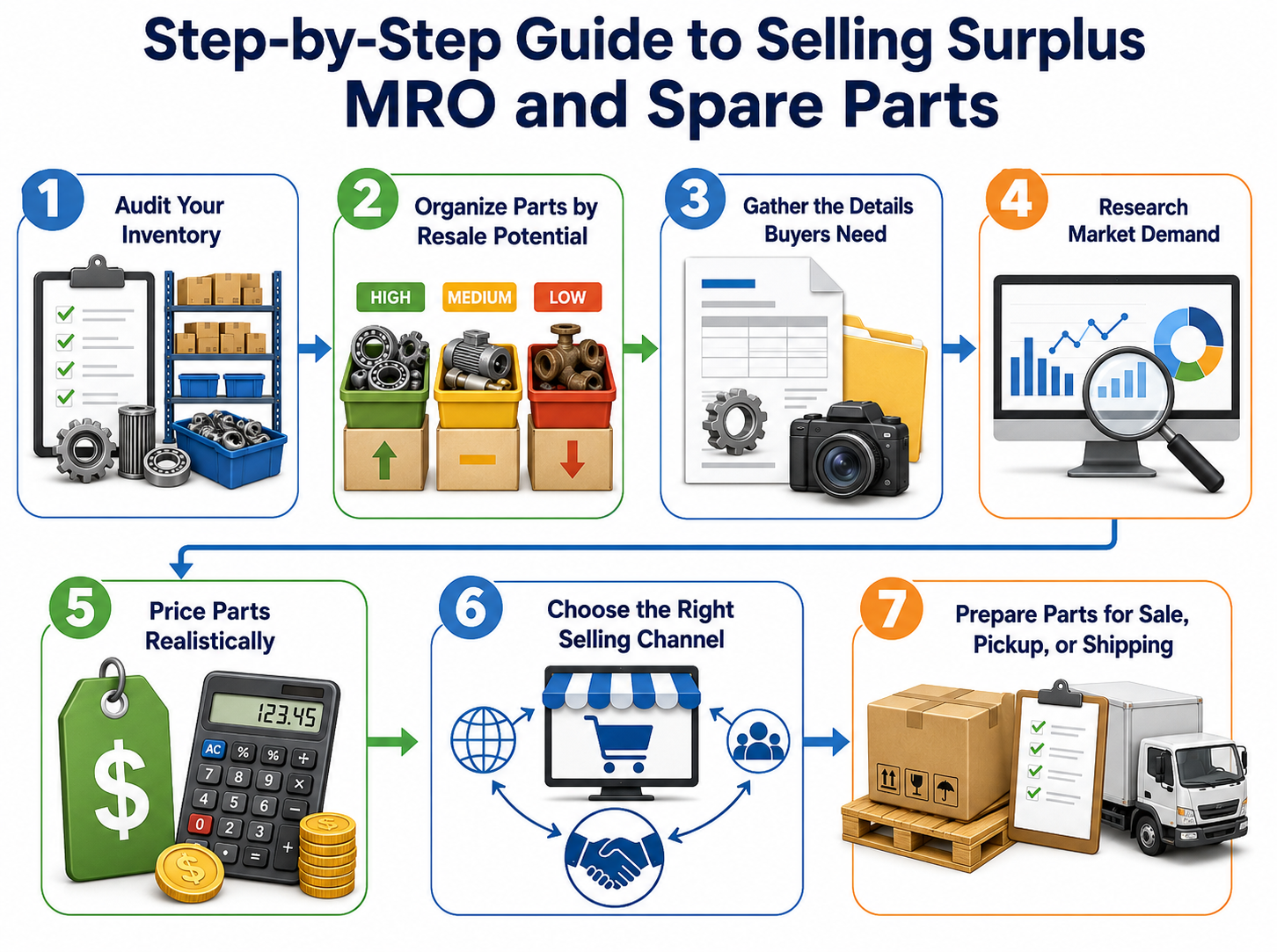
Selling surplus MRO and spare parts requires more than listing items for sale. A structured process helps you present inventory accurately, target the right buyers, and recover more value from excess stock.
1. Audit Your Inventory
Start with a complete and accurate inventory list.
Include part numbers, brand names, quantities, specifications, storage location, and condition. This creates the baseline for the sales process and gives buyers the information they need to assess the inventory quickly.
It also helps your team identify usable surplus, duplicate stock, and items that should be excluded because they are obsolete or damaged. For many businesses, this is the best method for creating a reliable starting point for sales decisions.
2. Organize Parts by Resale Potential
After the inventory is documented, sort it by likely resale value.
Separate high-demand parts from low-value, slow-moving, or obsolete stock. Group similar replacement parts and other surplus parts together where it improves buyer interest or supports bulk sale opportunities.
This helps determine which items should be sold individually, sold as a lot, or removed from the active sale plan.
3. Gather the Details Buyers Need
Buyers need clear information before they commit to a purchase.
That usually includes product specifications, OEM or manufacturer details, part numbers, photos, packaging information, and maintenance records where relevant. Strong documentation reduces uncertainty, improves buyer confidence, and helps move the sale forward faster.
Incomplete or inconsistent information can slow the process and weaken pricing power.
4. Research Market Demand
Before going to market, assess which parts still have buyer demand.
Review lead times, part availability, and current industry demand to identify which items are most likely to attract MRO buyers. Parts tied to active equipment, supply-constrained components, and commonly used replacement items usually have stronger resale potential than outdated or highly specialized stock.
This helps you prioritize the inventory most likely to generate returns.
5. Price Parts Realistically
Pricing should reflect current market value, not just historical purchase cost.
Base pricing on condition, demand, quantity, resale potential, and any factors that affect usability or availability. Competitive pricing improves sell-through, while inflated pricing often leaves surplus stock sitting in storage.
The objective is to set a fair price that supports recovery, protects potential profit, and avoids unnecessary delays in the sale.
6. Choose the Right Selling Channel
The right channel depends on the type of inventory, the volume involved, and the level of internal effort your team can support.
Industrial surplus buyers can help move stock quickly. Industrial liquidators are often better suited to large clear-outs that may include spare parts, components, and related used equipment. Online marketplaces and auction platforms can widen buyer reach. Asset recovery companies can support valuation, logistics, and execution. Direct sales to end users or other businesses may offer stronger returns when demand is clear and the inventory is well documented.
The best option depends on your priorities for speed, control, and value recovery.
7. Prepare Parts for Sale, Pickup, or Shipping
Once the inventory is ready to sell, prepare it so the transaction can move without unnecessary delays.
Label parts clearly, organize records, and stage the inventory to support inspection, pickup, and fulfillment. Good preparation improves logistics, reduces handling issues, helps control shipping costs, and creates a more efficient process for both your team and the buyer.
Where to Sell Surplus MRO & Spare Parts
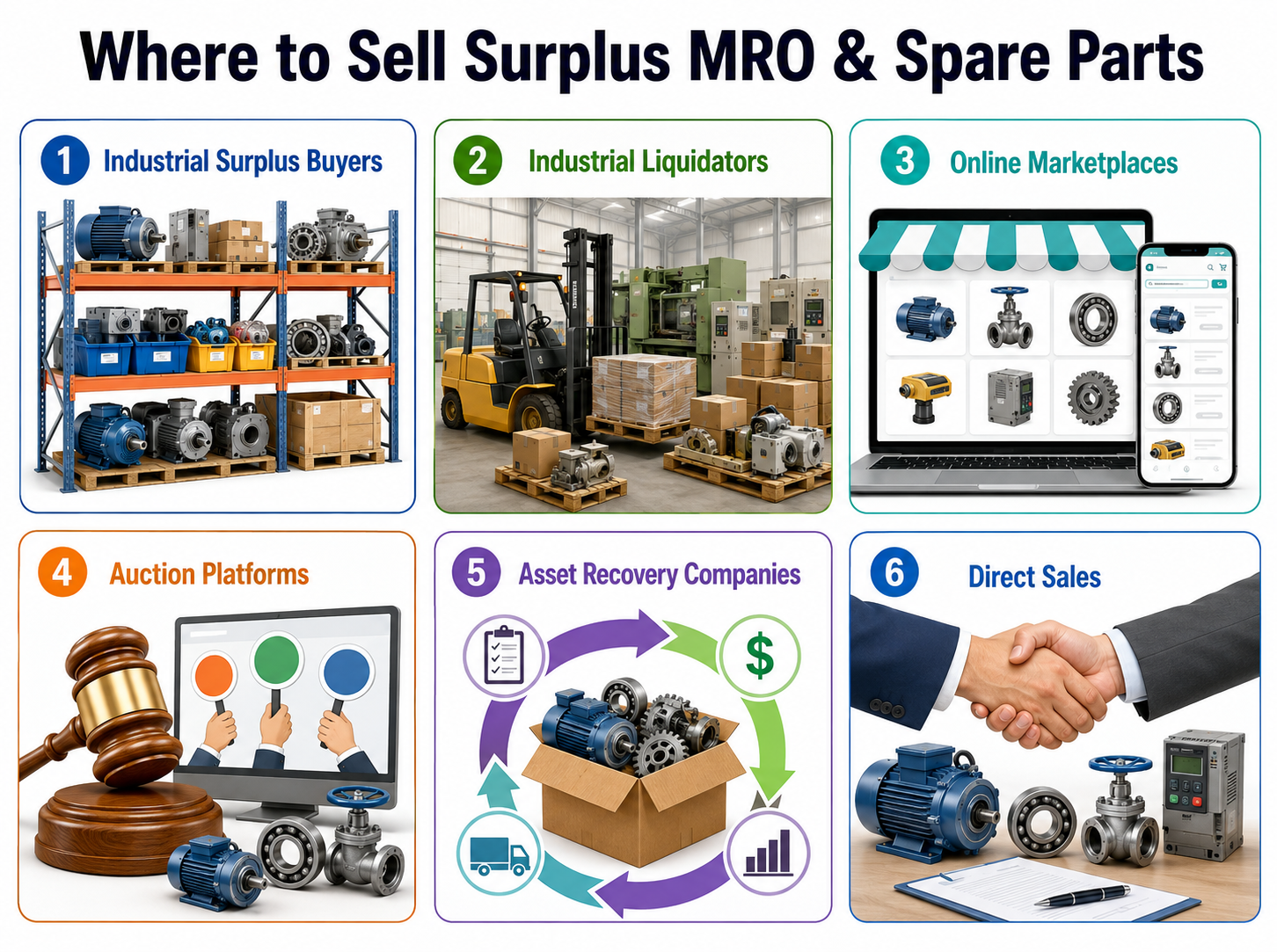
The best-selling channel depends on the type of inventory, the volume you need to move, and how much time your team can commit to the sale. Some options are built for speed. Others are better for a broader buyer reach or stronger recovery value.
1. Industrial Surplus Buyers
Industrial surplus buyers are a practical option when the priority is to move inventory quickly in bulk.
They are well-suited to companies that want a straightforward selling process with less internal effort. This channel can work well for mixed spare parts, excess parts, and surplus MRO equipment when the goal is to move inventory efficiently and secure competitive rates from bulk buyers.
2. Industrial Liquidators
Industrial liquidators are better suited to large clear-outs, plant-wide surplus, or inventory tied to shutdowns and consolidations.
This channel is commonly used when speed and site clearance matter more than maximizing price on each item. It can be an efficient option when the goal is to recover value, reduce inventory quickly, and avoid further waste tied to idle stock.
3. Online Marketplaces
Online marketplaces can expand your reach to a broader set of potential buyers.
They are usually a stronger fit for branded parts, in-demand replacement items, and industrial components with clear specifications and active market demand. This channel offers more visibility, but it also requires more listing work, buyer communication, and sales management.
4. Auction Platforms
Auction platforms can work well when competitive bidding is likely to drive buyer interest.
They are often used for specific equipment categories, used industrial equipment, or bulk lots that can attract multiple buyers. This option tends to perform best when the inventory has recognized demand and the sale terms are clearly defined.
5. Asset Recovery Companies
Asset recovery companies are useful when you need support beyond the sale itself.
They can assist with valuation, resale strategy, logistics, and execution, which makes them a strong fit for businesses managing more complex surplus positions. This option is especially valuable when your team wants a more structured recovery process.
6. Direct Sales
Direct sales can deliver stronger returns when you know the market and have identifiable buyers.
This approach gives you more control over pricing and deal terms, but it also requires more time, outreach, and coordination. It is usually the best fit when your business has the internal capacity to manage the selling process directly.
How to Maximize the Value of Your Surplus MRO and Spare Parts
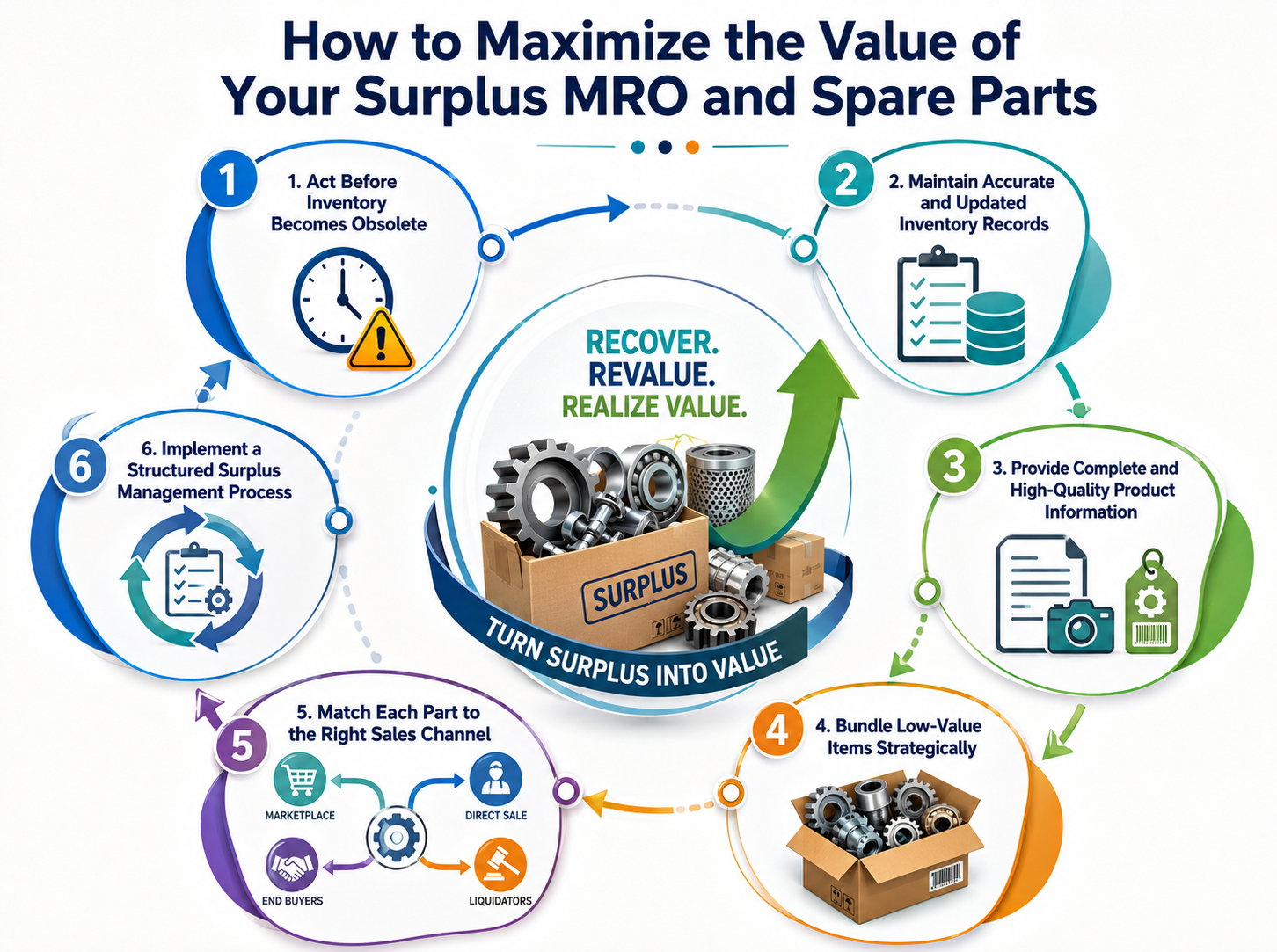
Maximizing value from surplus MRO and spare parts requires a structured approach. The stronger your inventory control and sales execution, the better your ability to improve value recovery and turn surplus stock into a more productive business outcome.
1. Act Before Inventory Becomes Obsolete
Timing directly affects resale value.
Once parts become outdated, unsupported, or tied to equipment no longer used in the market, buyer interest declines, and pricing becomes harder to support. Early action helps preserve resale potential and gives you more flexibility to achieve better recovery outcomes.
2. Maintain Accurate and Updated Inventory Records
Accurate inventory data supports stronger sales outcomes.
Clean records help buyers verify part numbers, quantities, specifications, and condition with less uncertainty. They also speed up internal review, reduce back-and-forth during the sale process, and improve confidence in the inventory being offered.
3. Provide Complete and High-Quality Product Information
Well-documented inventory is easier to sell.
Detailed product specifications, manufacturer information, part numbers, packaging details, and clear photos make it easier for buyers to assess fit and condition. Strong product information can support better pricing, reduce negotiation friction, and contribute to a smooth transaction.
4. Bundle Low-Value Items Strategically
Bundling can improve the sales potential of lower-value stock.
Combining slow-moving parts with higher-demand items can increase overall deal value and make the inventory more attractive to buyers. This approach can also help move multiple items faster and reduce the effort required to manage separate sales.
5. Match Each Part to the Right Sales Channel
Sales performance depends in part on channel fit.
High-value items with clear demand may be better suited to direct buyers, specialized resellers, or niche platforms. Lower-demand stock, mixed inventory, or bulk surplus may be a better fit for liquidators, bulk buyers, or broader clearance channels. Matching the part to the right route improves both sales efficiency and recovery value.
6. Implement a Structured Surplus Management Process
Long-term value recovery depends on ongoing surplus control.
A structured review process supports better MRO inventory management by helping your team identify excess stock earlier and decide what to keep, redeploy, or sell. Over time, this can turn surplus selling from a one-time cleanup effort into a more consistent and repeatable source of recovered value.
How Amplio Helps You Recover Value From Surplus MRO & Spare Parts
AI-Powered Appraisal and Inventory Review
Amplio starts by reviewing your surplus MRO and spare parts through an AI-powered appraisal process supported by expert review. This helps identify what should be sold, redeployed, recycled, or scrapped so you can move forward with a clearer recovery strategy and a more realistic view of resale potential.
Strategic Disposition Planning
Not all surplus MRO and spare parts should follow the same path. Amplio helps determine which items are better suited for resale, internal redeployment, recycling, or other recovery channels so you can improve value recovery while reducing excess inventory and storage pressure.
Executes Disposition With Qualified Buyers
Amplio does the heavy lifting for surplus MRO disposition: we organize logistics to remove inventory from your facility, stage it in one of ours, and strategically sell it over time to maximize recovery rate. Our large buyer network ensures that your inventory is visible to buyers already looking for mechanical spares, industrial electronics, and MRO storeroom stock, while supporting a smoother sales process through coordinated logistics, payments, and deal management.
When storerooms are holding MRO parts that no longer support maintenance needs, our surplus MRO removal solutions give you a clear path to move that inventory out of the facility and into the secondary market.
Contact us today to discuss the best way to handle your surplus MRO and spare parts.