How to Reduce Inventory Carrying Costs with Practical Solutions

Introduction
Indirect inventory is necessary for keeping production moving and orders flowing, but holding too much of it comes at a real cost. Businesses often focus on purchase price first, yet much of the financial pressure builds after inventory enters storage.
The U.S. total business inventories-to-sales ratio was 1.36 in December 2025, highlighting how much inventory businesses were holding relative to sales and why cash can remain tied up in stock longer than expected.
For manufacturers, distributors, and other B2B operations, these costs can do more than increase storage pressure. High inventory carrying costs can slow cash flow, increase inventory risk, reduce inventory turnover, and weaken profitability across the supply chain.
In this guide, you will learn what inventory carrying cost is, the main inventory types that add to holding costs, and practical ways to reduce carrying costs through stronger inventory management practices.
What Is Inventory Carrying Cost?
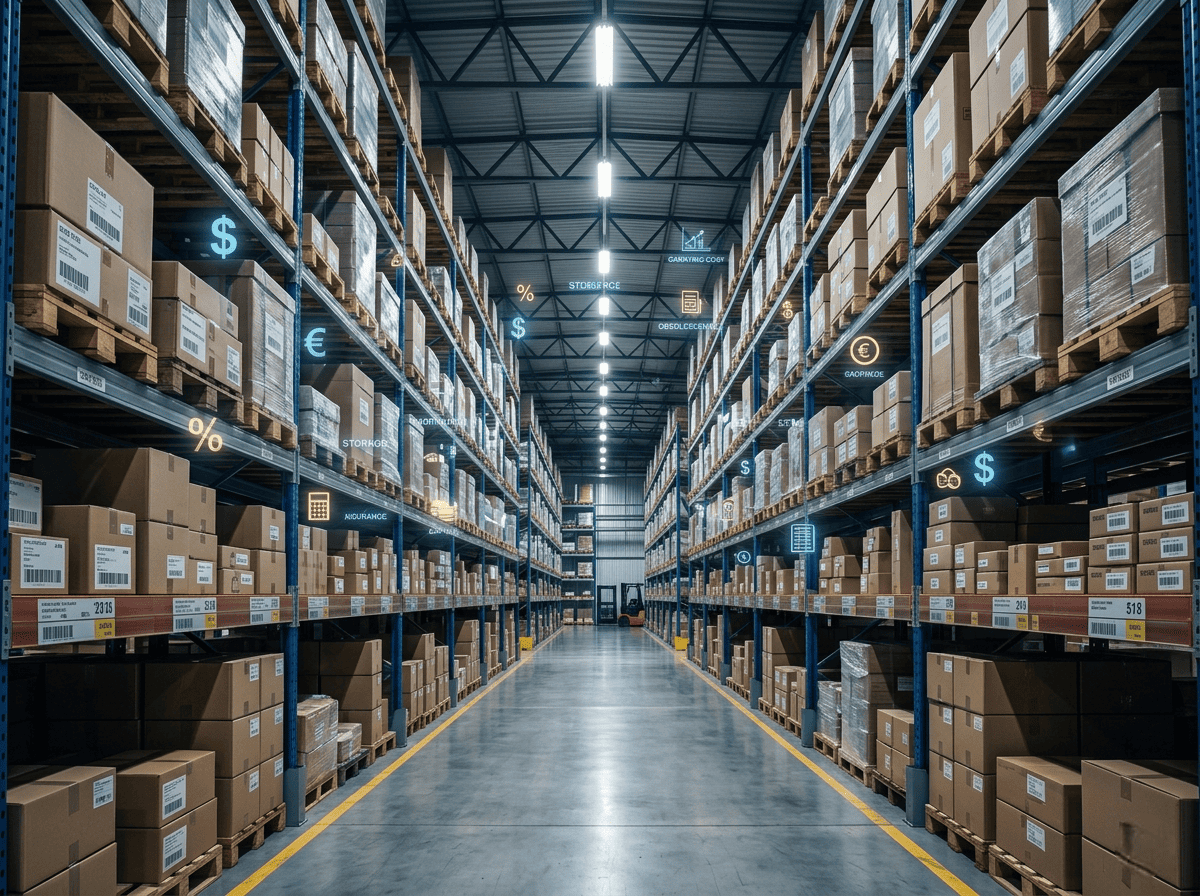
Inventory carrying costs are the total ongoing expenses your business pays to hold inventory before it is sold, used in production, or moved through the supply chain. In simple terms, they represent the cost of storing inventory over time, not just the cost of buying it.
Components of Inventory Carrying Cost
Inventory carrying cost includes several ongoing expenses that build up while stock remains in storage. These cost components shape the total cost of holding inventory and usually increase as inventory levels rise. The total cost usually includes the following:
1. Storage costs
Storage costs cover the physical expense of holding inventory in a warehouse, distribution center, or storage facility. This can include warehouse rent, utilities, shelving, equipment, and labor required to store and handle inventory.
2. Insurance
Insurance is the cost of protecting inventory against theft, damage, loss, or other covered risks while goods are in storage or in transit. As inventory value increases, insurance costs often increase as well, making them an important part of inventory service costs.
3. Taxes
Taxes can add to inventory carrying costs when businesses are required to pay taxes on stored inventory or related property. The impact depends on location, inventory value, and local tax requirements.
4. Depreciation
Depreciation refers to the loss of inventory value over time. This often affects goods that lose value as they age, especially products with shorter life cycles or changing market demand.
5. Obsolescence
Obsolescence occurs when inventory is no longer useful, sellable, or relevant to current demand. This can happen when products become outdated, specifications change, or buying patterns shift.
6. Shrinkage
Shrinkage refers to inventory loss caused by theft, damage, spoilage, misplacement, or record errors. These losses reduce inventory value and increase inventory risk costs over time.
7. Opportunity cost of tied-up capital
Opportunity cost of tied-up capital refers to the cash invested in inventory that could have been used elsewhere in the business. When too much capital is tied up in inventory, the business has less flexibility to purchase, operate, and grow.
What Types of Inventory Create Carrying Costs?
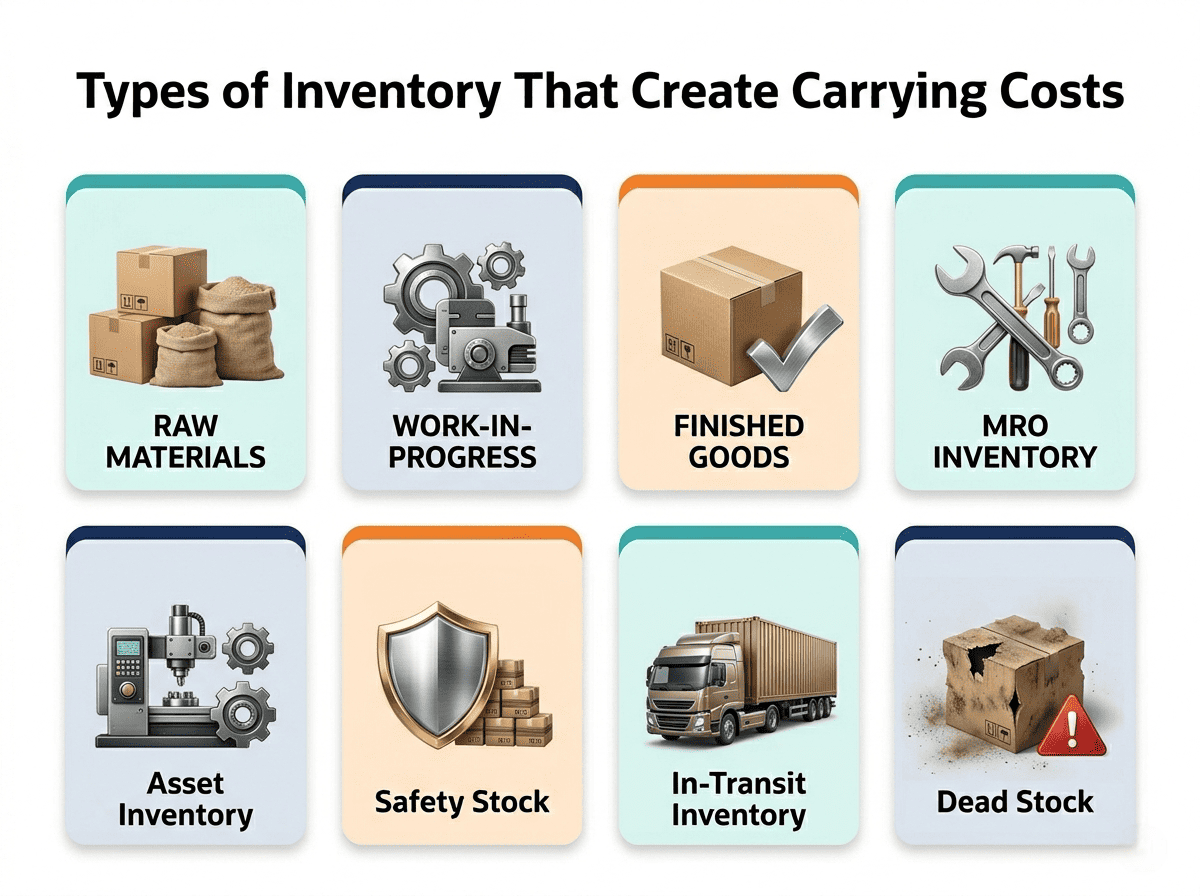
All inventory types create carrying costs while they remain in storage, in production, or in transit. The longer inventory stays in the system, the more it adds to storage costs, capital costs, handling expenses, and inventory risk. Below are the types of inventory that commonly contribute to inventory carrying costs.
1. Raw Materials
Raw materials are the inputs used to produce finished goods. These items create carrying costs when businesses buy more than needed, hold them for long periods, or store them as a buffer against supply delays.
2. Work-in-Progress Inventory
Work-in-progress inventory includes partially completed goods that are still moving through production. It creates carrying costs because capital remains tied up in materials and labor before the product is ready for sale.
3. Finished Goods
Finished goods are completed products ready for sale or shipment. These items create carrying costs when they remain unsold, take up warehouse space, and delay cash recovery.
4. MRO Inventory
MRO inventory includes maintenance, repair, and operations supplies used to support production and facility operations. These items may not be sold directly, but they still create carrying costs when businesses hold more stock than needed.
5. Asset Inventory
Asset inventory includes spare parts, tooling, production-support assets, and machinery. These assets create carrying costs when they sit idle for long periods, take up warehouse space, require handling and tracking, and tie up capital without supporting current production needs.
6. Safety Stock
Safety stock is extra inventory kept to prevent stockouts during demand spikes or supply delays. It helps protect service levels, but it also increases carrying costs when stock levels are set too high.
7. In-Transit Inventory
In-transit inventory refers to goods moving between suppliers, warehouses, production sites, or customers. Even though it is not sitting on a shelf, it still ties up capital and adds to total inventory value.
8. Dead Stock or Obsolete Inventory
Dead stock or obsolete inventory refers to items that are no longer likely to sell or be used. This type of inventory creates some of the highest carrying costs because it takes up warehouse space, ties up cash, and often loses value over time.
Strategies to Reduce Inventory Carrying Costs

Reducing inventory carrying costs requires better control over inventory levels, purchasing decisions, and stock movement. Below are practical strategies that can help your business lower carrying costs and improve inventory management.
1. Improve Demand Forecasting
Demand forecasting helps your business estimate future sales more accurately so inventory levels stay closer to actual demand. When forecasting is based on real data instead of assumptions, businesses can make better purchasing and stocking decisions.
This strategy is especially effective for raw materials, finished goods, and seasonal inventory, where demand patterns directly affect stock levels.
This usually involves reviewing:
- Historical sales data
- Seasonality
- Order history
- Customer demand patterns
Poor forecasting often leads to overbuying. When a business brings in more inventory than it can move, it increases storage costs, ties up working capital, and raises the risk of slow-moving or obsolete stock. Better forecasting helps reduce excess inventory, improve inventory turnover, and support lower carrying costs over time.
2. Internal Inventory Redeployment
Internal inventory redeployment helps businesses move idle or underused stock to other plants, warehouses, or business units where it can still be used. Instead of letting materials sit in one location and continue adding carrying costs, companies can put them back into operation where internal demand already exists.
This approach helps lower carrying costs by reducing surplus stock, avoiding unnecessary purchases, and improving the use of materials already on hand. It is especially useful for manufacturers and multi-site operations that manage MRO inventory, spare parts, components, or slow-moving materials across different facilities.
A practical redeployment process usually involves:
- Identifying idle or underused stock across locations
- Checking where the same items are needed internally
- Moving usable stock before placing new purchase orders
- Tracking redeployed items so they do not become excess stock again
3. Recalculate Safety Stock
Safety stock helps protect your business from supply delays and demand variability, but it should stay practical. When buffer stock is set too high, it increases inventory carrying costs without adding enough operational value.
It is useful for raw materials, finished goods, and critical MRO inventory where supply delays or demand variability can disrupt operations.
To keep safety stock under control, businesses should:
- Review safety stock levels regularly
- Compare buffer stock against actual demand and lead times
- Adjust for supplier reliability and order variability
- Remove outdated assumptions from earlier planning periods
4. Increase Inventory Turnover
Increasing inventory turnover means moving inventory faster so stock does not sit longer than necessary. When products move more quickly through storage and into sales or production, businesses spend less money on holding inventory and reduce pressure on cash flow.
To improve inventory turnover, businesses can:
- Review slow-moving inventory regularly
- Adjust purchasing based on actual demand
- Reduce excess stock that is not moving at the right pace
- Improve sales and replenishment planning across teams
5. Use ABC Analysis to Manage Inventory Better
ABC analysis helps businesses group inventory based on value and importance. This makes it easier to prioritize valuable inventory items and apply tighter control where the financial impact is higher.
A practical ABC approach usually involves:
- Giving the most attention to high-value items with the greatest cost impact
- Applying moderate control to mid-value inventory
- Using simpler controls for low-value items with lower business risk
- Reviewing each category regularly as demand and inventory value change
This approach supports more effective inventory management because it helps businesses focus time, space, and working capital where they matter most.
6. Improve Warehouse Layout and Storage Space Use
Warehouse layout has a direct impact on inventory carrying costs. A poorly organized facility can waste storage space, slow inventory movement, and increase handling time, all of which raise storage space costs.
Industry survey data shows the average storage cost per square foot increased from $1.22 in 2024 to $1.73 in 2025, which makes efficient space use even more important for businesses trying to control inventory costs.
This approach is relevant for fast-moving finished goods, bulky raw materials, and MRO inventory that require different storage and access priorities.
Businesses can improve warehouse layout and storage space use by:
- Organizing inventory based on movement and access needs
- Using storage areas more efficiently to avoid wasted space
- Placing faster-moving items where they are easier to reach
- Reviewing layout decisions as inventory levels and product mix change
A more efficient layout helps reduce storage costs, improve inventory flow, and support better use of available warehouse space.
7. Use Inventory Management Software
Inventory management software helps businesses track stock more accurately and make faster inventory decisions. Better visibility makes it easier to manage inventory, reduce manual errors, and identify issues before they increase carrying costs.
Businesses can use inventory management software to:
- Monitor stock levels in real time
- Improve inventory visibility across locations
- Reduce manual entry and recordkeeping errors
- Support more accurate purchasing and replenishment decisions
A stronger inventory management system helps lower carrying costs by improving stock control, reducing excess inventory, and supporting more informed planning.
8. Align Purchasing With Real Demand
Purchasing decisions should reflect actual demand, not unit price alone. When businesses buy more inventory than needed to secure a lower purchase price, they often increase carrying costs through extra storage, slower turnover, and more money tied up in stock.
As Theodore Stank, associate professor of logistics and supply chain management at Michigan State University, explains, “This approach is fine if you’re not accounting for the cost of inventory. But if you ask, ‘What is it costing us to have the inventory sit on the warehouse floor for a few more days,’ you start to see the real cost of that decision.”
This is useful for raw materials, finished goods, MRO inventory, and seasonal stock, where larger purchase quantities can quickly increase carrying costs if demand does not match.
A better purchasing approach usually involves:
- Reviewing demand patterns before placing larger orders
- Comparing unit price savings against the total carrying cost impact
- Avoiding bulk purchases that create excess inventory
- Coordinating purchasing decisions with current inventory levels and sales activity
This helps businesses reduce inventory costs by balancing purchase decisions with cash flow, storage capacity, and stock movement.
9. Reduce Inventory Through Surplus Asset Disposition
Excess inventory and obsolete stock increase carrying costs without adding value to the business. They take up warehouse space, tie up cash, increase inventory risk, and make it harder to maintain efficient stock levels.
This strategy is especially useful for obsolete inventory, surplus raw materials, slow-moving MRO inventory, spare parts, and excess components that no longer support current demand or operational needs.
Businesses can reduce inventory through asset disposition by:
- Reviewing slow-moving and non-moving inventory regularly
- Identifying stock that no longer supports current demand or operational needs
- Using strategic liquidation to move surplus and obsolete inventory
- Partnering with qualified liquidators to recover value from stock that no longer has internal use
- Adjusting purchasing and replenishment decisions to avoid future overstocking
This approach helps reduce excess inventory, lower storage costs, improve cash flow, and strengthen overall inventory control.
10. Renegotiate Supplier Contracts
Supplier contract terms can have a direct impact on inventory carrying costs. When lead times are long, order quantities are inflexible, or delivery schedules do not match actual demand, businesses often hold more inventory than necessary.
It is especially useful for raw materials, components, MRO inventory, and critical spare parts where lead times, minimum order quantities, and delivery schedules directly affect stock levels.
Businesses can reduce carrying costs by renegotiating supplier contracts to:
- Shorten lead times where possible
- Improve delivery frequency
- Reduce minimum order quantities
- Align replenishment schedules with actual demand
- Create more flexibility in purchasing terms
Better supplier terms can help reduce excess inventory, lower safety stock requirements, and improve cash flow without disrupting supply continuity.
How to Calculate Inventory Carrying Cost
To calculate inventory carrying cost, businesses compare total carrying costs against average inventory value over a defined period, often annually. This inventory carrying cost formula shows how much it costs to hold inventory as a percentage of its value.
The basic cost formula is:
Inventory Carrying Cost Percentage = Total Carrying Costs ÷ Average Inventory Value × 100
In this formula:
- Total carrying costs include storage, insurance, taxes, depreciation, obsolescence, shrinkage, and opportunity costs.
- Average inventory value refers to the average value of total inventory held during the period.
- Carrying cost percentage shows how much the business spends to hold inventory relative to total inventory value.
This method helps businesses calculate inventory carrying costs clearly and consistently. It also helps determine carrying cost trends, compare inventory performance over time, and identify areas where inventory costs are too high.
For example, if a business has total carrying costs of $200,000 per year and an average inventory value of $1,000,000, the carrying cost percentage would be:
$200,000 ÷ $1,000,000 × 100 = 20%
In this case, the business is spending 20% of its average inventory value each year to carry inventory. That figure can help decision-makers assess cost pressure, working capital use, and opportunities to minimize carrying costs.
How Amplio Helps Reduce Inventory Carrying Costs
- AI-Powered Appraisal for Faster Inventory Decisions
Amplio’s AI-powered appraisal process reviews inventory lists and helps identify what should be sold, scrapped, or redeployed. We help businesses act faster on slow-moving and obsolete stock instead of allowing inventory carrying costs to keep building.
- Internal Redeployment to Reduce Unnecessary Purchases
Amplio supports internal redeployment by helping businesses identify where idle or underused inventory can be moved across plants, warehouses, or facilities. We reduce unnecessary purchases, improve asset use, and lower the cost of holding inventory that still has operational value elsewhere in the business.
- Asset Disposition That Frees Up Space and Capital
Amplio helps businesses remove inventory that is no longer needed internally and continues to add storage costs, handling costs, and working capital pressure. We clear inventory that no longer supports current demand—freeing up warehouse space and recovering value from excess stock.
If excess inventory is increasing your storage costs and tying up cash, Amplio’s surplus inventory management solutions can help you recover value and reduce inventory carrying costs through a more structured recovery process.
Contact us to get started.