6 Easy to Implement Cost Saving Ideas for Manufacturing

Introduction
Reducing costs in manufacturing directly boosts your profit margins. Every dollar saved on the factory floor adds to your competitive advantage.
But cutting costs doesn't mean sacrificing quality or output.
This blog provides practical, easy-to-implement cost-saving ideas that move beyond basic tips.
You won't find generic advice here.
Instead, you’ll get proven tips backed by real industry examples and data.
By the end, you'll have clear actions you can apply immediately to reduce waste, streamline production, and improve profitability.
1. Vendor Managed Inventory (VMI) with Automated Replenishment
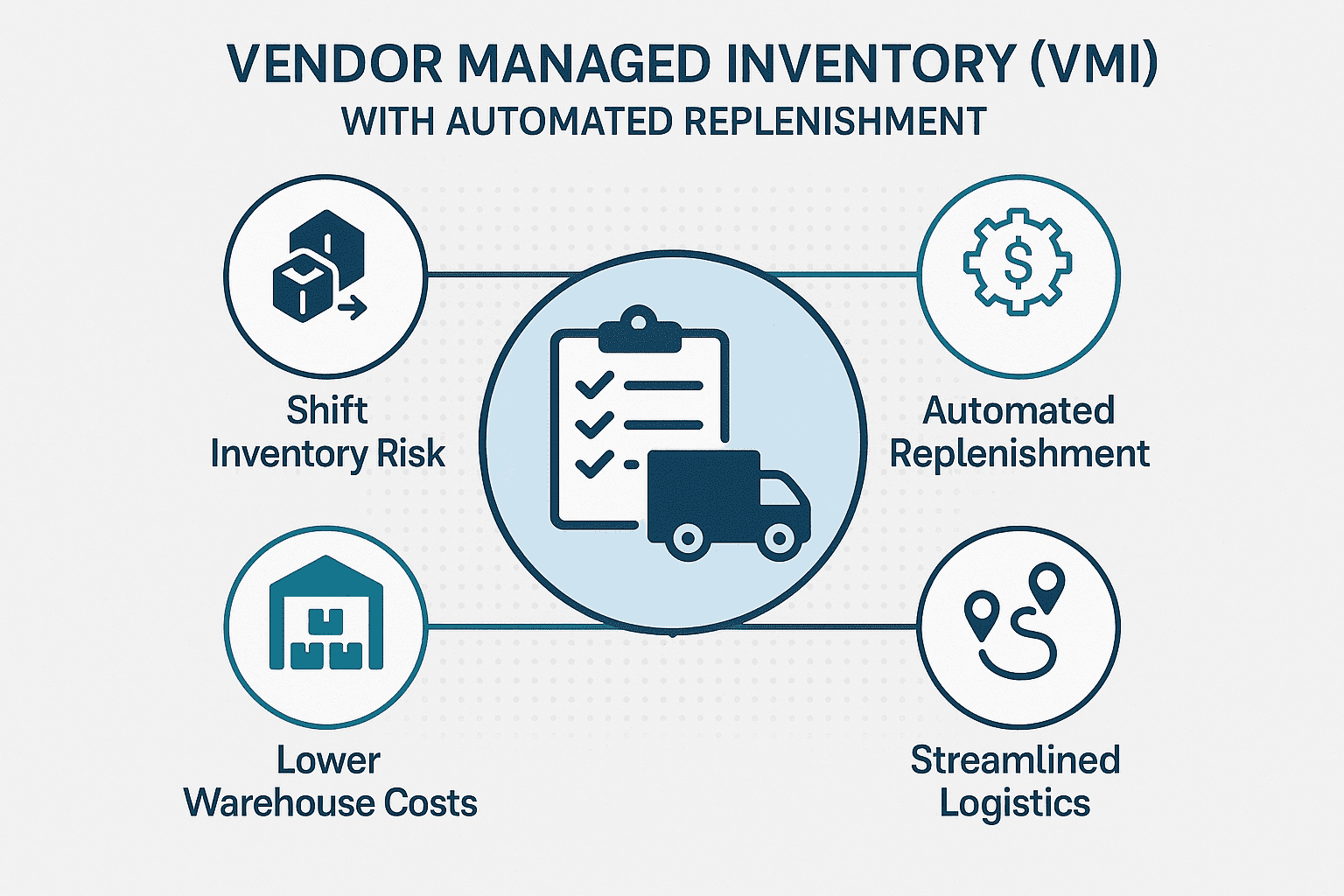
Vendor Managed Inventory (VMI) is a proven way to cut costs and keep your materials moving smoothly.
With VMI, your supplier tracks your inventory in real time. When stock runs low, they handle the restocking for you.
Here’s how this approach saves money:
- Shift Inventory Risk: Suppliers carry the inventory burden, not your balance sheet. You keep less on hand and free up cash for other needs.
- Automated Replenishment: Inventory is tracked by barcodes, RFID, or cloud systems. Orders are placed automatically, which reduces manual errors and emergency orders.
- Lower Warehouse Costs: You reduce safety stock and keep storage needs minimal. Less inventory means fewer carrying costs and less wasted space.
- Streamlined Logistics: Fewer deliveries and more predictable supply schedules help you optimize receiving and labor.
Real World Example
4.75% Lower MRO Costs, 6.3% Less Admin Work
A case study at a large industrial manufacturing plant in the Great Lakes region showed that using VMI for its maintenance, repair, and operations (MRO) inventories yielded clear savings. The vendor-managed system automated ordering and tracking of items, which reduced total inventory management costs by about 4.75% and cut administrative procurement workload by 6.3%.
2. Equipment Monitoring and Diagnostics
Unplanned equipment downtime is expensive. You lose production hours, pay extra for emergency repairs, and risk missing delivery deadlines.
Installing IIoT (Industrial Internet of Things) sensors on your machines can prevent this.
Here’s how equipment monitoring and diagnostics help you cut costs:
- Real-Time Data Collection: Sensors track temperature, vibration, and run time. You see the health of your machines at a glance.
- Remote Diagnostics: Your team can check equipment status from anywhere. You spot early warning signs before a failure happens.
- Predictive Maintenance: With live data, you schedule service only when needed. No more wasted labor on unnecessary routine checks.
- Reduce Unplanned Downtime: Address problems before they stop your line. This keeps production steady and cuts overtime.
- Lower Maintenance Costs: Fewer breakdowns mean less money spent on urgent repairs and replacement parts.
Real World Example
40% Fewer Failures, $1M Annual Savings
Even in regulated manufacturing like pharma, IIoT analytics drive big gains. A leading pharmaceutical manufacturer implemented a sensor-driven predictive maintenance framework to move away from reactive fixes. According to a case study, this initiative achieved a 40% reduction in critical equipment failure rates, which translated into roughly $1 million in annual savings on maintenance and downtime costs.
3. Hybrid and Flexible Manufacturing Cells

Traditional production lines can limit your ability to adapt. Hybrid and flexible manufacturing cells solve this problem.
With modular work cells, you can quickly switch between product types or batch sizes. Here’s how this approach drives cost savings:
- Rapid Changeovers: Reconfigure workstations in minutes—not hours—when demand shifts. This reduces costly downtime between jobs.
- Lower Inventory Levels: Produce only what’s needed when it’s needed. You avoid overproduction and excess finished goods.
- Smaller Batches, Less Waste: Flexible cells support small runs without sacrificing efficiency. This cuts scrap and raw material losses.
- Meet Customer Needs Faster: You can pivot production to fill urgent or custom orders. This improves customer satisfaction and reduces the risk of lost sales.
- Optimize Labor: Assign workers to the most critical tasks as priorities change, using cross-training and clear workflows.
Real World Example
50% Faster Throughput, 95% Utilization, Zero Scrap
Prince Industries, a precision contract manufacturer of machine components, assemblies, hydraulic valves and fabrications, implemented a flexible manufacturing system (FMS) to handle high-mix, low/medium-volume machining. The results were dramatic:
- Higher throughput & lower cycle time: Overall throughput time (raw material to finished part) was cut by ~50%, as output rose from 3–4 parts/hour on standalone machines to about 6 parts/hour. Tool-change improvements alone saved an estimated 20–30% in cycle time.
- Near-full utilization & quality gains: The FMS runs ~22 hours per day at 95% efficiency, with 24 pallets queued 24/7. Scrap was eliminated and no part has been rejected since implementation.
4. Centralized Inventory Management for Optimizing Asset Utilization
Scattered data leads to wasted resources and missed savings. Many manufacturers operate multiple sites, each with its own inventory system. This lack of visibility drives up costs.
Centralized inventory management changes that.
Here’s how it delivers real savings:
- Gain Full Visibility: A centralized system pulls data from every facility. You see what’s available across the business, even if sites use different ERPs.
- Identify Surplus Fast: Find slow-moving or surplus inventory in real time. No more “hidden” stock that sits unused.
- Enable Internal Redeployment: When one site has excess and another needs the same asset, you can coordinate transfers. This reduces external purchases and avoids rush orders.
- Data-Driven Decisions: Advanced tools compare inventory levels, demand forecasts, and lead times. You match needs efficiently and cut carrying costs.
- Automate Coordination: Some platforms automate notifications and transfer requests, so you act quickly when an opportunity appears.
Real World Example
$20.9M Excess Inventory Cut, 3,000+ Duplicates Removed
Fortune 500 Industrial Equipment Maker – A global industrial machinery manufacturer consolidated MRO (maintenance, repair, operations) inventory from multiple ERP systems into a single AI-driven platform. With cross-site inventory visibility established, the company identified 3,000+ duplicate spare parts across its facilities and updated over 800 stocking policies. These changes unlocked about $20.9 million in excess inventory reduction opportunities (and corresponding cost avoidance), all while maintaining reliability.
5. Liquidate Idle and Surplus Assets
Idle assets drain your cash flow and clutter valuable space. Every unused machine or piece of equipment represents tied-up capital and lost opportunity.
Liquidating surplus assets is a straightforward way to recover value and cut carrying costs.
Here’s how you benefit:
- Free Up Working Capital: Selling idle equipment puts cash back in your budget for other priorities.
- Reduce Carrying Costs: Surplus equipment sitting in your facility can accrue carrying costs of about 21% of its original value every year. By selling what you no longer use, you avoid these unnecessary expenses and keep your resources focused on production, not storage.
- Reduce Storage Costs: Removing surplus assets clears warehouse and production floor space. You lower your facility expenses.
- Avoid Depreciation Losses: Equipment loses value every year it sits unused. Liquidation helps you capture higher returns before assets become obsolete.
- Streamline Operations: A cleaner, less crowded environment improves workflow and safety.
Real World Example
$15M Recovered from Surplus Assets, 30% Above Target
A leading electronics manufacturing services company closed a tablet-component factory and needed to dispose of roughly 2,000 surplus assets (including 450 late-model CNC machines) within a six-month window. Partnering with a liquidation specialist, they sold and removed all the equipment on schedule, generating over $15 million in return, about 30% higher than the company’s own recovery expectations.
6. Source Refurbished or Used Equipment
Buying new equipment isn't always necessary. Many manufacturers are saving money by sourcing high-quality, pre-owned machinery from reputable resellers.
Here’s how this approach cuts costs:
- Lower Upfront Investment: Refurbished or used equipment typically costs 30–60% less than new models.
- Trusted Quality: Leading resellers inspect, test, and refurbish assets before resale. You get reliable performance without the sticker shock.
- Preserve Cash Flow: By spending less on equipment, you free up capital for other priorities like training, automation, or working capital.
Real World Example
50% CapEx Saved, 66% Faster Deployment
A major oil refinery in Brunei faced replacing a 22‑year‑old naphtha (hydrogen‐duty) centrifugal compressor. Instead of buying new, Sulzer engineers reverse‑engineered and rebuilt the “condemned” unit in‐house. The repaired compressor was returned to full operating speed and gained an extra 20–25 years of life, while costing only ~50% of a new unit. Lead time was cut from roughly 3 years (new) to about 12 months (refurbish), a 66% reduction.
Final Thoughts
Run a quick audit today. Pick the two or three ideas that solve your biggest pain points and act within this quarter. Fast wins drive momentum.
How Amplio helps you act now
- Identify surplus: By partnering with Amplio and using our AI tools, you can scan and compare excess equipment across all facilities, thus facilitating redeployment across sites.
- Sell fast:
- We appraise each asset and set a market‑based reserve.
- Your equipment is listed on our platform and reaches qualified buyers.
- Amplio handles marketing, negotiation, removal logistics, and paperwork.
- You recover cash and clear floor space without tying up staff time.
- We appraise each asset and set a market‑based reserve.
Visit Amplio today. Turn surplus into capital, redeploy what you can, and secure the right equipment for less— all in one platform.