Why Industrial Surplus Appraisal Without Liquidity Data Leads to Bad Disposition Decisions

Manufacturers often evaluate surplus inventory by looking at historical sales, comparable assets, or estimated values. These figures can provide useful information, but they do not always show what a business can realistically recover from its surplus.
An asset may have a strong historical sale price but limited buyer demand. If the market cannot absorb the available quantity, that value may not translate into a realistic recovery opportunity.
This is where liquidity becomes important. Understanding how often similar assets sell, how much demand exists, and how much inventory the market can support helps manufacturers make better surplus disposition decisions.
Why Price Alone Does Not Show the Real Value of Industrial Surplus

A comparable sale can provide useful information about what a similar asset has sold for, but it does not tell the full story of what a manufacturer can realistically recover. A single transaction only shows one point in the market. It does not explain whether that value can apply across a larger surplus inventory.
The value of industrial surplus also depends on factors beyond past sale prices. Asset condition, age, changing market demand, and differences between equipment models can all affect what buyers are willing to pay. In many cases, comparable data may also be limited, making it difficult to determine whether a previous sale reflects a realistic recovery opportunity.
This is why historical price alone can create misleading expectations. An asset may have sold at a certain value in the past, but that does not always mean a manufacturer can recover the same value from its surplus inventory.
Why Liquidity Matters in Industrial Surplus Valuation
Liquidity shows how realistic it is to sell an asset in the secondary market. It considers factors such as how often similar assets sell, how many buyers are available, and whether the market can absorb the quantity a manufacturer owns.
An asset may have a strong historical sale price but limited liquidity. This means the asset may have value on paper, but the manufacturer may not be able to achieve that value across the full inventory.
Liquidity becomes especially important when manufacturers are trying to recover value from large quantities of the same asset. “If you have a hundred circuit breakers that only two sell a year across all secondary market channels, it doesn't matter that those two sold for 10 grand each because it's a big fancy circuit breaker. You can only sell two,” said Luke Crihfield, Senior Director of Revenue at Amplio. “Maybe you can sell more, maybe you can find more buyers, but it fundamentally changes the price at which you can sell those items and the way you are going to try to sell them.”
Liquidity changes how manufacturers should evaluate surplus. Price shows what an asset may sell for, but liquidity shows whether the market can realistically support that value at the quantity a manufacturer owns.
How Missing Liquidity Data Leads to Poor Disposition Decisions
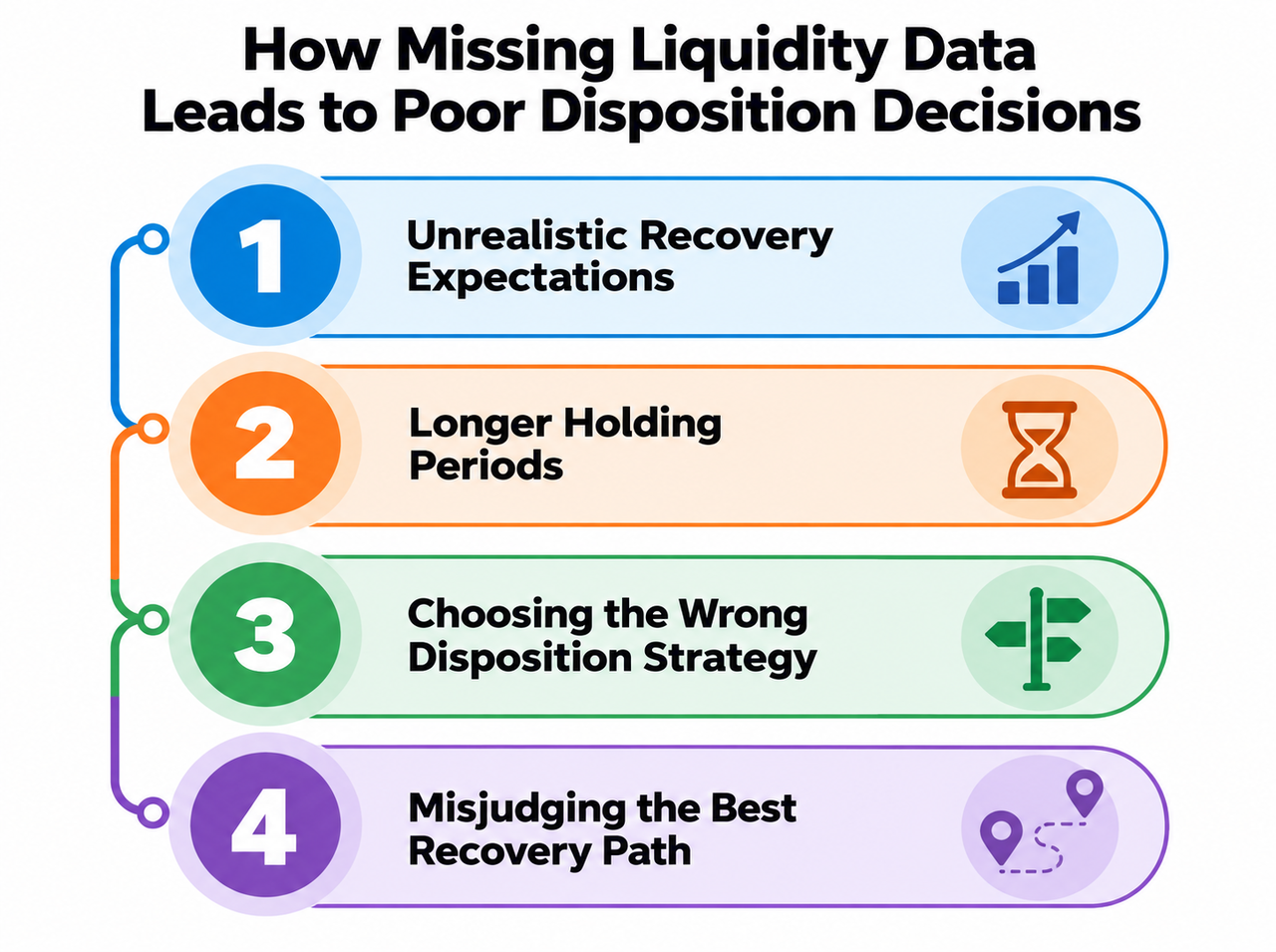
Without liquidity data, manufacturers may make disposition decisions based on theoretical value rather than practical recovery potential.
1. Unrealistic Recovery Expectations
A historical sale price can create expectations that do not match the actual market opportunity. Manufacturers may assume their entire surplus inventory can be recovered at a similar value, even when buyer demand is limited, or the market cannot absorb the available quantity.
2. Longer Holding Periods
When expected recovery values are based on limited market information, assets may remain stored while teams wait for buyers who may not exist. During that time, manufacturers continue carrying storage, handling, and management costs for inventory that is no longer supporting operations.
3. Choosing the Wrong Disposition Strategy
Liquidity affects which sales approach makes sense for an asset. An asset with strong buyer demand may support resale efforts, while an asset with limited market activity may require a different recovery approach. Without liquidity insights, manufacturers may choose a strategy that doesn't match market conditions.
4. Misjudging the Best Recovery Path
Limited understanding of market demand makes it harder for manufacturers to decide whether to sell, redeploy, hold, or choose the most suitable asset recovery strategy. This can result in missed opportunities and lower recovery outcomes.
How Amplio Combines Liquidity With Appraisal Data
Manufacturers need more than a historical price to understand what their surplus inventory may realistically recover. Amplio combines AI-powered appraisal with secondary-market data to evaluate both potential recovery value and market demand.
Our free equipment and machinery appraisal service uses comparable sales, price ranges, liquidity insights, asset size, and logistics factors to help determine the right disposition approach for each SKU.
By combining these inputs, Amplio helps manufacturers move beyond simple valuations and make more informed disposition decisions across large surplus portfolios.
Contact us to evaluate your surplus inventory with AI-powered appraisal and market insights.