Why Do Well-Run Plants Accumulate Dead Inventory?
Well-run plants still accumulate dead inventory.
A facility may have strong procurement controls, reliable maintenance practices, accurate inventory records, and efficient operations. Yet storerooms can still fill with parts and materials that have not moved for years.
That looks like poor inventory management. In many cases, it is not.
The deeper issue is how decisions are made around surplus. When keeping inventory is easier, safer, and less disruptive than dealing with it, dead stock continues to build.
The Surplus Problem Looks Like an Inventory Management Problem From the Outside
When companies discover large volumes of surplus stock, they often look first at forecasting, purchasing, warehouse processes, or inventory accuracy. Common explanations include poor visibility, inaccurate records, weak demand planning, limited resale channels, and difficult logistics.
These issues contribute to excess inventory. But they do not fully explain why known surplus persists for years, especially when the plant already has detailed records of what it owns.
Most established plants can identify the quantity on hand, storage location, purchase cost, last movement date, and the equipment or production process tied to an item. In many cases, they already know which inventory is inactive or unlikely to be used again.
That changes the nature of the problem.
It is not simply an inventory problem. It is a behavioral problem, and the behavior is shaped by how each function involved is measured.
How Departmental Incentives and Default Responses Lead to Dead Inventory
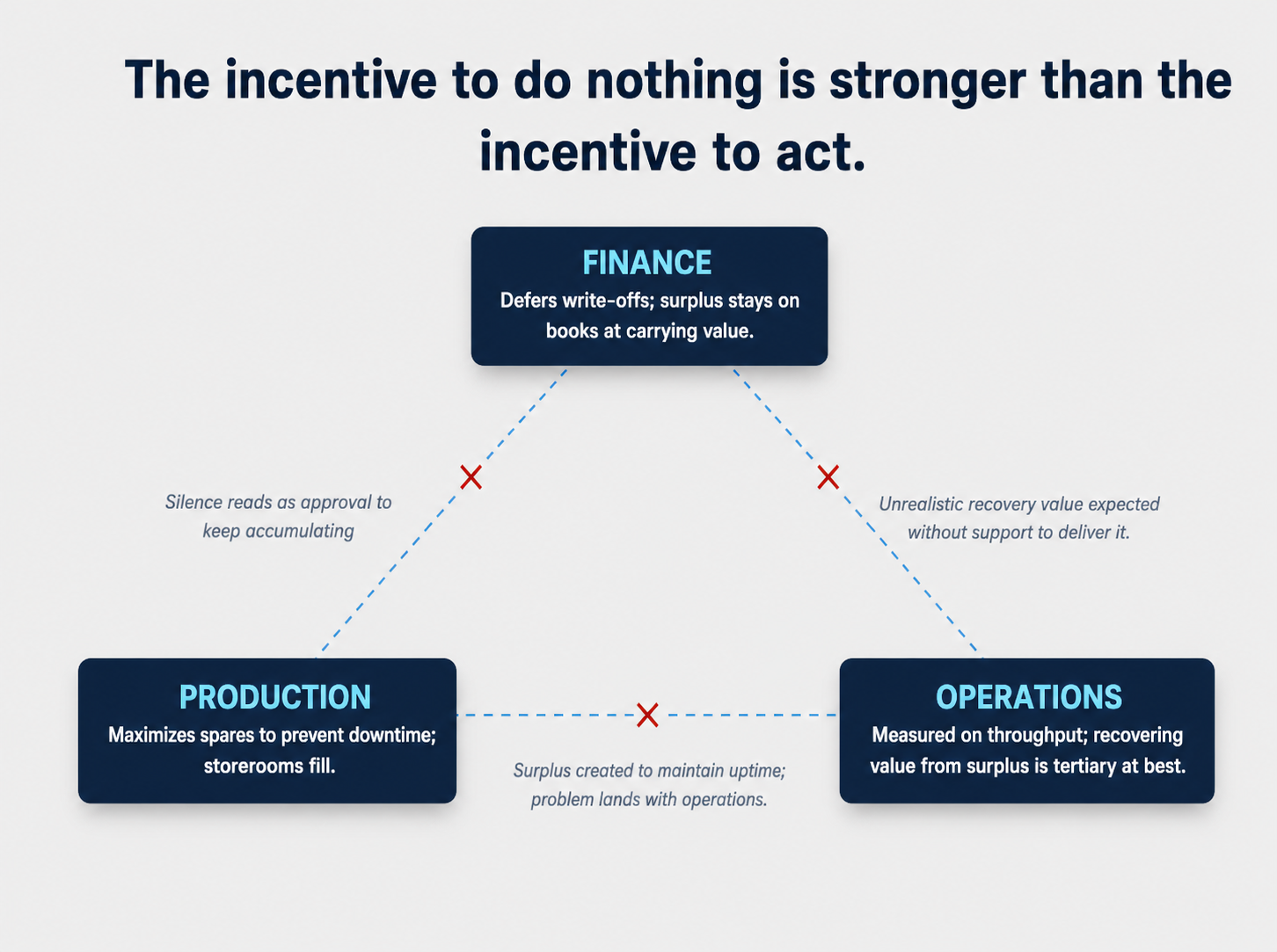
Dead inventory often builds because finance, production, and operations are all measured against different outcomes than surplus inventory minimization. Those incentives can make retaining surplus easier to justify than disposing of it, even when the business as a whole would benefit from acting.
1. Finance Has an Incentive to Delay Disposition
Surplus inventory typically remains on the books at a carrying value that exceeds what the secondary market will pay.
Accounting rules require companies to recognize declines in inventory value when the expected recoverable amount falls below cost. But determining that value requires estimates about future use, demand, obsolescence, and expected proceeds. Those estimates are not the same as an actual market transaction.
Slow-moving spare parts make that distinction important. A part can have little recent demand and still retain an estimated future use within the plant. Until stronger evidence shows that its recoverable value has fallen, the carrying value remains based on an internal estimate.
Disposition changes that. A sale establishes what a buyer is prepared to pay and makes the gap between carrying value and net proceeds visible.
That creates a clear incentive to wait. Acting produces a definite financial outcome and a likely write-down or write-off. Waiting delays the issue and makes books easier to balance.
2. Production Prioritizes Parts Availability to Protect Uptime
Production teams are measured on uptime, and that shapes how they treat spare parts.
A missing spare can stop a line, delay output, or extend equipment downtime. The cost is immediate, quantifiable, and traceable to a specific part that was not on the shelf. Against that exposure, an extra spare can look like inexpensive protection.
The cost of holding too much inventory works differently. A part can sit untouched for years while storage and handling costs accrue and its resale value declines. Those costs build gradually, sit in overhead, and rarely reach the measures the production team is judged on.
A spare that sits unused for years often attracts far less scrutiny than a line that stops for four hours.
Where uptime is the priority, keeping one more spare can be the rational decision. The problem is that the same decision gets repeated across thousands of items and years of purchasing, adding up to a silent yet material drag on efficiency.
3. Operations Prioritizes Plant Performance Over Surplus Disposition
Operations teams are typically measured on throughput, safety, labor, production schedules, and cost per unit. Those measures are reviewed regularly and tied directly to how the team is evaluated.
A surplus disposition program improves none of them (unless the surplus problem was so large that it actively disrupted normal operations).
Someone has to identify the inventory, confirm it is no longer needed, collect item data, coordinate approvals, qualify buyers, arrange removal, and document the result. That work can stretch across weeks or months and draws on the same people responsible for running the plant. At the end of it, throughput, safety, and cost per unit are where they started.
Not choosing to prioritize disposition is not resistance to disposition. Plant leaders can agree that surplus should be addressed without being accountable for the result. Recognizing a problem and being measured on solving it are two different things.
That makes delay rational at the department level, even when the company loses value by waiting.
Nobody Owns the Economic Outcome of Surplus Inventory
Once inventory becomes surplus, responsibility often becomes fragmented across several functions.
Each function controls part of the decision, but none is directly accountable for recovering the remaining value, creating an ownership gap.
If there is no clear recovery target, disposition deadline, or person accountable for aging inventory, there is little pressure to act. No function is directly measured on how much value is recovered from surplus, so the stock can remain in place even after its operational need has declined.
In that environment, inaction becomes the default because responsibility for the economic outcome remains unclear.
Conclusion
The dead inventory problem persists because each stakeholder is making a rational decision from their own position. Finance avoids converting an estimate into a realized loss. Production protects uptime. Operations protect plant performance. None of those priorities is unreasonable on its own.
The conflict becomes costly at the company level. Capital stays tied up in aging inventory, recovery value declines, and no single function is accountable for the outcome.
That is why the solution cannot stop at better inventory data or more disposition tools. Those improve execution for organizations that have already decided to act.
The organization has to change the default behavior around surplus. That means assigning clear ownership, setting recovery targets, defining when inventory moves into disposition, and measuring the financial result.
Until those incentives change, well-run plants will continue to accumulate dead inventory even when everyone involved is doing exactly what their role encourages.
If surplus assets are already accumulating across your operations, Amplio’s surplus asset management services provide a structured way to identify, value, and move surplus into the right recovery channel.
Contact us now to get started.