What to Do With Retired Industrial Assets? (Don’t Scrap It)
Introduction
In many manufacturing environments, industrial equipment is retired not only because it has failed, but also because production needs change. As processes evolve, plants consolidate, or new technology is introduced, machines that still work are taken out of service and pushed aside, continuing to depreciate while consuming valuable plant resources.
Over time, retired equipment creates hidden costs by occupying floor space, adding handling and safety overhead, and tying up storage space. As assets sit idle, records fade, and recovery options shrink, making it harder to reclaim value.
A value-first approach helps manufacturers act quickly and prioritize higher-return recovery paths instead of defaulting to the lowest-value outcome.
This article explains why industrial assets get retired in manufacturing operations and outlines practical value-recovery options beyond scrap.
Why Industrial Assets Get Retired
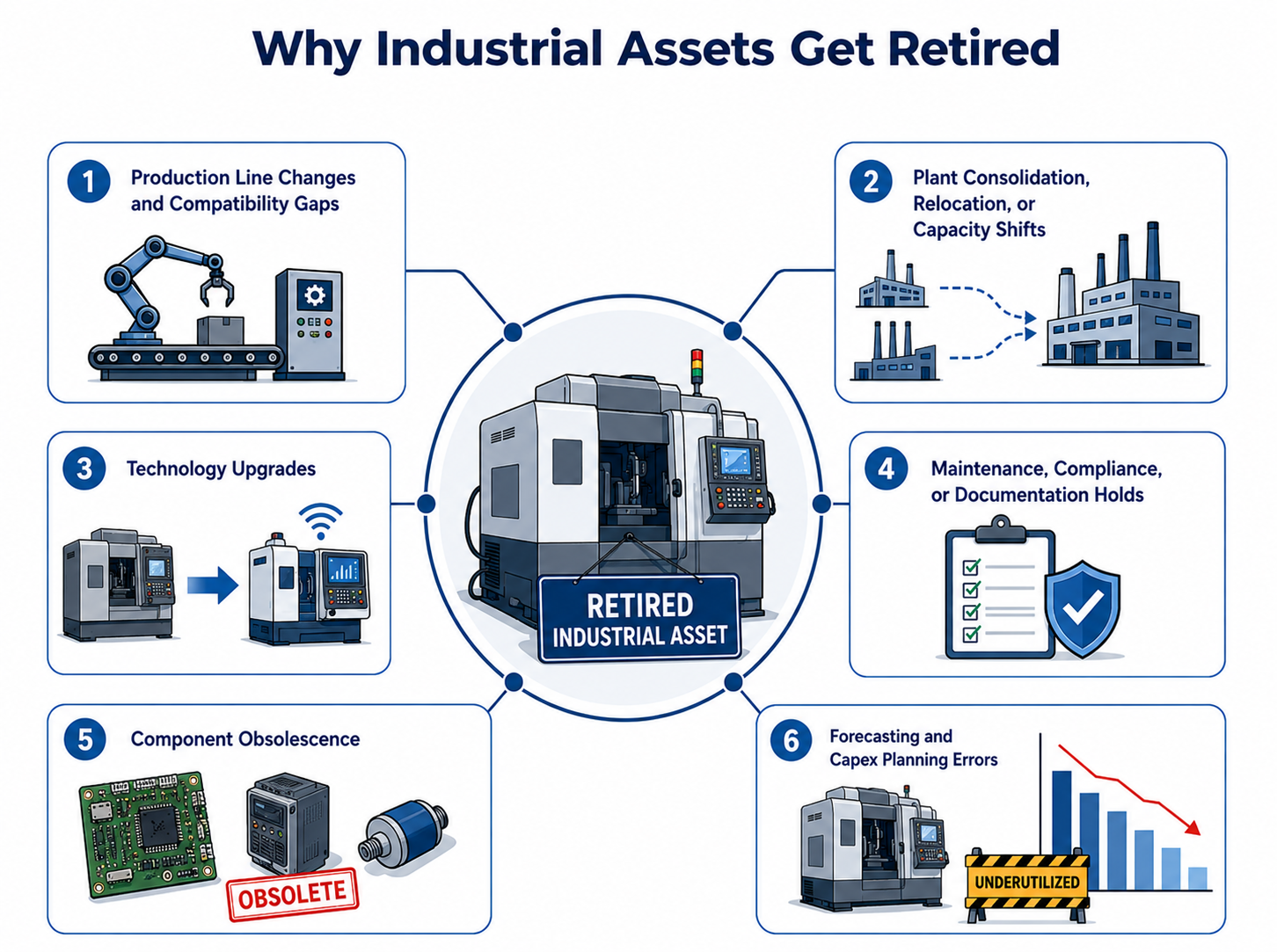
Industrial assets are rarely retired because they stop working. The retirement decisions are often operational:
- Production line changes and compatibility gaps: New specifications, automation upgrades, tooling changes, utility requirements, control systems, footprint constraints, or updated safety standards can make existing equipment incompatible.
- Plant consolidation, relocation, or capacity shifts: When production moves or facilities merge, duplicate machines and surplus equipment are left without a role. These situations are common during manufacturing plant consolidation, where teams must decide which assets to retain, redeploy, sell, or remove.
- Technology upgrades: Legacy assets may still run, but they become non-standard as plants adopt newer systems and digital workflows.
- Maintenance, compliance, or documentation holds: Inspection backlogs, expired certifications, or missing documentation can sideline equipment even when it is mechanically sound.
- Component obsolescence: Equipment may rely on control boards, drives, sensors, or proprietary parts that are no longer supported or available. Even if the machine runs, the risk of downtime increases when replacement components cannot be sourced reliably.
- Forecasting and capex planning errors: Overestimated demand or poorly timed purchases can lead to excess equipment that never gets fully utilized.
How to Recover Value From Retired Industrial Assets
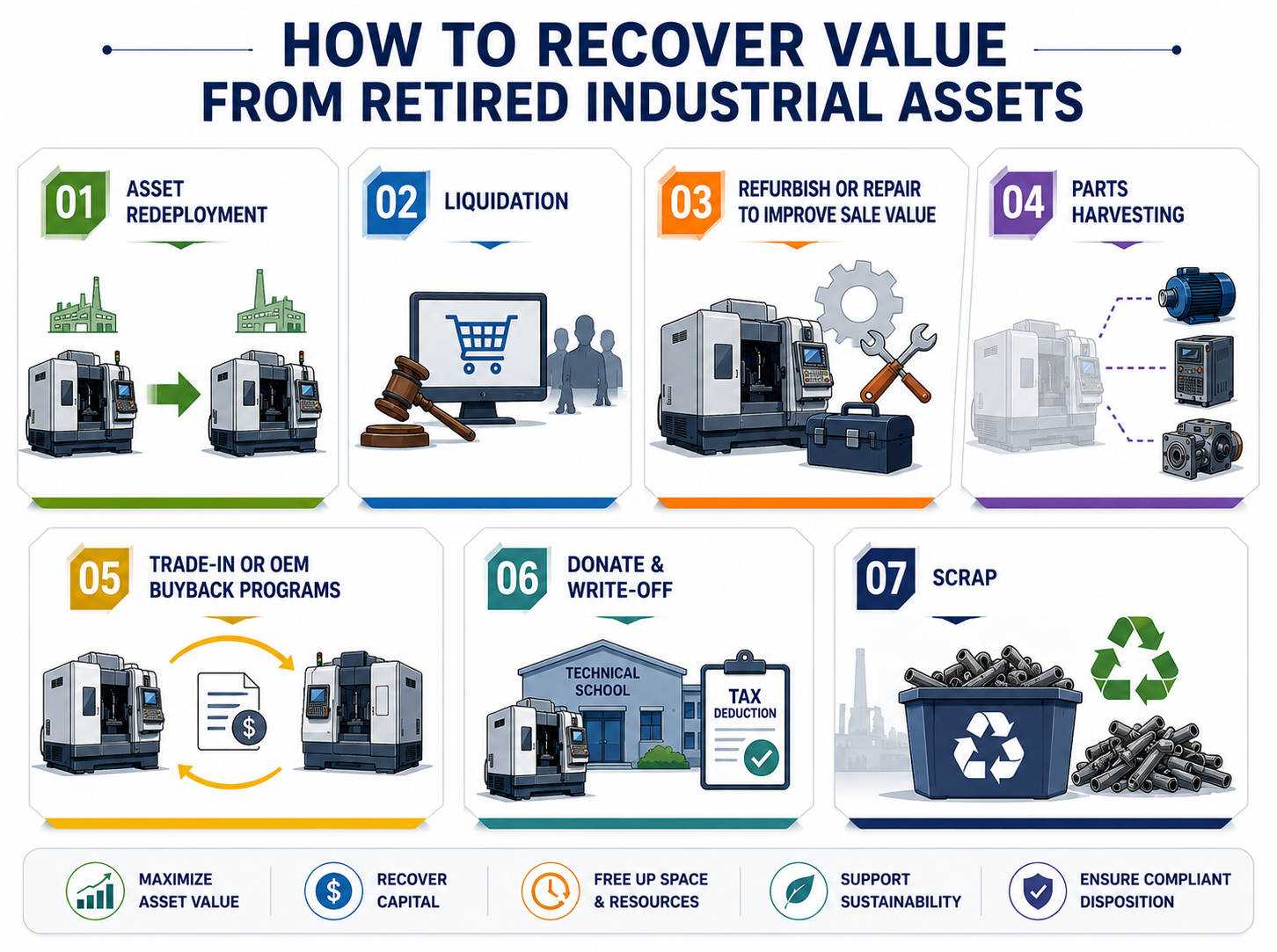
1. Asset Redeployment
Redeployment is the highest-value option when a retired asset can be reassigned to another plant or production line with the same operational compatibility.
This works best when the receiving facility runs similar processes, and the equipment aligns with required specifications, controls, utilities, safety standards, footprint, tooling, and output targets.
When compatibility is confirmed, redeployment keeps the asset productive, avoids unnecessary new capex, reduces lead times, and promotes a circular supply chain by extending the usable life of equipment already owned.
2. Liquidation
When redeployment is not viable, liquidation is often the fastest path to recover capital from retired industrial assets. If the equipment is still functional but no internal demand exists, selling through targeted industrial liquidation channels helps convert idle machinery into cash while quickly freeing up valuable floor and storage space.
Common liquidation channels include:
- Private industrial marketplaces with vetted buyers for faster, higher-quality offers.
- Industrial dealers and resellers who specialize in specific equipment categories.
- Auctions for time-bound sales when speed matters more than price certainty.
- Consignment partners to market assets while you retain ownership until sold.
3. Refurbish or Repair to Improve Sale Value
In some cases, modest repairs or light refurbishment can significantly increase the resale value of retired industrial assets. Equipment that is mechanically sound but cosmetically worn, partially disassembled, or missing minor components is often heavily discounted by buyers unless it is restored to a market-ready condition.
This option works best for assets with strong secondary-market demand, where a small investment in cleaning, testing, calibration, or part replacement can unlock disproportionately higher recovery value and improve buyer confidence.
4. Parts Harvesting
Many retired machines still contain high-value components such as motors, drives, PLCs, pumps, and gearboxes that remain in demand even when the full asset is no longer useful.
In these cases, harvesting and selling components separately can deliver higher recovery than selling the equipment as a complete unit, especially when buyers would otherwise discount the system for risk or obsolescence.
This approach is especially effective for obsolete, incomplete, or non-standard machines where resale is difficult, but individual parts still have strong aftermarket value and can reduce spare-part purchasing elsewhere.
5. Trade-In or OEM Buyback Programs
Some original equipment manufacturers offer trade-in or buyback programs that allow retired equipment to be exchanged for credits toward new purchases. This option can simplify the disposition process by combining asset removal and equipment replacement into a single, coordinated transaction.
Trade-in programs also help reduce upgrade costs and administrative effort, since the OEM typically manages evaluation, logistics, and resale or refurbishment. They are most effective for brand-specific or standardized equipment where manufacturers maintain established secondary markets and clear valuation frameworks.
6. Donate & Write-Off
When resale demand is limited, but equipment remains functional, donation can be a practical alternative to scrap. Many organizations donate retired assets to technical schools, training centers, or educational institutions where the equipment can still provide instructional value.
In some cases, donations may qualify for tax write-offs, subject to proper accounting and legal review. While this option does not generate direct cash recovery, it helps avoid disposal costs, supports workforce development, and creates a documented, compliant exit for surplus equipment.
7. Scrap (Last-resort recovery)
Scrap should be treated as the final recovery option when equipment is beyond reuse, resale, or part harvesting, and no economically viable recovery paths remain. At this stage, the goal shifts from value maximization to responsible and compliant disposition.
Using certified recycling partners ensures that materials are recovered safely and in accordance with environmental and regulatory requirements. While scrap delivers only commodity value, it provides documented compliance, supports ESG reporting, and brings formal closure to the asset’s lifecycle when higher-value options are no longer feasible.
How Amplio Helps You Recover More Than Scrap Value
AI-Powered appraisal
At Amplio, we combine AI-powered technology with the expertise of seasoned asset recovery professionals to deliver accurate, efficient equipment appraisals. Our AI analyzes asset condition signals and current market demand to generate data-driven valuations. Meanwhile, our specialists validate each appraisal against real-world factors, including documentation, compliance requirements, and buyer expectations, to ensure that every valuation aligns with industry standards.
Redeploy Equipment
When an asset still fits production requirements, Amplio helps match it to compatible lines or sister facilities across your network. By validating process fit, controls, utilities, safety standards, and output needs, equipment can be reused where it delivers immediate value. Redeployment reduces unnecessary capital spending, shortens lead times, and extends the productive life of assets you already own.
Liquidate Retired Assets
If internal demand does not exist, Amplio enables faster, more efficient liquidation by positioning retired equipment with the right industrial buyers and dealers. Assets are marketed through private marketplace or auction channels, providing accurate data and visibility, which helps recover cash sooner while clearing valuable floor and storage space.
Contact us now to have a custom disposition strategy planned for you.