Top Cost-Saving Strategies and Opportunities for Businesses

Introduction
According to PwC’s August 2023 Pulse Survey, 59% of CFOs placed cost-cutting at the top of their agenda, a sharp rise from 38% in 2022. With rising operational costs, fluctuating market conditions, and increasing supply chain complexities, businesses are under greater pressure to optimize spending and improve financial health.
For large enterprises, cost-saving is not just about cutting expenses. It is about strategic resource allocation, ensuring that every dollar spent across business operations contributes to growth, efficiency, and competitive advantage. A well-structured cost-saving strategy helps businesses improve cash flow, optimize operations, and reinvest in innovation without compromising productivity.
This blog explores proven cost-saving strategies and opportunities businesses can implement to uncover financial efficiencies while positioning themselves for short-term, medium-term, and long-term success.
What Is Cost Savings in Business?
Cost savings in business mean reducing spending without affecting output, quality, or long-term growth. It focuses on cutting avoidable costs and improving how money is used across the organization.
For large businesses, cost savings often come from controlling overhead, reducing waste, and making business operations more efficient. The aim is to protect margins, strengthen financial performance, and align spending more closely with business priorities.
Why Cost Saving Matters for Businesses?

Cost saving affects multiple areas of business performance, especially in large organizations where spending decisions have wider operational and financial implications.
1. Protects Profit Margins
Cost savings help businesses protect profit margins as expenses rise. In large organizations, overhead costs, administrative expenses, and other operating costs can quickly erode profitability. Even minor inefficiencies can have a measurable impact at scale, making cost control essential for maintaining financial performance.
2. Improves Cash Flow
Cost savings improve cash flow by reducing avoidable spending. By controlling business costs and improving expense management, large organizations can free up cash for operations, capital needs, and other strategic priorities.
3. Supports Better Resource Allocation
Cost savings allow businesses to allocate resources more effectively across the organization. When companies reduce waste and control unnecessary spending, they can direct more capital and operational focus toward higher-value priorities such as core operations, process improvements, and long-term growth.
Key Cost Centers in Large Organizations

Cost structures in large enterprises are complex and multifaceted, but most financial outflows fall under a few primary categories. Managing these costs effectively requires a targeted approach to improve efficiency, reduce waste, and free up capital for reinvestment.
Here are the major cost centers that significantly impact enterprise financial performance:
1. Capital Expenditures (CAPEX)
Investments in machinery, infrastructure, and long-term assets are essential but often result in capital lock-up, limiting financial flexibility. Poor CAPEX planning can lead to underutilized assets, excessive depreciation costs, and misallocated funds. This can weaken financial health and limit the ability to reallocate resources toward higher-value priorities.
2. Operating Expenses (OPEX)
Day-to-day operational expenses, including rent, utilities, salaries, and software, continue to rise due to inflation, labor costs, and increasing service costs. Without careful cost control, OPEX grows disproportionately to revenue, straining cash flow and reducing profit margins. Over time, this can limit financial flexibility and reduce the ability to invest in higher-value business priorities.
3. Manufacturing & Production Costs
Manufacturing costs fluctuate due to raw material price volatility, equipment maintenance issues, and inefficient production workflows. Supply chain disruptions, fluctuating demand, and compliance costs further increase financial strain. Unoptimized production lines result in excess waste, higher defect rates, and longer production cycles, all of which reduce efficiency and profitability.
4. Procurement Costs
Procurement inefficiencies drive higher costs for raw materials, components, and services. Weak vendor contracts, unfavorable payment terms, and over-reliance on a limited supplier base can increase exposure to price fluctuations and stock shortages. That risk becomes even greater when businesses lack an alternate sourcing strategy.
5. Supply Chain & Logistics Costs
Supply chain disruptions, rising fuel costs, inefficient distribution networks, and excess inventory significantly increase logistics expenses. Poor demand forecasting results in overstocking or stockouts, leading to higher storage fees, increased waste, and lost sales opportunities. The complexity of managing global supplier networks and transportation costs further strains profitability, especially as geopolitical and economic conditions shift.
Short-Term Quick Win Cost Reduction Strategies

Short-term cost-reduction strategies focus on immediate actions that lower spending without disrupting daily operations. Unlike long-term structural changes, these measures are designed to deliver faster results and help organizations respond more effectively to rising costs.
Here are some practical short-term strategies businesses can use to reduce costs quickly.
1. Eliminate Non-Essential Spending
Eliminating non-essential spending is one of the fastest ways to reduce costs without affecting core operations. Travel, corporate events, and other low-priority activities often create unnecessary expenses without adding meaningful business value.
By tightening expense policies and focusing only on essential spending, companies can generate short-term savings and improve control over each business expense.
Example:
At IKEA, executives use in-house cafeterias instead of expensive restaurants when hosting guests, including VIPs, reflecting a broader culture of cost-conscious spending.
2. Automate Basic Processes
Automating repetitive tasks helps businesses reduce labor costs, save time, and improve efficiency. By using cost-saving technology such as Robotic Process Automation (RPA), companies can streamline workflows such as data entry, invoice processing, and reporting without increasing manual effort.
These process improvements can reduce administrative expenses and make business operations more efficient. Many organizations use RPA to maintain speed and accuracy while lowering repetitive manual work.
Example:
A large global telecommunications company used RPA solutions to automate cell tower setup processes that required teams to move data across more than 50 applications. The initiative generated savings of more than $1 million per month while reducing manual work and errors.
3. Optimize Energy & Utility Usage
Reducing energy waste is a fast and effective way to cut costs. Simple energy-efficiency measures such as smart lighting, HVAC optimization, and automated power-down policies help lower utility expenses without disrupting business operations.
Over time, these cost-saving measures can also reduce overhead costs and improve control over facility-related spending.
Example:
Toyota retrofitted an older plant’s HVAC fans with smart variable frequency drives, cutting HVAC energy use by 30–86% depending on conditions, with an ROI of under two years.
4. Work with Temporary Workers
Managing labor costs effectively requires flexibility, not just budget cuts. Businesses with fluctuating workloads can control expenses and maintain productivity by using temporary workers during peak demand periods.
This approach supports flexible work arrangements without requiring long-term full-time hires.
Example:
According to a 2022 Society for Human Resource Management (SHRM) study, the average cost per hire is nearly $4,700, with many employers estimating the total expense at three to four times the position’s salary. During high-demand events like Black Friday, warehouse companies face up to 14× their usual volume. Instead of adding permanent staff, they scale up with temp workers, ensuring operational efficiency without long-term salary and benefits costs.
5. Renegotiate Vendor and Supplier Contracts
Vendor and supplier contracts often present clear short-term opportunities for cost reduction. For large organizations, revisiting pricing structures, payment terms, and service scope can uncover savings without disrupting day-to-day operations.
Even small improvements across multiple vendor contracts can lead to significant cost savings over time. This also gives businesses better control over supplier-related spending and supports procurement cost savings by aligning purchasing terms with current operating needs.
Example:
American Airlines reported renegotiating more than 9,000 vendor contracts and addressing over 500 real estate leases as part of a broader non-labor cost reduction program. The company projected $4.3 billion in non-labor savings over five years, with vendor and facility savings contributing significantly to that total.
6. Idle Asset Liquidation & Monetization
Holding onto idle inventory ties up capital, increases storage costs, and limits financial flexibility. Whether it is excess equipment, raw materials, or outdated IT infrastructure, underused assets create hidden costs that businesses often overlook.
Instead of letting these assets sit idle, companies can free up capital, reduce carrying costs, and create new savings opportunities through liquidation or resale. This also supports cost avoidance by limiting the ongoing expense of storing assets that no longer serve current business needs.
Example:
According to 2024 survey data from Fulfillment Advisor, the yearly cost per square foot for warehouse storage rose to $8.31 in 2024, up from $8.22 in 2023. As warehousing expenses continue to climb, holding onto surplus inventory becomes an unnecessary financial burden.
Amplio Helps You Maximize Value from Industrial Surplus
"Our warehouse was filling up, and we were missing out on the opportunity to generate significant cash from these depreciated assets. Amplio’s data-driven approach and efficient logistics have not only freed up our warehouse space but also unlocked significant cash flow."
— Supply Chain Manager of a Fortune 500 Company
Mid-Term Cost Efficiency Improvements
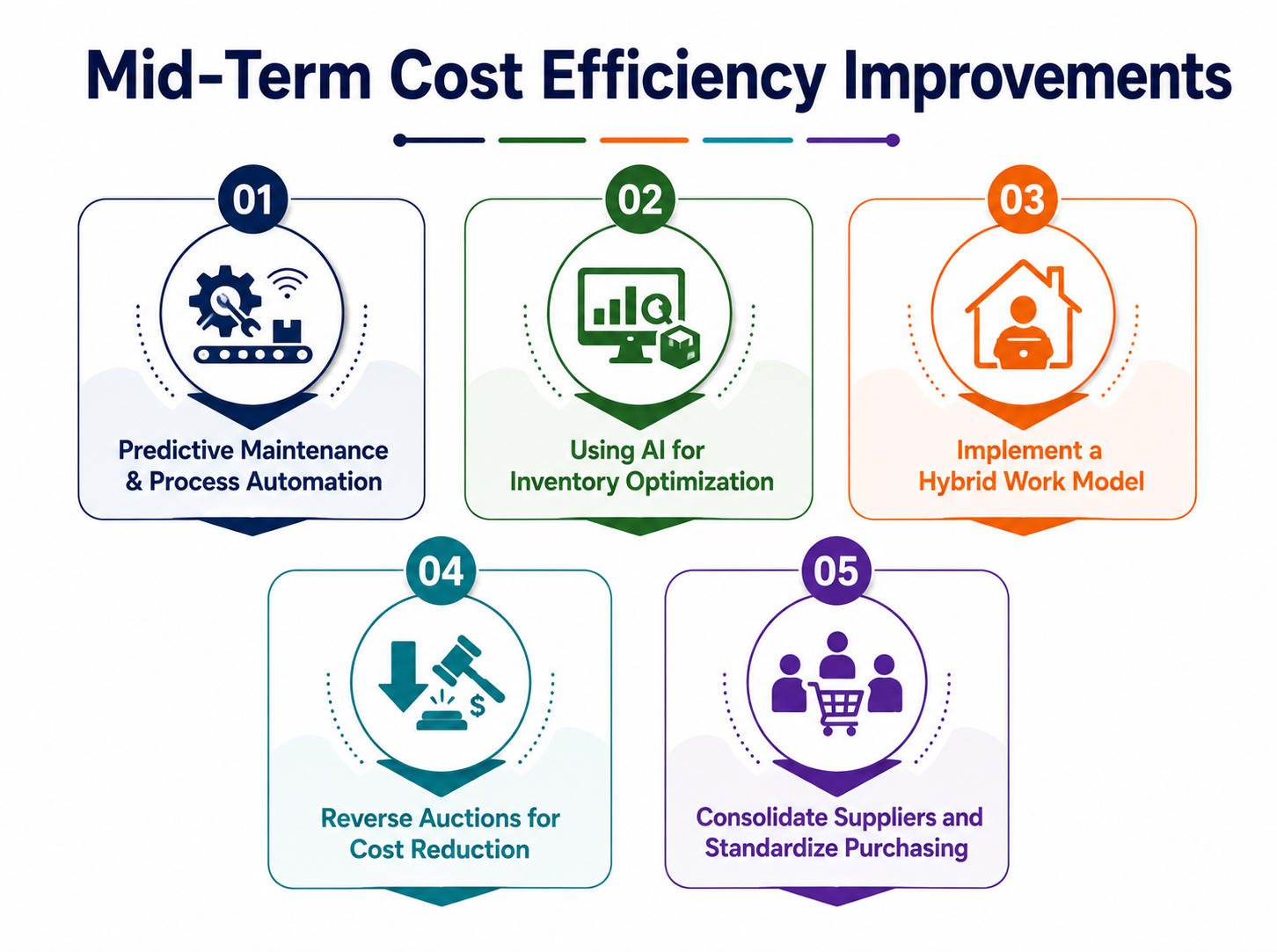
Mid-term strategies focus on eliminating inefficiencies, optimizing workflows, and improving resource utilization over several months. These improvements create sustainable cost reductions without disrupting productivity or limiting growth.
Here are some key mid-term efficiency strategies that businesses can implement.
1. Predictive Maintenance & Process Automation
Unexpected equipment failures drive high repair costs, unplanned downtime, and lost productivity. Traditional maintenance methods rely on fixed schedules or reactive repairs, often leading to unnecessary servicing or costly breakdowns.
By adopting predictive maintenance and process automation, businesses can optimize asset performance, extend equipment lifespan, and reduce the risk of failure.
Example:
The Noranda Alumina plant in Gramercy, Louisiana, saw a 60% reduction in bearing replacements within two years after implementing a predictive lubrication solution, resulting in $900,000 in cost savings. The plant also avoided costly downtime, where just four hours of production loss equals nearly $1 million in lost revenue, according to Russell Goodwin, a reliability engineer at Noranda Alumina.
2. Using AI for Inventory Optimization
Poor inventory management leads to excess stock, shortages, and high carrying costs, all of which put pressure on cash flow and operational efficiency.
By leveraging AI-driven inventory optimization, businesses can analyze real-time data, eliminate inefficiencies, and optimize inventory levels more accurately. This helps uncover cost reduction opportunities, reduce waste, and improve supply chain performance.
Example:
A Fortune 500 industrial equipment manufacturer implemented an AI-based MRO inventory optimization strategy and identified $20.9 million in reduction opportunities. Within the first six months, they verified $55,000 in immediate savings and updated over 800 material stocking policies. Additionally, 2,000 materials at risk of stockout were identified, improving supply reliability and preventing costly operational disruptions.
3. Implement a Hybrid Work Model
A hybrid work model can help businesses reduce office space requirements, utility expenses, and other facility-related costs while improving workforce flexibility.
By adopting structured hybrid policies, large organizations can reduce their office footprint, control overhead costs, and support stronger employee retention. In many cases, greater flexibility can also support employee morale without disrupting day-to-day operations.
Example:
According to Global Workplace Analytics, a typical U.S. employer can save an average of $11,000 per half-time telecommuter per year. Much of that value comes from lower real estate costs, making hybrid work a practical way to reduce office footprint and improve cost efficiency.
4. Reverse Auctions for Cost Reduction
Traditional procurement often relies on fixed pricing models and standard supplier negotiations, which can limit cost-saving opportunities. Reverse auctions offer a more competitive and transparent alternative in which vendors bid against each other and lower their prices to win contracts.
This approach can help businesses secure competitive pricing, reduce procurement costs, and generate significant savings on goods and services.
Example:
The U.S. Government Accountability Office (GAO) highlights the effectiveness of this strategy. According to its findings, reverse auctions saved the U.S. government up to $100 million in 2016, with vendors frequently submitting multiple, progressively lower bids to remain competitive.
5. Consolidate Suppliers and Standardize Purchasing
Managing too many suppliers often leads to fragmented spending, inconsistent pricing, and weaker purchasing control. Consolidating suppliers and standardizing purchasing processes can help businesses improve visibility, reduce complexity, and strengthen procurement efficiency across the organization.
This approach can also reduce supplier fragmentation, strengthen purchasing governance, and improve consistency across teams.
Example:
Mercy Health implemented a centralized purchasing model and worked with Medline to standardize products and consolidate distribution. In the first year, the effort eliminated nearly 2,000 SKUs, reduced distribution hubs from 14 to 2, and streamlined procurement in less than a year. The broader initiative was expected to generate more than $100 million in cost savings through product standardization and related process improvements.
Long-Term Transformational Strategies
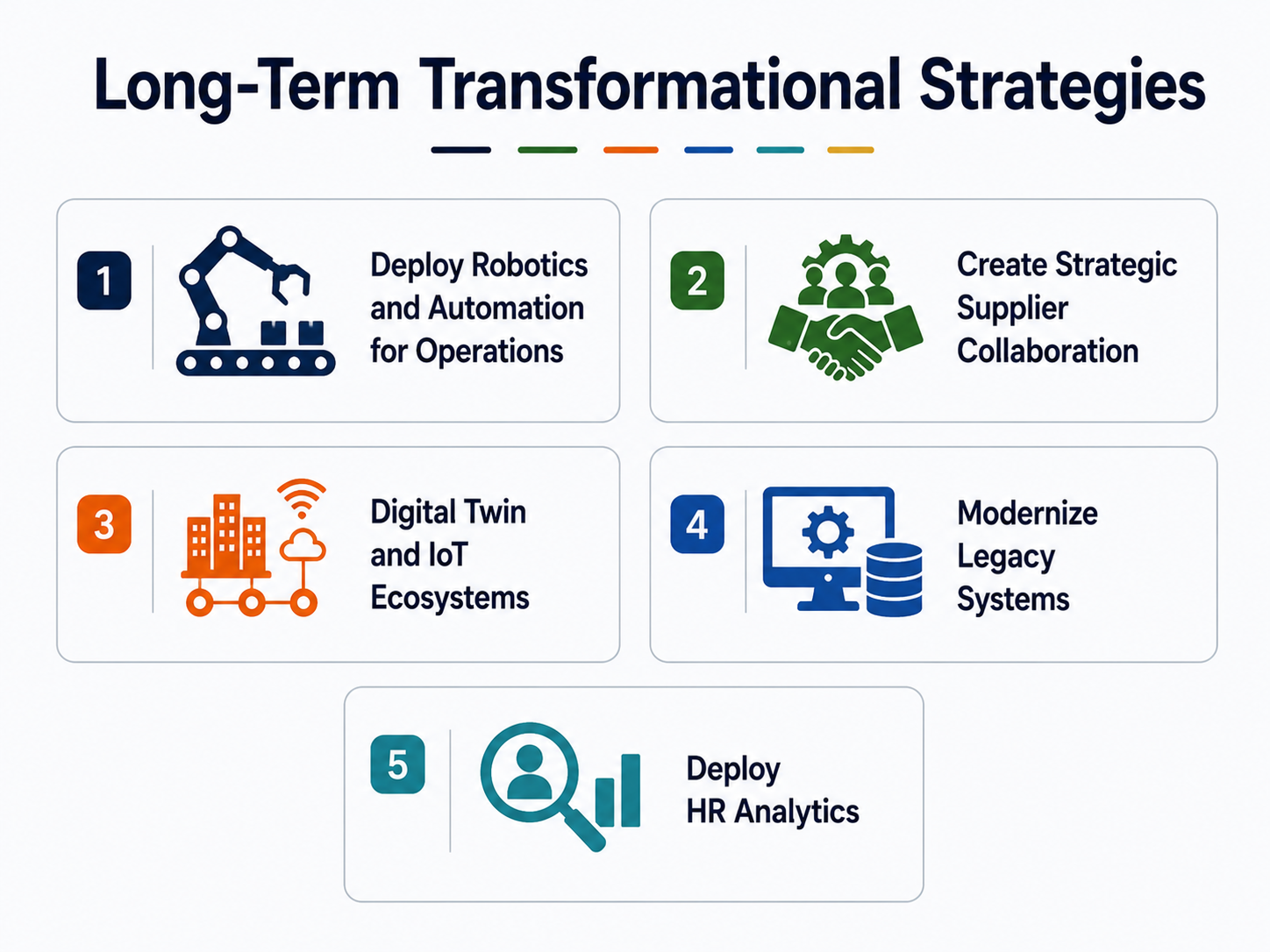
Long-term transformational strategies focus on fundamentally reshaping cost structures, improving scalability, and driving lasting operational efficiency. These initiatives often require significant investments, process overhauls, and cultural shifts but yield substantial financial benefits over time.
Here are key strategies that enable businesses to achieve cost transformation at scale.
1. Deploy Robotics and Automation for Operations
As businesses scale, manual processes and labor-intensive workflows become costly and inefficient.
Long-term cost transformation requires automation at scale, where Automation and robotics take over complex, repetitive, and high-precision tasks, leading to lower labor costs, faster production cycles, and improved accuracy.
Example:
Amazon provides a prime example of AI-driven automation in warehousing. The company has integrated robotics at nearly every stage of fulfillment, from inventory sorting to packaging, reducing operational costs by up to 25% while improving warehouse efficiency.
2. Create Strategic Supplier Collaboration
Traditional supplier relationships often focus on cost reduction rather than long-term value creation, leading to inefficiencies and missed opportunities. Businesses that shift from transactional supplier management to collaborative partnerships can unlock cost savings, innovation, and greater supply chain resilience.
Rather than simply consolidating suppliers or renegotiating contracts, leading companies build structured collaboration models that align suppliers more closely with business goals.
Example:
Toyota fosters deep supplier engagement by establishing clear performance targets and value-sharing agreements. Through joint steering committees, Toyota ensures continuous improvements in cost efficiency, quality, and delivery performance, strengthening long-term supplier relationships while maintaining operational excellence.
3. Digital Twin and IoT Ecosystems
As businesses scale, real-time insights and predictive analytics become essential for improving efficiency and operational control. While AI and robotics automate tasks, digital twin technology and IoT ecosystems extend optimization by creating virtual replicas of production lines, warehouses, and supply chains.
These digital models continuously analyze operations, identify inefficiencies, and enable more proactive decision-making across complex environments.
Example:
LG Electronics digitized its Changwon, Korea, factory using IoT and digital twin technology, updating its virtual model every 30 seconds. The initiative contributed to a 17% increase in productivity and a 30% reduction in energy consumption.
4. Modernize Legacy Systems
Outdated systems and aging industrial technology often create hidden costs due to inefficiency, higher maintenance needs, and limited visibility across operations. As businesses scale, legacy infrastructure can slow decision-making, increase the risk of downtime, and limit the ability to support modern process improvements.
Modernizing these systems can improve reliability, strengthen data visibility, and support more efficient business operations over the long term. It also gives businesses a stronger foundation for automation, predictive maintenance, and better cost control across the organization.
Example:
Hexcel modernized aging production technology at its Salt Lake City facility and reduced unplanned maintenance downtime from 2% to 0.4%. Before the upgrade, the company had been losing $70,000 per downtime incident.
5. Deploy HR Analytics
Traditional HR strategies often rely on reactive decision-making, leading to avoidable attrition and misaligned staffing levels.
By deploying HR analytics and AI-driven insights, businesses can improve workforce planning, predict turnover risks, and strengthen overall productivity.
Example:
IBM implemented AI-driven “flight risk” modeling to predict employee turnover in critical roles. By proactively addressing attrition risks, IBM saved an estimated $300 million over four years by reducing hiring costs and preventing productivity disruptions.
To Wrap It Up
Sustainable cost reduction comes from combining short-term wins, mid-term efficiency improvements, and long-term transformation. Businesses that take a structured approach can reduce waste, improve control, and build stronger cost discipline across operations.
Lasting results depend on better processes, smarter use of technology, and more strategic decisions across procurement, operations, and workforce planning. Organizations that adopt a data-driven approach are better positioned to improve financial performance and remain competitive over time.