Factory Inventory Management: Common Issues and Their Practical Solutions
Introduction
Factory inventory management breaks down when inventory visibility does not match real production needs. A plant may carry excess raw materials yet still face delays because a critical spare part is missing, mislabeled, or sitting unused at another site.
That gap can tie up significant capital. In December 2025, U.S. manufacturers held $949.6 billion in inventories, according to the U.S. Census Bureau’s Manufacturers’ Shipments, Inventories, and Orders report. When inventory data is inaccurate, factories overbuy parts they already own, miss critical spares, delay maintenance, and keep cash locked in materials that no longer support production.
In this article, we’ll explore the most common factory inventory management problems and the practical steps manufacturers use to reduce waste, control inventory costs, and improve MRO availability.
What Is Factory Inventory Management
Factory inventory management is the process of tracking, controlling, and allocating raw materials, spare parts, work-in-progress inventory, and finished goods across a manufacturing facility or network. It supports supply chain management by helping teams maintain optimal stock levels for production while reducing shortages, excess stock, and avoidable holding costs.
Why Factory Inventory Management Matters
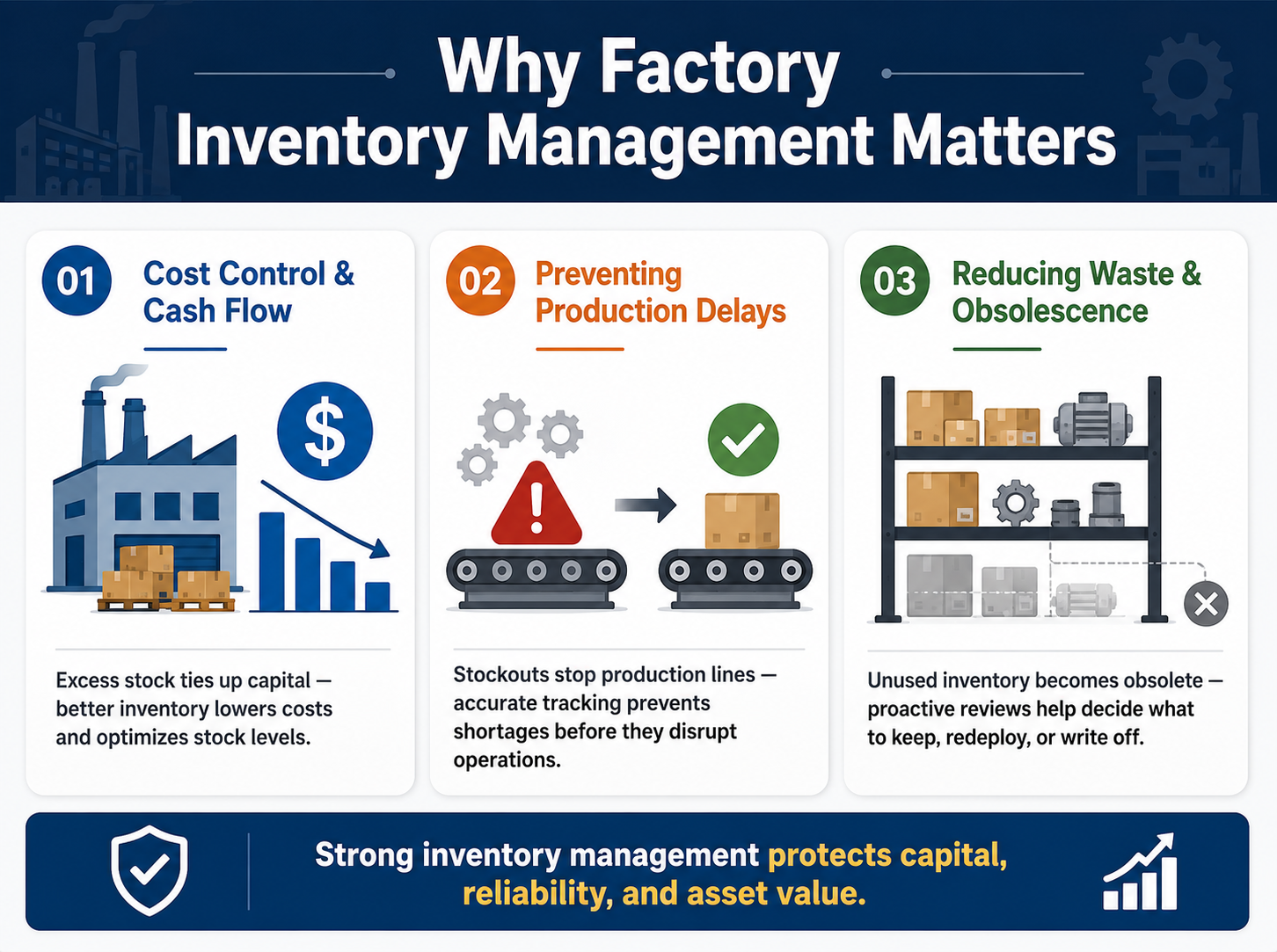
Strong factory inventory management protects working capital, production reliability, and asset value. The benefits can be seen in three key areas:
1. Cost Control and Cash Flow
Poor inventory control ties up cash in surplus stock, limiting capital available for maintenance, production planning, or growth. Holding excess inventory also increases storage, insurance, and depreciation costs. Better inventory control helps manufacturers lower operational costs and optimize stock levels based on real production needs.
2. Preventing Production Delays
Missing parts or materials can stop production lines, especially when the shortage involves critical MRO items, replacement components, or production inputs with long supplier lead times. Stockouts disrupt schedules, delay customer orders, and reduce customer satisfaction when timelines are missed. Accurate stock tracking helps teams identify shortages before they affect manufacturing operations.
3. Reducing Waste and Obsolescence
Unused inventory can become obsolete when production needs change, equipment is replaced, or parts lose resale value. Proactive inventory management helps manufacturers identify slow-moving stock before it consumes more warehouse space, labor, and capital. Regular inventory reviews also help teams decide what to keep, redeploy, liquidate, recycle, or write off.
Common Issues in Factory Inventory Management and Their Practical Solutions

Factory inventory problems often start with poor visibility, weak demand planning, or slow-moving stock that ties up cash and warehouse space.
Below are the most common factory inventory management problems, along with practical inventory control techniques manufacturers can use to improve inventory accuracy and keep production moving.
1. Overstocking and Excess Inventory
Overstocking often happens when factories rely on poor demand forecasting or purchase in bulk without aligning orders with actual consumption patterns.
This creates an imbalance where more materials sit in storage than production requires.
The impact goes beyond space. Excess stock ties up working capital, increases storage costs, and raises the risk of obsolescence. What looks like a safety buffer can turn into waste, higher carrying costs, and unnecessary expense.
Solutions:
Manufacturers can reduce overstocking through two practical actions:
I. Redistribution
Shifting excess stock across facilities through a structured internal redeployment moves usable materials where they are needed most. This approach balances inventory levels, reduces duplicate purchases, and keeps production steady. It is one of the most effective ways to avoid overstocking in one location while another faces shortages.
II. Liquidation
Selling excess items that are no longer required allows factories to recover value and free up warehouse space. It can reduce carrying costs, lower obsolescence risk, and turn idle inventory into usable cash. For long-term excess inventory with no internal use case, liquidation may be a strong recovery path.
2. Stockouts and Production Delays
Stockouts usually occur when inventory tracking is inaccurate or when suppliers fail to deliver materials on time. Without real-time inventory tracking, factories may underestimate usage, miss critical reorder points, or discover shortages too late.
The result is halted production lines, missed deadlines, and a weaker ability to meet customer demand on time. Even short-term shortages of essential MRO items can create costly downtime and damage customer trust.
Solutions:
I. Better Demand Forecasting
Accurate demand forecasting helps factories predict future demand for materials and equipment based on historical data, seasonal patterns, production schedules, and supplier lead times. It supports timely replenishment and reduces the risk of sudden shortages. This helps prevent costly production stoppages, especially when critical parts or production inputs have long supplier lead times.
II. Automated Reorder Points with Supplier Integration
One effective way to prevent stockouts is to automate reorder points based on real-time consumption. Inventory systems can trigger replenishment when critical thresholds are reached, reducing manual oversight gaps. When paired with supplier integration, vendors can receive clearer signals of upcoming demand. This helps factories secure timely deliveries and reduce production delays caused by missing materials.
3. Inaccurate Inventory Tracking
Inventory tracking becomes unreliable when factories depend on manual processes or outdated systems. Human errors, delayed data entry, and a lack of real-time updates often create gaps in important inventory data.
These mistakes lead to mismatched records, poor visibility, and flawed decision-making. In turn, managers may over-purchase, understock critical items, or miss inventory already available at another site, increasing costs and disrupting production efficiency.
Solutions:
I. Centralized Inventory Tracking Systems
Switching from manual methods to centralized inventory tracking systems gives teams real-time updates and reduces data errors. With accurate records, factories can align stock levels with actual demand, avoid duplicate purchases, and reduce shortages. This gives teams a stronger foundation for keeping inventory under control.
II. Barcode Scanning and RFID Tracking
Barcode scanning and Radio Frequency Identification (RFID) tracking reduce manual entry errors during receiving, picking, transfers, and physical inventory counts. By scanning materials as they move through the facility, factories can improve inventory accuracy, strengthen stock tracking, and lower the risk of missing or misplaced items.
4. Obsolete Inventory
Obsolete inventory is one of the most costly issues in factory operations. It arises when parts, components, or equipment become unusable due to design changes, product updates, equipment upgrades, or shifts in production processes.
As Trey Closson, CEO and Co-founder of Amplio, explains, “Production lines evolve constantly — new equipment gets swapped in, processes get redesigned — but the MRO inventory ordered for the old configuration doesn’t disappear. It just becomes obsolete.”
Unlike slow-moving stock, obsolete items no longer have a clear operational purpose. Even then, plants may continue holding inventory that is no longer needed, consuming warehouse space, tying up capital, and losing value over time.
Left unchecked, they represent a silent drain on both financial resources and operational efficiency.
Solutions:
I. Proactive Inventory Management
Regular inventory reviews help manufacturers identify components at risk of becoming obsolete before they lose most of their value. By monitoring usage trends and aligning stock with current production needs, factories can phase out outdated parts and machinery in time. This helps minimize waste and reduce costly write-offs.
II. Secondary Marketplace
When inventory obsolescence occurs, a secondary marketplace offers two benefits. Companies with outdated parts can sell them to industries that still use them or recover value and reduce waste through component harvesting and recycling.
5. Component Obsolescence
Obsolete inventory refers to stock that has lost its utility within a specific factory or organization. Component obsolescence, however, is a broader issue across supply chain operations, occurring when a part is no longer produced or supported by its original manufacturer. This creates challenges for industries that still rely on equipment requiring those parts.
In factory inventory management, component obsolescence can become a serious operational risk. When a supplier discontinues a part, factories may struggle to maintain enough MRO inventory for existing machinery, leading to higher maintenance costs, unplanned downtime, and forced redesigns.
Left unmanaged, this issue can disrupt production schedules and tie up resources as procurement teams scramble to secure last-available units or source parts from unverified sellers.
Solutions:
I. Track Supplier EOL Notices
Monitoring supplier announcements for end-of-life (EOL) parts is the first step in managing obsolescence. Early awareness gives factories time to plan replacements, secure last-available stock, or transition to alternatives before supply runs out.
II. Secure Alternate Sources
Building resilience means going beyond a single supplier. By identifying alternate vendors and tapping into surplus markets, factories can source discontinued components and maintain continuity even when primary suppliers stop production.
III. Leverage Asset Recovery Specialists
Working with asset recovery specialists provides access to enterprises that still hold a surplus of discontinued parts. These experts can help review documentation, assess condition, manage compliance requirements, and connect you to reliable surplus sources.
6. High Holding and Carrying Costs
Carrying costs include the expenses of storing inventory, such as warehouse space, insurance, handling, and depreciation over time. These costs can increase the longer materials sit unused.
When holding costs rise, they reduce profit margins and limit operational efficiency. Instead of adding value, excess inventory drains resources and limits a factory’s financial flexibility.
Solutions:
I. Vendor Managed Inventory
With Vendor Managed Inventory (VMI), suppliers monitor agreed stock levels and replenish items when needed. This can reduce the amount of inventory factories store on-site, lowering costs for warehousing, insurance, and handling. VMI works best for predictable, repeat-use items where supplier reliability, lead times, and consumption patterns are clear.
II. Proactive Removal of Surplus
Another practical way to reduce carrying costs is through proactive removal of surplus stock. Instead of letting unused or obsolete materials sit idle, factories can recover value by redeploying and liquidating them through trusted surplus channels and through industrial value recovery specialists.
Note: For some equipment, maintaining stock on-site is necessary, especially MRO inventory in factories. These items directly support ongoing operations, and shortages can lead to costly downtime. In such cases, a balanced approach is essential: reduce excess where possible, but ensure critical spares are always available.
7. Inventory Idle Time
Inventory idle time occurs when materials sit in storage without being used in production. This often happens when teams do not track last usage dates, stock movement, work order demand, or inventory age across facilities.
Idle inventory ties up working capital, consumes warehouse space, and exposes materials to depreciation or obsolescence. The longer inventory sits unused, the harder it becomes to redeploy, resell, or return to active production.
Solutions:
I. Centralized Inventory Visibility and Allocation
A practical fix is to implement a centralized inventory management system that gives teams real-time inventory visibility across all sites, storage areas, and active work orders. This allows planners to:
- Track available stock against active work orders.
- Reallocate surplus to areas with immediate demand.
- Set automated triggers to move or release materials before they sit idle too long.
Best Practices for Effective Factory Inventory Management
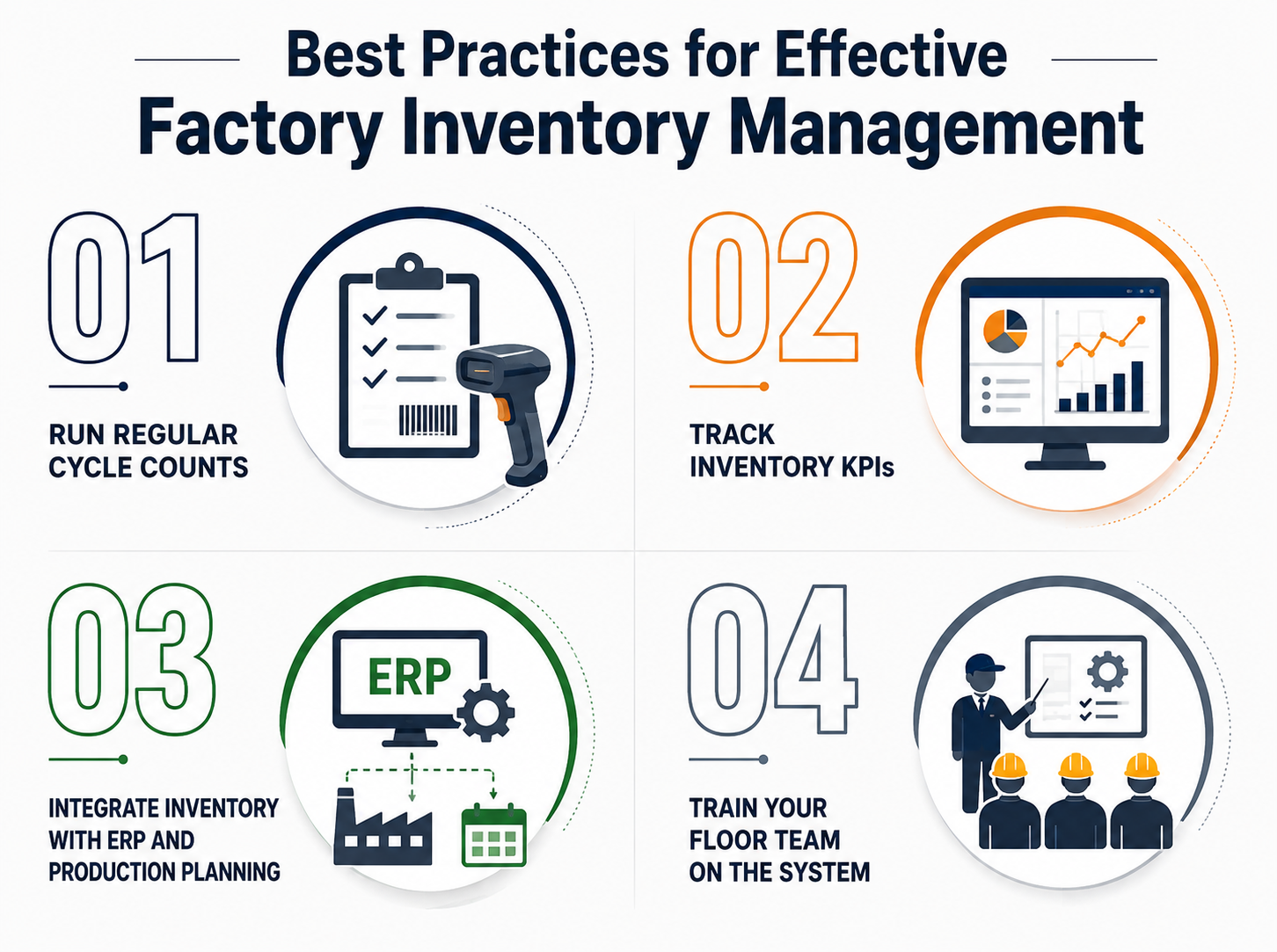
Effective inventory management is not a one-time fix. It depends on routine inventory management processes that keep data accurate, control stock levels, and keep production moving.
Below are the key manufacturing inventory management strategies companies can use to improve efficiency, reduce waste, and keep inventory aligned with real production needs.
1. Run Regular Cycle Counts
Regular cycle counts help manufacturers check inventory accuracy without shutting down operations for a full physical inventory count. Instead of waiting for an annual audit, teams inspect selected items on a set schedule as part of a routine inventory inspection process.
These regular inventory audits help identify mismatched records, missing parts, and data entry issues before they affect production planning or purchasing decisions.
2. Track Inventory KPIs
Inventory KPIs show how well your inventory processes support production and cost control. Key metrics may include:
- Inventory turnover ratio
- Carrying cost
- Order accuracy
- Stockout frequency
- Excess inventory value
Modern inventory software can generate detailed reports on these metrics, helping teams identify weak inventory performance, rising costs, and items that need closer control.
3. Integrate Inventory With ERP and Production Planning
Inventory data should connect with Enterprise Resource Planning (ERP) systems, procurement, maintenance, and production planning. When these systems work together, teams can make decisions based on real-time data instead of outdated spreadsheets or disconnected records.
This helps manufacturers align inventory levels with work orders, supplier lead times, and production schedules.
4. Train Your Floor Team on the System
Even the best inventory management software will fail if teams do not use it correctly. Floor staff, maintenance teams, and warehouse workers need clear training on scanning, stock movement, item labeling, and data entry.
When your team follows the same process, inventory accuracy improves, and managers can trust the data used for planning, purchasing, and daily operations.
How Amplio Supports Factory Inventory Management
- Identify Idle and Surplus Inventory With AI
Amplio’s AI agents connect across ERP systems and analyze inventory data from multiple sites to find idle, underutilized, and excess assets. This helps manufacturers see surplus materials, spare parts, MRO inventory, and equipment before teams place new orders or let valuable stock sit unused.
- Redistribute Available Stock Across Facilities
Amplio helps classify idle, underutilized, and surplus items for internal redeployment when another facility, production line, or maintenance team can use them. This supports better inventory allocation, reduces duplicate purchasing, and helps manufacturers keep usable stock tied to active operational needs.
- Recover Value Through Amplio’s Private Marketplace
When internal redeployment is not viable, Amplio supports asset valuation and listing through its private marketplace. This helps manufacturers recover capital, reduce carrying costs, maintain traceability, and move surplus inventory through vetted industrial resale channels.
Contact Us to optimize your factory inventory, reduce waste, and recover value from surplus.