Industrial Maintenance Management: A Guide to Extending Equipment Lifecycle
Equipment reliability drives productivity in industrial facilities and manufacturing plants. When industrial equipment fails, production slows or stops, leading to unplanned downtime, costly emergency repairs, and rising maintenance costs. In many operations, a single failure can disrupt multiple industrial processes, reduce equipment performance, and lower overall equipment effectiveness across the plant.
Because of this impact, extending equipment lifespan is a priority for organizations that depend on continuous production. Strong maintenance strategies, supported by effective maintenance planning, maintenance scheduling, and modern industrial maintenance technology, help maintenance teams prevent failures before they disrupt operations.
In this guide, you will learn how industrial maintenance management helps reduce downtime, strengthen equipment reliability, and improve the performance of industrial equipment used in daily operations. We will also explore the types of industrial maintenance, the role of maintenance management systems, and strategies that help maintenance teams improve performance while lowering maintenance costs.
What Is Industrial Maintenance Management
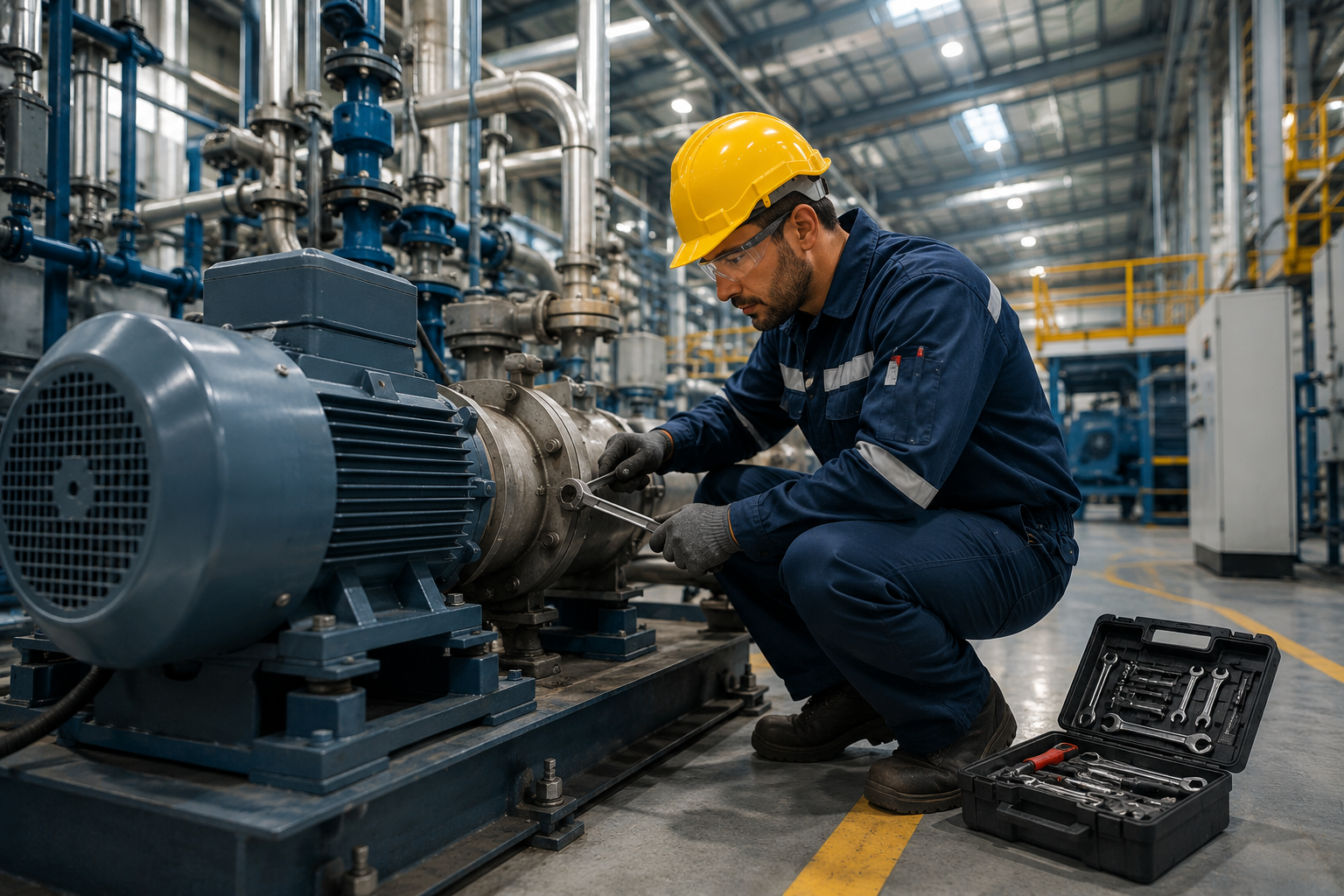
Industrial maintenance management is the process used to plan, organize, and control maintenance activities across industrial operations. It ensures that industrial equipment, machinery, and facility infrastructure operate correctly through inspections, repairs, and routine servicing, allowing production systems to run without unnecessary disruption.
In practice, maintenance management oversees equipment upkeep, schedules repairs, and uses operational data to support informed decisions. A structured industrial maintenance program coordinates daily maintenance tasks, monitors equipment performance, and enables maintenance teams to respond quickly when issues arise. This approach strengthens equipment reliability, stabilizes equipment operation, and reduces the risk of failures that interrupt production.
Core Types of Maintenance Strategies
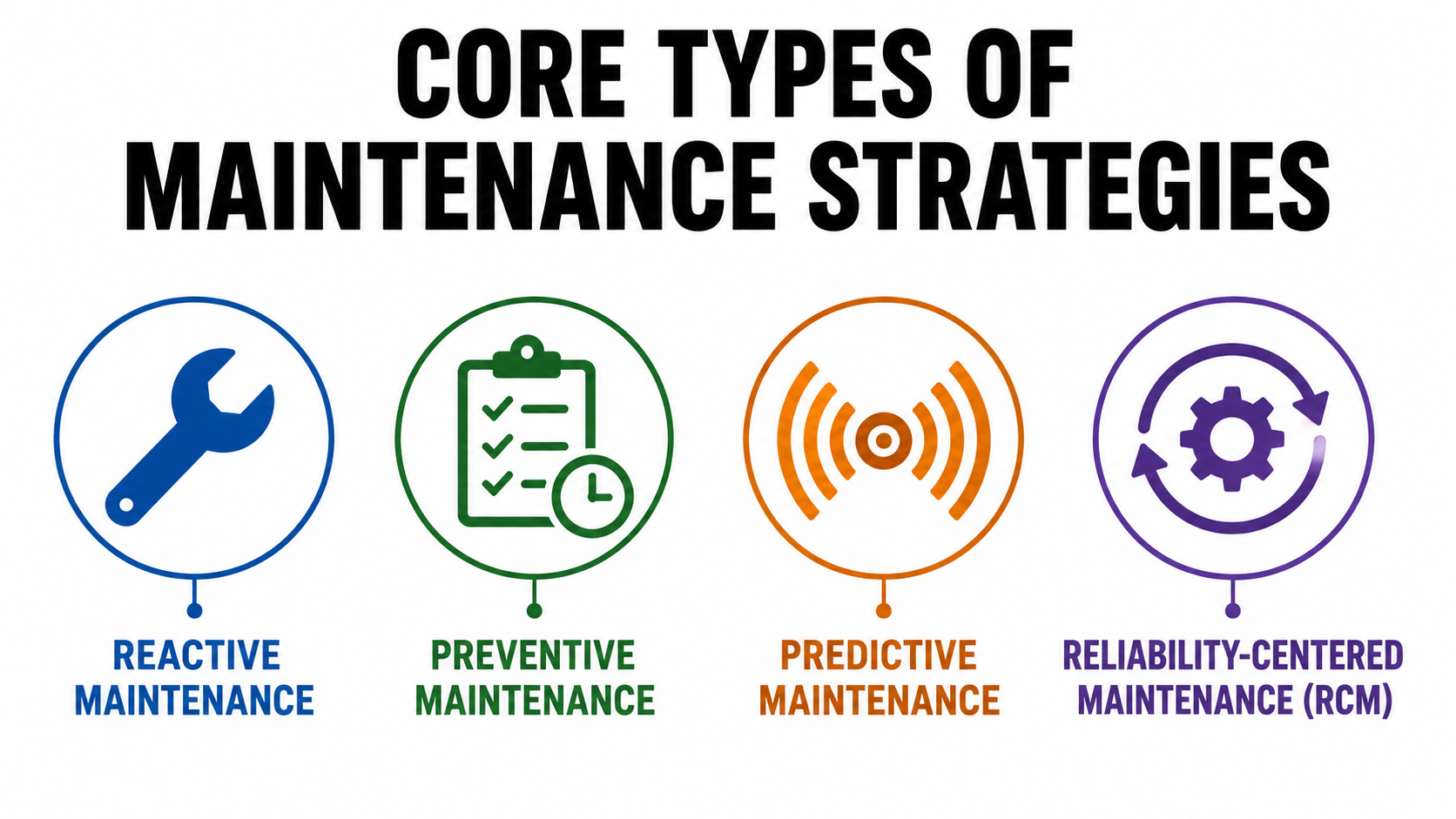
Industrial operations rely on several industrial maintenance strategies because different assets require different approaches to maintenance. Selecting the right strategy helps organizations maintain equipment reliability, support consistent equipment operation, and reduce disruptions to industrial processes.
1. Reactive Maintenance
Reactive maintenance occurs when maintenance teams repair or replace equipment only after it fails. This approach is often used for non-critical equipment where the cost of failure is low, and repairs can be completed quickly.
In some situations, run-to-failure can make sense. Small components such as light fixtures, minor valves, or inexpensive parts may not justify routine inspections or planned maintenance. Allowing these assets to operate until failure can reduce unnecessary maintenance work.
However, reactive maintenance becomes expensive when it involves critical equipment. Unexpected failures often lead to unplanned downtime, emergency repairs, and disruptions to production schedules. Maintenance teams may also face rush parts orders and overtime labor, which quickly increases maintenance costs.
2. Preventive Maintenance
Preventive maintenance focuses on performing planned maintenance at scheduled intervals to reduce the risk of equipment failure. Maintenance teams follow predefined preventive maintenance tasks, checklists, and OEM service intervals to inspect and service equipment through regular maintenance activities before problems develop.
A preventive maintenance program typically includes lubrication, component inspections, calibration checks, and routine replacements. These tasks help maintain stable equipment operation and improve equipment reliability across industrial operations.
However, preventive maintenance can become inefficient if schedules are not aligned with the actual condition of the equipment. Excessive servicing may lead to over-maintenance, unnecessary inspection downtime, and wasted labor. Effective maintenance planning ensures that preventive tasks support equipment reliability without creating additional maintenance work.
3. Predictive Maintenance
Predictive maintenance uses equipment condition data to determine when maintenance should occur. Instead of relying on fixed schedules, maintenance teams monitor equipment signals to detect early signs of failure and plan maintenance work before breakdowns disrupt production.
Common predictive maintenance technologies include vibration monitoring, thermography, ultrasound inspection, and oil analysis. These tools allow maintenance teams to analyze equipment condition and identify developing issues such as bearing wear, misalignment, overheating, or lubrication problems.
Organizations that adopt predictive maintenance often see measurable operational benefits. According to the U.S. Department of Energy’s Federal Energy Management Program, predictive maintenance programs can reduce maintenance costs by 25%–30% and lower unplanned downtime by 35%–45%, demonstrating how condition-based monitoring improves equipment reliability and supports stable industrial operations.
Reliability-Centered Maintenance (RCM)
Reliability-centered maintenance (RCM) is a structured method used to determine the most effective maintenance strategy for each asset. Instead of applying the same approach to all equipment, RCM evaluates failure modes, operational impact, and asset criticality.
Based on this analysis, maintenance teams select the strategy that best supports equipment reliability and operational performance. Some assets may require preventive maintenance, while others benefit from predictive maintenance or controlled run-to-failure. Aligning maintenance strategies with equipment risk helps organizations improve operational efficiency, control maintenance costs, and protect critical production systems.
Core Components of Effective Industrial Maintenance Management
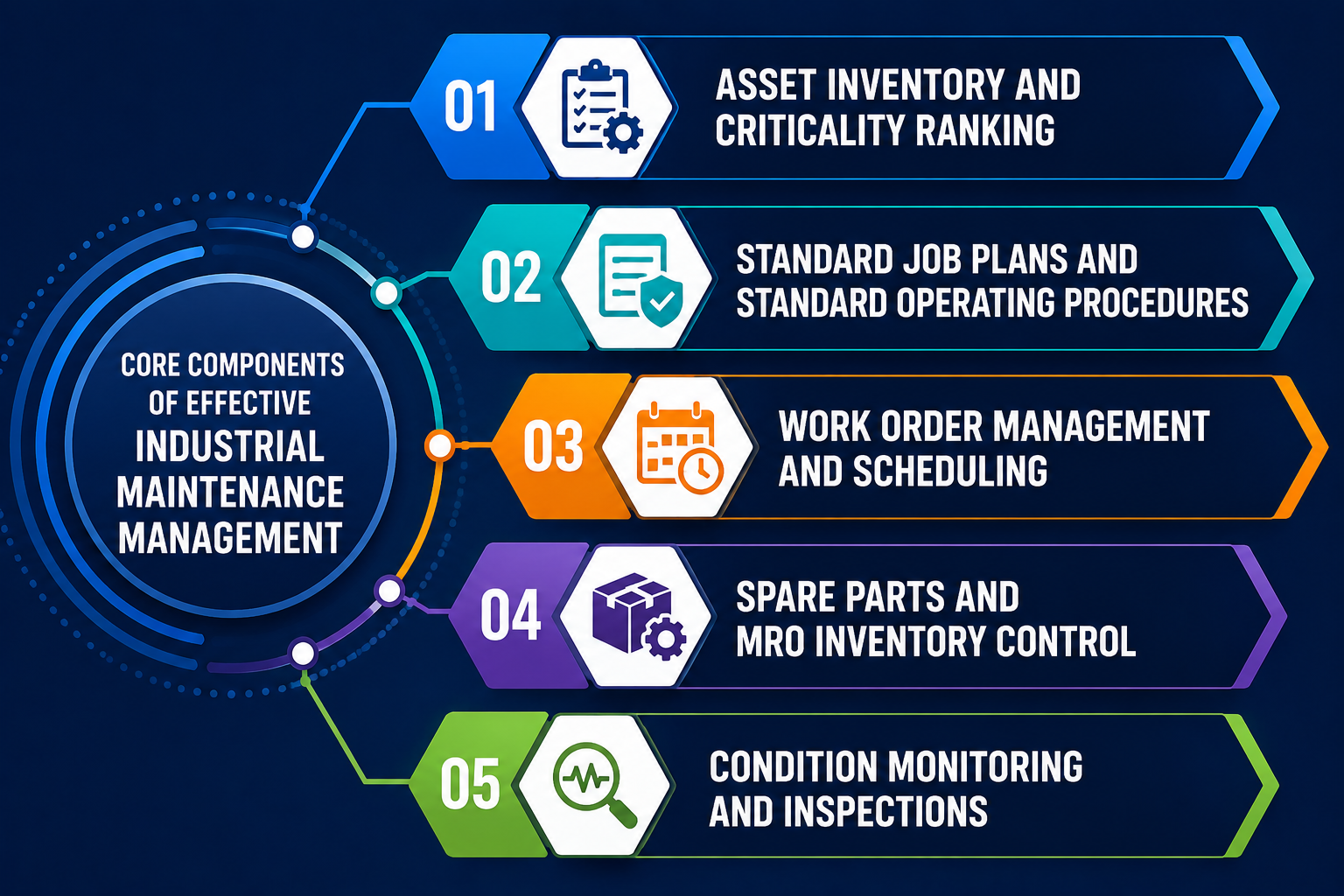
An effective industrial maintenance management program relies on several core components that keep maintenance operations organized and predictable. These elements help maintenance teams manage industrial equipment, prevent equipment failures, and maintain reliable production across industrial facilities.
The following components form the operational foundation of effective maintenance management.
1. Asset Inventory and Criticality Ranking
Effective maintenance management begins with a complete asset inventory of all industrial equipment used in production. Each asset should be documented with key details such as equipment type, location, operating function, and maintenance history. This inventory helps maintenance managers track equipment across the facility and plan maintenance activities more effectively.
After building the inventory, organizations rank assets based on criticality. Critical equipment directly affects production, safety, or regulatory compliance. If these assets fail, they can cause unplanned downtime or major operational disruption. Non-critical assets may still require maintenance, but their failure has a smaller impact on industrial processes.
A simple scoring model can help rank equipment. Maintenance teams often evaluate assets using factors such as production impact, repair cost, safety risk, and downtime consequences. Equipment with the highest combined score becomes a priority for preventive maintenance, predictive maintenance, and closer monitoring.
2. Standard Job Plans and Standard Operating Procedures
Standard job plans and standard operating procedures (SOPs) define how maintenance work should be performed. These documents outline maintenance procedures, including task steps, required tools, torque specifications, and safety precautions.
When maintenance teams follow consistent job plans, they perform maintenance tasks the same way each time. This consistency helps reduce errors, improve repair quality, and maintain safe equipment operation.
Standard work also reduces repeat failures. When technicians follow documented procedures, they are less likely to miss inspection steps, incorrect torque settings, or critical adjustments. Over time, this approach improves equipment reliability and supports more efficient maintenance operations.
3. Work Order Management and Scheduling
Work order management organizes daily maintenance work and ensures that tasks are completed in a controlled manner. Each work order records the maintenance task, equipment involved, required tools, and technician assignments. This system allows maintenance teams to track completed work and maintain accurate maintenance records.
Backlog control is an important part of maintenance management. A maintenance backlog includes all approved work orders that have not yet been completed. Maintenance managers regularly review this backlog to prioritize tasks and prevent important work from being delayed.
Weekly maintenance scheduling helps balance available labor with planned work. For example, maintenance teams may schedule preventive tasks at the start of the week while reserving capacity for unexpected issues. This structure helps maintain steady maintenance operations while reducing disruptions to production.
4. Spare Parts and MRO Inventory Control
Spare parts management is a critical part of MRO inventory management and maintenance planning. Maintenance teams must ensure that the parts required for industrial equipment maintenance are available when needed.
Many organizations manage spare parts using min-max inventory levels, reorder points, and supplier lead times. These controls help prevent stockouts while avoiding excessive inventory that increases storage costs.
A list of critical spares is also important. Some components may have long lead times or play a key role in equipment operation. For example, a production line can remain idle if a small component, such as a seal kit, is unavailable. Maintaining these critical spare parts helps prevent unnecessary unplanned downtime.
5. Condition Monitoring and Inspections
Condition monitoring and routine equipment inspections allow maintenance teams to detect problems before failures occur. These activities support predictive maintenance strategies and improve equipment performance.
Many organizations create inspection routes where technicians regularly collect readings from equipment. These readings may include vibration levels, temperature measurements, lubrication conditions, or other performance indicators.
Maintenance teams then establish threshold values to determine when action is required. Setting proper alarm limits is important. If thresholds are too sensitive, teams receive excessive alerts and lose focus on real issues. Proper calibration helps ensure that condition monitoring systems identify meaningful problems without overwhelming maintenance teams with unnecessary alarms.
Common predictive maintenance technologies include vibration monitoring, thermography, ultrasound insp
Step-by-Step Plan to Improve Equipment Lifecycle
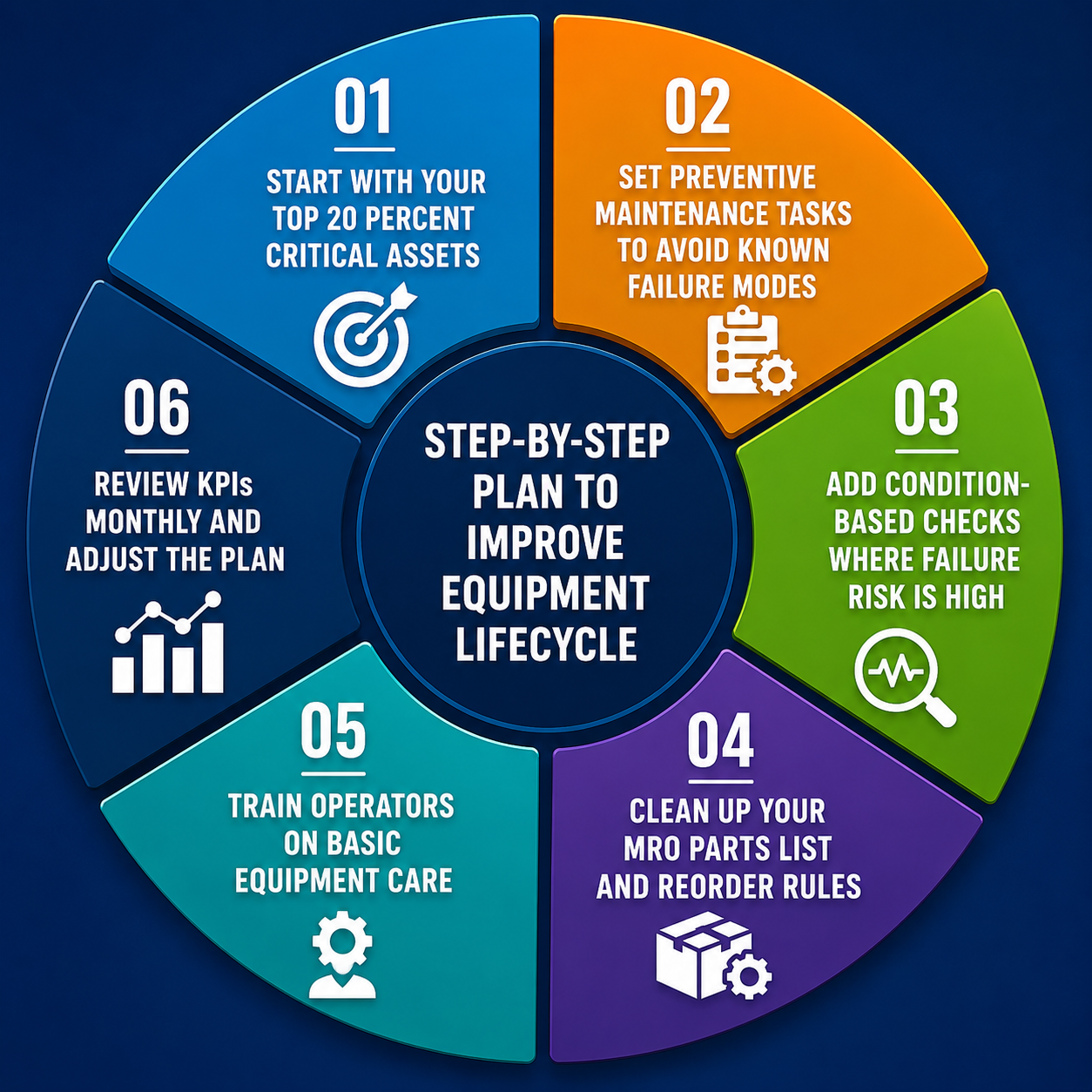
Improving equipment lifespan requires a structured approach to industrial maintenance management. Maintenance teams need to focus on high-risk assets and apply the right maintenance strategies to prevent failures. Following a structured improvement plan helps organizations strengthen equipment reliability, reduce unplanned downtime, and support continuous improvement across maintenance performance.
Step 1: Start with Your Top 20 Percent Critical Assets
Begin by identifying the critical equipment that has the greatest impact on production, safety, or regulatory compliance. In many industrial facilities, a small portion of assets drives most operational risk.
Maintenance managers can rank equipment using a simple scoring approach based on:
- Production impact
- Downtime cost
- Repair complexity
- Safety or regulatory risk
Focusing maintenance planning on the top 20 percent of assets helps maintenance teams prioritize resources and protect the equipment that supports key industrial processes.
Step 2: Set Preventive Maintenance Tasks to Avoid Known Failure Modes
After identifying critical assets, define preventive maintenance tasks that target common failure patterns. Maintenance teams should review past maintenance reports, OEM guidelines, and historical equipment failures.
Typical preventive maintenance tasks include:
- Lubrication and fluid checks
- Alignment inspections
- Calibration verification
- Replacement of wear components
These planned maintenance activities reduce failure risk and support long-term equipment reliability.
Step 3: Add Condition-Based Checks Where Failure Risk Is High
For equipment with a higher failure risk, maintenance teams should introduce condition-based maintenance checks. These inspections monitor equipment health and help identify problems before they lead to breakdowns.
Common predictive maintenance technologies include:
- Vibration monitoring
- Thermography inspections
- Ultrasound testing
- Oil condition analysis
These tools help maintenance teams analyze data from operating equipment and detect early warning signs such as bearing wear, imbalance, or overheating.
Step 4: Clean Up Your MRO Parts List and Reorder Rules
Reliable MRO inventory management supports effective industrial equipment maintenance. Maintenance teams should review spare parts inventories and remove obsolete or rarely used components.
Important controls include:
- Clear min-max inventory levels
- Defined reorder points
- Supplier lead time tracking
- A documented critical spares list
For example, a production line may remain idle if a small component, such as a seal kit, is unavailable. Maintaining these parts helps prevent unnecessary unplanned downtime.
Step 5: Train Operators on Basic Equipment Care
Operators interact with equipment daily, making them a key part of effective maintenance practices. Training operators to perform basic maintenance tasks allows small issues to be detected early.
Operators can support equipment reliability by performing:
- Visual inspections for leaks or damage
- Cleaning equipment surfaces and work areas
- Monitoring abnormal noise or vibration
- Reporting unusual operating conditions
This approach supports autonomous maintenance, where operators help maintain equipment health while maintenance teams focus on specialized repairs.
Step 6: Review KPIs Monthly and Adjust the Plan
Maintenance improvement requires continuous monitoring. Maintenance managers should review key maintenance KPIs regularly to evaluate the effectiveness of their maintenance strategies.
Important metrics include:
- Mean Time Between Failures
- Mean Time To Repair
- Planned Maintenance Percentage
- Overall Equipment Effectiveness
Reviewing these metrics each month helps maintenance teams adjust maintenance planning, refine preventive tasks, and optimize maintenance schedules based on performance data.
Technologies Used in Modern Industrial Maintenance
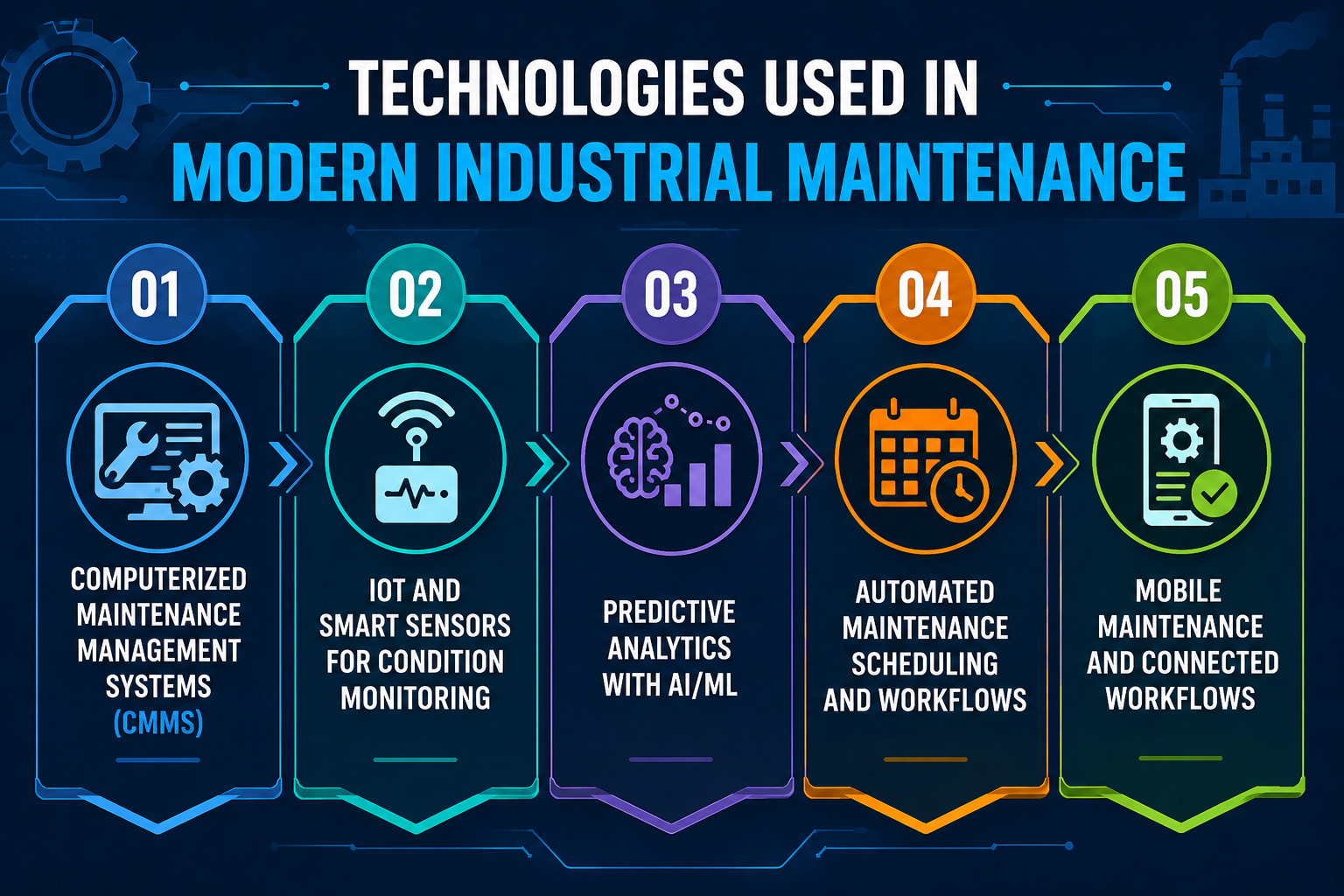
Modern industrial maintenance uses connected tools to track equipment performance, manage maintenance work, and reduce costs linked to equipment failures and emergency repairs. These technologies support stronger maintenance planning and more reliable equipment operation.
1. Computerized Maintenance Management Systems (CMMS)
A Computerized Maintenance Management System helps organizations manage maintenance operations and track all maintenance activities in one system. It allows maintenance teams to organize work orders, maintain equipment history, and schedule preventive maintenance tasks.
Maintenance managers use maintenance management software to:
- Track maintenance tasks and completed work
- Store asset records for industrial equipment
- Manage maintenance scheduling
- Monitor maintenance KPIs such as MTBF and MTTR
By centralizing maintenance data, a CMMS improves coordination between maintenance technicians, planners, and supervisors. It also helps organizations analyze equipment failures and improve long-term maintenance management decisions.
2. IoT and Smart Sensors for Condition Monitoring
IoT sensors allow maintenance teams to monitor equipment condition while machines are operating. These sensors collect data such as vibration levels, temperature, pressure, and runtime hours from industrial equipment.
This data supports condition-based maintenance, where maintenance teams act based on the actual health of equipment rather than fixed service schedules. Sensors installed on critical equipment can detect early signs of wear, overheating, or abnormal vibration.
Early detection allows maintenance teams to address issues before they cause equipment failures. This approach strengthens equipment reliability and supports more effective predictive maintenance strategies.
3. Predictive Analytics with AI/ML
Predictive analytics uses historical maintenance records and equipment condition data to identify patterns that indicate future failures. Advanced models built with artificial intelligence (AI) and machine learning (ML) analyze sensor data, operating conditions, and maintenance history.
These systems help maintenance teams:
- Identify early failure patterns
- Prioritize maintenance for critical equipment
- Detect abnormal equipment behavior
Predictive insights allow maintenance teams to focus resources on assets with the highest failure risk. This supports proactive maintenance strategies, improves equipment effectiveness, and reduces unexpected downtime.
4. Automated Maintenance Scheduling and Workflows
Modern maintenance platforms can automate parts of the maintenance planning process. Instead of manually assigning tasks, systems can generate work orders automatically based on equipment runtime, inspection results, or sensor alerts.
Automated workflows help organizations:
- Maintain consistent maintenance scheduling
- Ensure preventive maintenance tasks are completed on time
- Reduce reliance on reactive maintenance
This structure improves coordination between maintenance teams and production staff while maintaining stable equipment operation.
5. Mobile Maintenance and Connected Workflows
Mobile maintenance tools allow industrial maintenance workers and technicians to access maintenance information directly on the production floor. Technicians can view work orders, record inspection readings, and update maintenance reports using mobile devices.
Connected workflows allow industrial maintenance mechanics, maintenance planners, and supervisors to share maintenance data instantly. Instead of waiting for paper reports, teams can track maintenance work in real time.
This improves communication across the industrial maintenance team, speeds up troubleshooting, and ensures that maintenance records remain accurate. Over time, better data collection helps organizations optimize maintenance processes and improve equipment reliability.
How Amplio Supports Industrial Maintenance Management
Managing industrial assets efficiently plays an important role in maintaining equipment reliability and controlling maintenance costs. Amplio helps organizations support industrial maintenance management by improving visibility and control of surplus equipment and idle assets across industrial facilities.
Optimizing Asset Utilization
Identify idle or underused equipment across facilities so maintenance teams can clear space, improve equipment access, and reduce operational clutter.
Maximizing Value Recovery
Amplio’s AI-powered appraisal helps companies evaluate surplus assets and determine whether they should be redeployed, sold, or removed, supporting more efficient asset management decisions.
Reducing Operational Overhead
Amplio manages logistics, surplus handling, and reporting so maintenance teams can focus on preventive maintenance, predictive maintenance, and critical equipment repairs.
Contact us now to turn surplus equipment and excess inventory into recovered value, free up space in your industrial facilities, and support stronger industrial maintenance management.