Heavy Equipment Asset Recovery: Why It Matters and the Best Channels to Use
Introduction
Across industries, companies hold millions of dollars in idle heavy equipment, such as turbines, excavators, compressors, and full plant systems.
When this equipment sits unused, it continues to lose value through depreciation and storage costs. In fact, construction equipment can lose 20–30% of its value within the first year, which makes delayed recovery decisions even more costly.
A structured heavy equipment asset recovery strategy turns idle or non-performing high-value assets into measurable returns. It helps reduce rushed disposition decisions, recover capital, cut waste, and improve overall operational efficiency.
In this blog, you will learn why heavy equipment asset recovery matters and explore the best channels companies can use to recover more value from surplus machinery.
What is Heavy Equipment Asset Recovery
Heavy equipment asset recovery is the process of identifying idle, decommissioned, retired, or repossessed machinery and recovering as much value from it as possible. It is a practical way to reduce losses and regain value from equipment that no longer supports active operations.
Why Heavy Equipment Asset Recovery Matters

Heavy equipment asset recovery delivers value across several business areas:
1. Financial Impact
Idle heavy equipment ties up capital while continuing to lose value. Depreciation, storage, insurance, and maintenance costs can keep building even when the equipment no longer supports active operations, putting added pressure on operating budgets.
Heavy equipment asset recovery helps companies support investment recovery by capturing value from underused assets before losses grow further. It can improve cash flow, reduce carrying costs, and help businesses get more value from equipment that no longer supports operational priorities.
2. Operational Efficiency
Unused machinery takes up space that active operations may need. It can crowd yards, limit access, and complicate movement across sites, especially in tight spaces where equipment handling becomes more difficult.
Removing or reallocating idle machinery helps companies reduce clutter and improve workflow. It also allows teams to focus on productive assets instead of spending time and resources on equipment that no longer supports the business.
3. ESG & Sustainability Goals
Heavy equipment asset recovery can support more responsible asset management. Reusing or repurposing existing machinery helps companies reduce waste and lower the need for premature replacement.
It also supports circular economy goals by keeping equipment in use longer and reducing unnecessary disposal. For companies with Environmental, Social, and Governance (ESG) priorities, this creates a more disciplined approach to managing idle or underused assets.
4. Risk Reduction and Compliance
Idle heavy equipment can create operational and compliance risks. Equipment left in unsuitable locations can affect site safety, block access, and complicate removal planning. In some cases, poor records or delayed action can also create documentation and accountability issues.
A structured recovery strategy helps companies maintain better control over equipment condition, asset records, and disposition planning. That reduces the risk of rushed decisions, avoidable losses, and compliance gaps.
5. Better Capital Planning
Heavy equipment asset recovery also improves capital planning. When companies identify which assets are no longer needed, they gain better asset visibility and a clearer view of where capital is tied up and how it can be used more effectively.
That visibility supports better decisions about replacement timing, fleet management, and future equipment investments. Instead of letting value sit idle, companies can direct recovered capital toward higher-priority operational needs.
The Best Channels for Heavy Equipment Asset Recovery
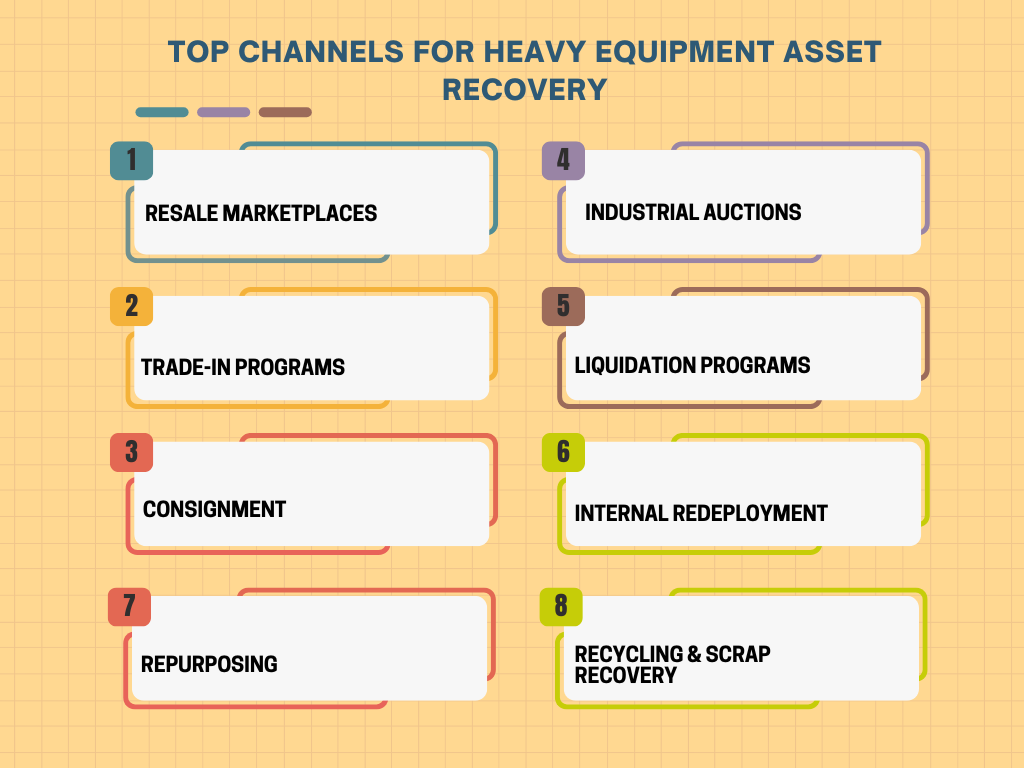
Below are the most effective channels for recovering value from idle or surplus heavy equipment.
1. Resale Marketplaces
Resale marketplaces provide a route for companies to recover value from surplus or decommissioned heavy equipment. By connecting sellers to a wide pool of buyers, these platforms help assets find fair market value based on real demand.
They are often a strong option when:
- The equipment is still in working condition
- Buyer demand is active
- The company wants more pricing control
- The sales timeline is flexible
Results can vary across platforms, as pricing and transparency often depend on how structured and trusted the marketplace is.
2. Industrial Auction
Industrial auctions offer a fast, structured way to liquidate surplus heavy machinery when time is a priority. Assets are listed for public or private bidding, allowing buyers to compete and helping establish market-driven pricing.
This channel works well when:
- The company needs a faster recovery timeline
- Multiple assets need to be sold at once
- Plant closures or fleet reductions are underway
- Broad buyer exposure is important
Auctions can streamline the selling process and reduce holding time, which may help companies convert assets into cash more quickly than slower sale channels.
Note: Auctions typically don’t yield the highest returns, as a portion of the proceeds goes to the auction house managing the process. However, they can be a practical strategy for selling large volumes of mixed-value equipment efficiently.
3. Trade-in Programs
For companies upgrading fleets or replacing outdated machinery, trade-in programs offer a simple and efficient recovery option. Instead of listing equipment for resale, companies exchange older assets for credit toward newer models from OEMs (Original Equipment Manufacturers) or authorized dealers.
This approach works best when:
- Administrative simplicity is a priority
- Storage space needs to be cleared quickly
- Equipment replacement is already planned
- Operational continuity matters more than maximizing sale value
The trade-in value is often lower than what open-market resale might bring, making it better suited for businesses that prioritize convenience and speed over maximum financial recovery.
4. Liquidation Programs
When companies need to clear multiple assets quickly during plant shutdowns or surplus reduction efforts, liquidation programs provide a structured and coordinated way to recover value. These programs often bring valuation, cataloging, transportation, and sales execution into a single, coordinated workflow that supports better control across the entire process.
This channel works well when:
- Multiple assets need to be cleared on a defined timeline
- Plant shutdowns or site consolidations are underway
- Internal teams do not have the time or capacity to manage the process
- Documentation and execution need to be handled in an organized way
Companies often rely on trusted partners in these situations to help manage the disposition process.
Liquidation programs are often best suited to large-scale recoveries where speed, process visibility, and execution matter alongside financial return.
5. Consignment
For companies seeking a flexible recovery option, consignment allows them to sell heavy equipment while maintaining ownership until a buyer is found.
This channel is a strong fit when:
- The equipment is high-value or specialized
- The company is not under immediate pressure to convert assets into cash
- Stronger recovery matters more than speed
- Outside sales support is needed without an immediate transfer of ownership
Consignment supports better returns than quick liquidation because equipment is marketed more deliberately to the right audience.
However, it typically takes longer to convert assets into cash since sales depend on market demand and timing.
6. Internal Redeployment
Internal redeployment is a practical and often overlooked asset recovery method. It involves transferring unused equipment from one facility to another where it’s still needed, keeping the asset productive without additional capital expense.
This approach is most effective when:
- Equipment is no longer needed at one site, but is still useful at another
- The company wants to avoid unnecessary new purchases
- Lead times for replacement equipment are a concern
- Keeping assets within the business supports operational priorities
By using what already exists, businesses can recover value indirectly through cost savings rather than resale revenue, while keeping recovered assets productive inside the business.
However, without centralized inventory visibility or coordination between sites, potential redeployment opportunities can be easily missed, limiting the overall recovery impact.
7. Repurposing
Not every piece of heavy equipment needs to be sold to deliver value. In many cases, machinery can be repurposed — adapted for a different function or integrated into a new process. For example, an outdated generator can serve as a training unit, or an unused pump can be modified for backup operations.
This recovery path is most useful when:
- The equipment still has functional value, but limited resale appeal
- Internal teams can adapt it for another operational use
- Delaying a new purchase has practical value
- Reuse within the business is more realistic than sale or redeployment
Repurposing helps companies stretch the lifespan of their assets, delay new purchases, and reduce waste.
It also supports innovation within maintenance or R&D teams that can creatively reapply existing equipment to meet evolving needs.
Note: Repurposing is not the most profitable recovery method, but it becomes viable when other channels — such as resale, liquidation, and redeployment— are not feasible. It ensures equipment continues to add value internally instead of sitting unused.
8. Recycling & Scrap Recovery
For heavy equipment that’s beyond repair or resale, recycling and scrap recovery provide a compliant and environmentally responsible way to extract remaining value.
This option makes sense when:
- The equipment is no longer operational
- Repair is not economically justified
- Resale demand is no longer realistic
- Materials or components still have residual value
Certified recyclers process metals, electronics, and other recoverable materials, ensuring they re-enter production streams rather than ending up as waste.
This channel supports sustainability and regulatory compliance while returning some residual value from non-operational assets.
However, the financial recovery is typically limited compared to resale or liquidation, making it a suitable option only when other recovery methods are no longer viable.
How Amplio Streamlines Heavy Equipment Asset Recovery
Trusted Private Marketplace
Amplio connects sellers directly with a vetted network of industrial buyers. Each transaction takes place in a controlled, verified environment, ensuring fair pricing, fast turnaround, and secure payment release once assets are received.
AI-driven Redeployment Opportunities
Amplio’s AI-powered agents scan enterprise inventories to identify where idle or underused machinery can be redeployed across facilities. By analyzing equipment compatibility and operational needs, the system helps companies reduce new capital spending, cut procurement time, and keep valuable assets productive instead of sitting idle.
Expert Appraisal Team
Amplio’s dedicated expert appraisal team combines market data, industrial machinery expertise, and AI-driven analysis to provide accurate asset valuations. Each item is reviewed to determine its true market potential and the best recovery route, supported by comprehensive reports that give sellers clearer documentation for decision-making.
If you are looking to recover more value from idle or surplus machinery, our heavy equipment asset recovery services can help you put underused equipment back to work or move it toward a more profitable disposition.