Decommissioning Costs: What’s Included and How to Reduce Them
Introduction
when retiring aging machinery, production lines, or entire sites. It involves specialized labor, equipment removal, waste handling, and strict compliance with environmental and safety regulations, making it far more complex and costly than a standard shutdown.
When decommissioning is unplanned or poorly scoped, expenses can escalate quickly. Hidden hazards, inaccurate asset data, unclear responsibilities, and inefficient logistics often lead to cost overruns, extended downtime, and regulatory risks. A clear understanding of what decommissioning costs include and the strategies that reduce them helps industrials avoid these pitfalls and manage projects more efficiently.
In this article, we will explore what decommissioning cost is, the major cost components involved in industrial decommissioning, and the most effective methods to reduce them.
What Are Decommissioning Costs?
Decommissioning costs are the total expenses required to safely retire, remove, and dispose of industrial equipment, production lines, or entire facilities when they reach the end of their useful life or during a factory liquidation.
What Decommissioning Costs Typically Include
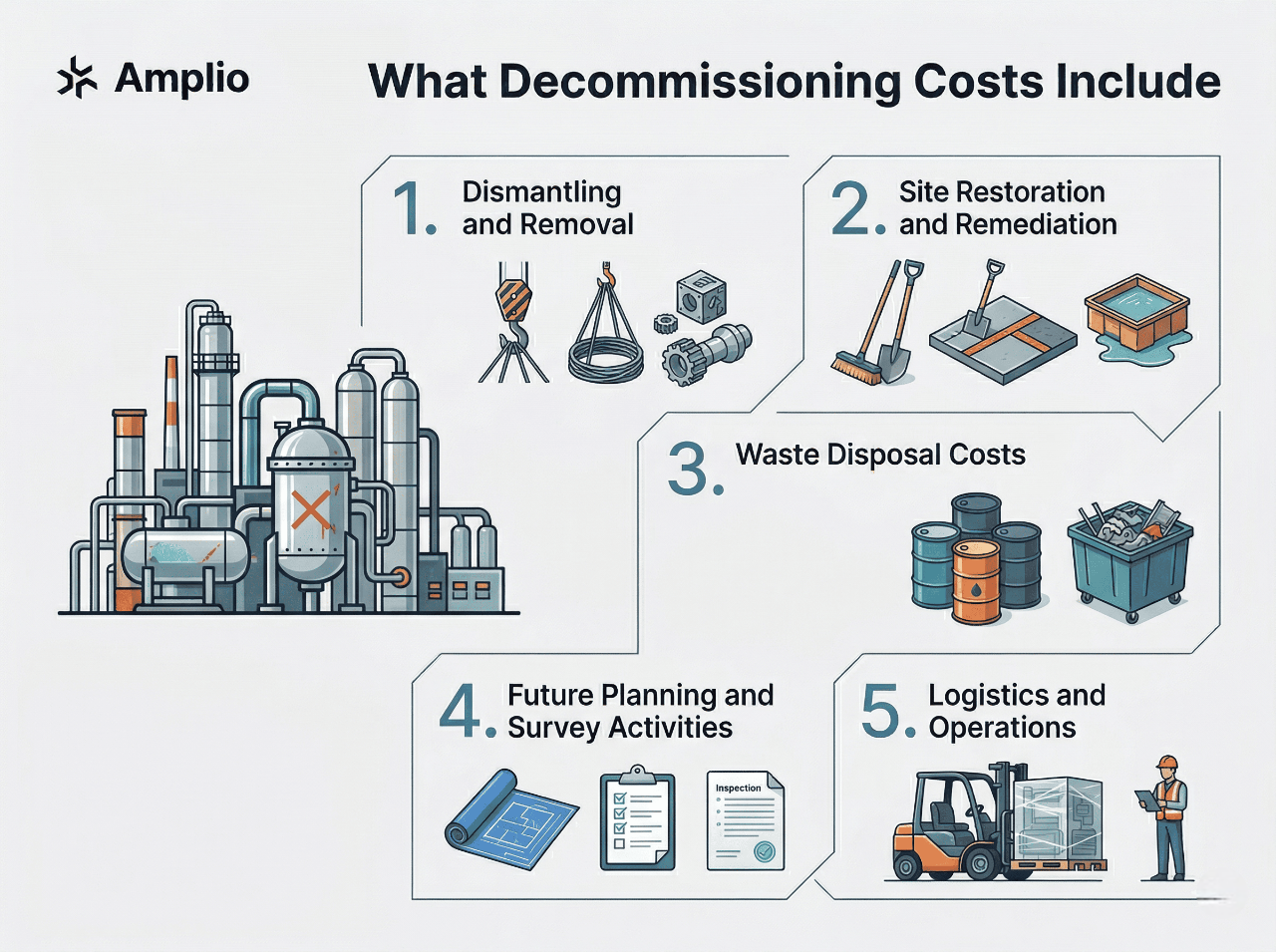
These are the core cost components that industrials typically incur when disposing of equipment, production lines, or entire facilities.
1. Dismantling and Removal
This is a major component that holds a significant portion of total decommissioning costs. Dismantling and removal refer to the expenses involved in physically taking apart machinery, structural elements, or process equipment and safely removing them from the site.
These costs include labor for disassembly, rigging and cutting work, crane or lift rentals, and the transportation of extracted components out of the facility. Because the work requires specialized crews and heavy lifting equipment, it often represents one of the largest line items in a decommissioning project.
2. Site Restoration and Remediation
This is a major component that also contributes significantly to overall decommissioning costs. Site restoration and remediation involve the expenses required to clean, repair, and restore the area after equipment or structures have been removed.
These costs typically include hazardous waste handling, spill cleanup, soil or floor remediation, and any corrective work needed to meet environmental standards set by regulatory bodies.
Because compliance and environmental safety are tightly regulated in industrial settings, restoration often becomes one of the most tightly scrutinized and costly parts of the decommissioning process.
3. Waste Disposal Costs
Disposal costs cover the expenses of getting rid of materials that cannot be reused or recycled. This includes paying certified disposal partners, covering landfill or tipping fees, and managing any restricted materials that require special treatment.
Since these items must be handled according to strict environmental rules, disposal becomes one of the more unavoidable and costly parts of the process.
4. Future Planning and Survey Activities
Planning- and survey-related expenses also make up a meaningful part of decommissioning spend. These costs come from the professional services needed before and after equipment removal, such as engineering assessments, structural studies, environmental surveys, compliance reviews, and final verification reports.
Because these evaluations guide the entire project and confirm regulatory closure, they carry their own dedicated cost within the overall budget.
5. Logistics and Operations
Logistics and operational activities often account for a substantial share of decommissioning costs. This category covers the practical expenses required to carry out the work, including transportation, heavy equipment usage, packaging materials, and specialized labor.
It also includes the coordination efforts needed across multiple contractors and vendors to keep the project running smoothly. Since these elements support the physical execution of decommissioning, they frequently represent one of the more variable and project-specific cost areas.
How to Reduce Decommissioning Costs

The following are the major methods industrials can use to meaningfully reduce decommissioning costs while maintaining safety and compliance.
1. Verified Decommissioning Vendors
Partnering with verified and certified decommissioning vendors helps avoid many of the hidden costs that can inflate a project’s budget. Experienced providers follow established safety, environmental, and compliance standards, reducing the risk of rework, site incidents, or regulatory penalties.
Their expertise ensures that dismantling, waste handling, and documentation are completed correctly the first time, preventing costly delays or corrective actions.
Reliable vendors also deliver more accurate pricing and predictable outcomes, making them a critical factor in controlling overall decommissioning spend.
2. Project Bundling Efficiency
Bundling multiple decommissioning tasks into a single coordinated project can significantly reduce overall costs.
When jobs are grouped, companies cut down on repeated mobilization fees, minimize the number of crane or equipment rentals, and negotiate better pricing from contractors handling multiple assignments at once.
This approach also streamlines scheduling and resource use, reducing idle time and improving efficiency across the entire decommissioning scope.
For multi-site or multi-asset projects, bundling often delivers some of the strongest cost savings.
3. Hazardous Waste Reduction
Reducing the volume of hazardous waste is a highly effective way to lower decommissioning costs, since hazardous disposal carries the highest fees.
By properly segregating oils, chemicals, batteries, contaminated components, and other regulated materials from general scrap, companies can shift most waste into lower-cost recycling or disposal streams.
This targeted separation reduces the amount of material classified as hazardous, cutting treatment charges and transport rates.
4. Competitive Vendor Bidding
Using transparent and competitive bidding for decommissioning work helps drive down overall project costs.
When multiple qualified vendors compete for the same scope, companies gain access to better pricing on labor, haulage, equipment rentals, and specialized services.
This approach also improves cost clarity by revealing market rates and reducing the likelihood of inflated or inconsistent charges.
Competitive sourcing ensures that industrials select vendors who offer both value and capability, ultimately lowering the financial burden of decommissioning.
5. Redeployment
Redeploying equipment within the organization is not a common way, but it can be a useful way to reduce decommissioning costs when assets still have usable life remaining.
Instead of paying for disposal, companies can move functional machinery, tools, or components to other plants or production lines where they are still needed.
This eliminates disposal fees, reduces new equipment purchases, and makes better use of existing capital.
Note: Redeployment is especially effective for companies with multiple facilities or diverse operations, as it keeps valuable assets in circulation rather than sending them to waste streams.
6. Working With Asset Recovery Specialists
Partnering with asset value recovery specialists can significantly reduce the cost and complexity of decommissioning industrial equipment. These specialists act as an extension of your disposition team, helping you identify which assets still hold value in the secondary market.
Before any removal begins, they assess the operational and resale potential of the equipment scheduled for disposition. If the machinery or parts have viable secondary market value, recovery specialists connect with their network of vetted industrial buyers who are often willing to cover decommissioning and removal as part of the purchase in most cases.
However, these savings are only possible when the assets being decommissioned retain functionality, demand, or reusable value within the secondary market. In such cases, working with experienced asset recovery specialists turns what would have been a cost center into a savings opportunity.
How Amplio Helps You Reduce Decommissioning Costs Through Asset Recovery
Amplio helps companies cut decommissioning expenses by identifying equipment that still holds resale value and routing it to verified industrial buyers. Its AI-driven appraisal and private marketplace enable fast and accurate valuation, ensuring every recoverable asset is monetized before removal begins.
When buyers purchase the equipment, they typically cover rigging, removal, or transport costs as part of the transaction. This offsets — and often eliminates — the decommissioning spend that companies would otherwise absorb.
Our plant liquidation services extend this asset recovery approach across the plant, helping manage asset disposition as part of the overall decommissioning process.
Contact us today to learn how Amplio can improve your asset liquidation results and reduce the decommissioning costs tied to equipment removal and disposition.