What is Capital Equipment and How To Manage It
Introduction
Capital equipment represents some of the most significant investments an organization makes. These assets sit at the center of daily operations, influencing how efficiently products are made, services are delivered, and facilities function over time. When capital equipment performs as intended, it enables stable production, predictable costs, and operational continuity. When it does not, the impact is often felt across the entire business.
Because of its high cost and long service life, capital equipment requires deliberate planning and ongoing oversight.
This article breaks down what capital equipment is, how it is classified, and how it should be managed across its entire lifecycle to ensure long-term operational and financial value.
What Is Capital Equipment?
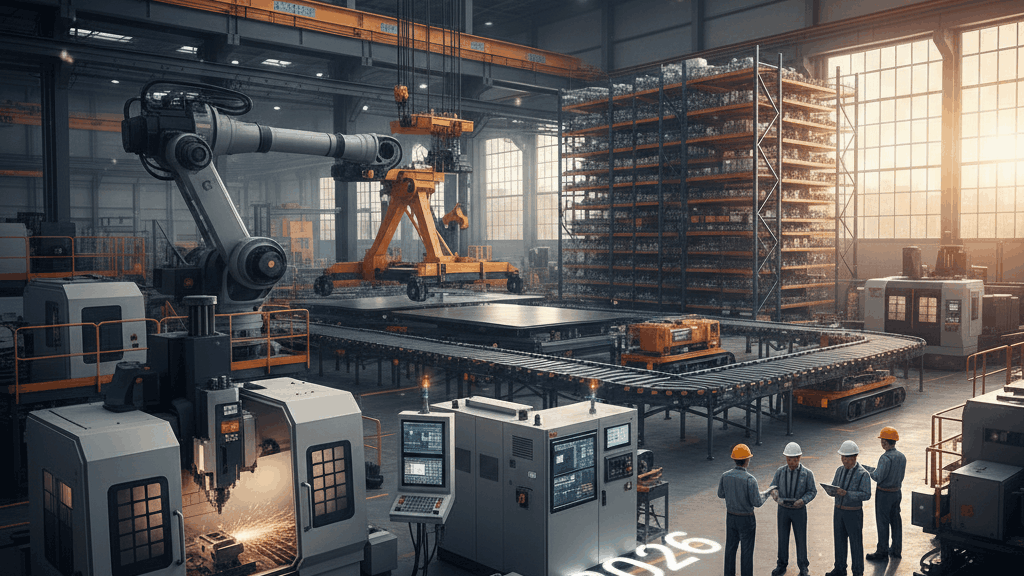
Capital equipment refers to long-term, high-value capital capital-intensive physical assets that a business uses to produce goods, support operations, or deliver services. These assets are purchased for ongoing operational use, and they remain in service over multiple years as part of the company’s productive capacity.
Unlike inventory or consumables, capital equipment is intended to enable work, not to be sold or quickly replaced. It is typically recorded on the balance sheet and managed over a defined useful life.
Core Characteristics of Capital Equipment
- Long Useful Life
Capital equipment is designed to operate over many years, often spanning multiple production cycles or business phases.
- High Capital Value
These assets require significant upfront investment and represent a meaningful portion of an organization’s capital expenditure.
- Operational Use
Capital equipment is essential to daily operations, directly or indirectly supporting production, logistics, utilities, or facility functions.
Classification of Capital Equipment
.png)
Capital equipment can be classified in multiple ways, but this article uses a functional classification based on how each type of equipment supports operations and contributes to production, infrastructure, and overall facility performance.
1. Production Equipment
Production equipment includes machinery that is directly used in manufacturing or processing operations. These assets perform the core activities that convert raw materials or components into finished products.
Because production equipment drives output, quality, and efficiency, it is often the most critical and highest-value category of capital equipment. Examples include CNC machines, presses, molding machines, and assembly lines.
2. Material Handling Equipment
Material handling capital equipment includes heavy equipment used to move, store, and transport materials within a facility. These assets support the flow of raw materials, work-in-progress, and finished goods between production, storage, and shipping areas.
Examples include forklifts, conveyors, pallet systems, and automated storage and retrieval systems (AS/RS). Efficient management of material handling equipment helps reduce bottlenecks, improve safety, and support smooth operations across the facility.
3. Utility and Infrastructure Equipment
Utility and infrastructure equipment supports plant operations by providing power, climate control, water, and compressed air. These assets do not produce goods directly but are essential for keeping facilities operational.
Common examples include HVAC systems, boilers, chillers, compressors, and generators.
4. Automation and Control Equipment
Automation and control equipment are used to monitor, regulate, and automate industrial processes, helping improve accuracy, consistency, and operational efficiency. These systems coordinate how equipment operates and how data is collected across the facility.
Common examples include PLC systems, SCADA systems, sensors, and control panels, which enable real-time monitoring and process control.
5. Quality, Testing, and Inspection Equipment
Quality, testing, and inspection equipment is used to verify that products and processes meet required quality, safety, and regulatory standards. These assets help detect defects, ensure consistency, and support compliance throughout the production process.
Common examples include vision inspection systems, coordinate measuring machines (CMMs), material testing machines, gauges, sensors, and calibration and measurement equipment.
6. Maintenance, Safety, and Support Equipment
Maintenance, safety, and support equipment play an essential role in keeping operations safe, reliable, and efficient. These assets support routine upkeep, emergency repairs, and worker protection across the facility.
This category typically includes industrial MRO equipment, such as tools and systems used for maintenance, repair, and ongoing operational support. Common examples include maintenance tools, lifting and hoisting equipment, safety systems, fire protection equipment, and environmental protection systems.
Capital Equipment Management Cycle
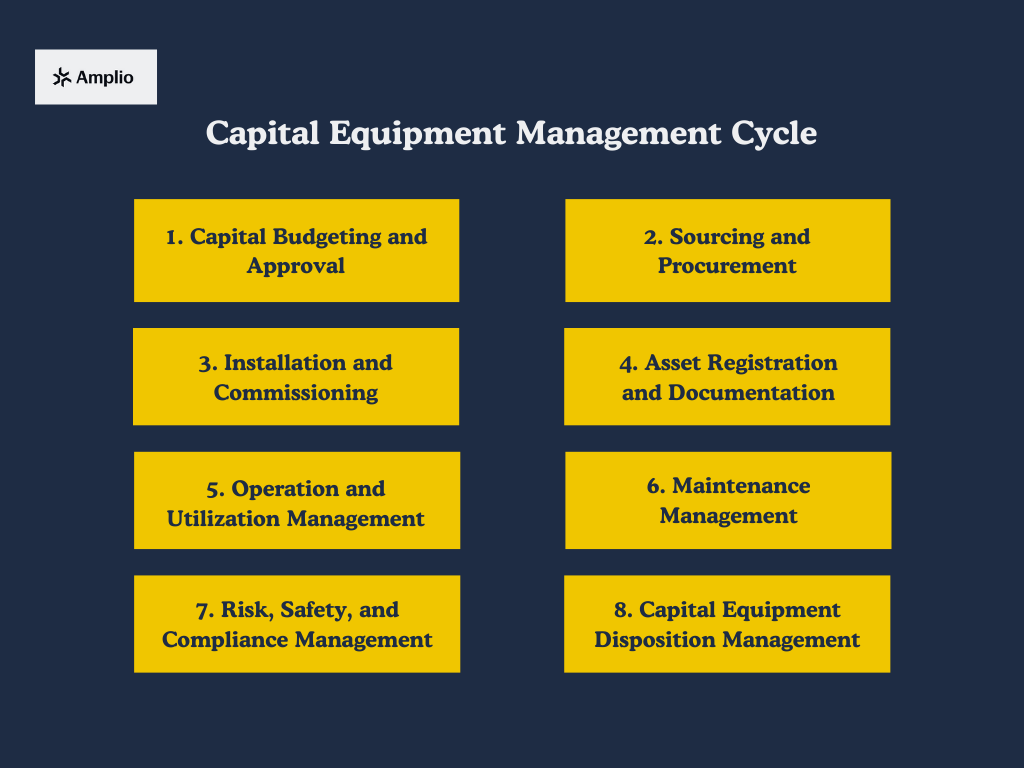
Here are the key lifecycle stages involved in managing capital equipment effectively, from sourcing and procurement through to disposition.
1. Capital Budgeting and Approval
Capital budgeting and approval ensure that equipment investments are financially sound and aligned with business priorities. This stage helps organizations avoid overspending, underestimating long-term costs, or investing in assets that fail to deliver expected value.
To evaluate capital equipment investments effectively, the following factors should be considered:
a. Cost Estimation
Assessing the full upfront cost, including purchase price, installation, integration, and commissioning expenses.
b. Total Cost of Ownership (TCO)
Accounting for ongoing costs such as energy consumption, maintenance, downtime, and long-term operating expenses.
c. ROI and Payback Analysis
Measuring expected productivity improvements, cost savings, and the time required to recover the initial investment.
2. Sourcing and Procurement
Sourcing and procurement translate planning and budgeting decisions into binding commitments. They set the foundation for how well capital equipment will perform over its entire lifecycle. Decisions made at this stage influence cost, reliability, flexibility, and long-term value, making it critical to approach procurement with a clear understanding of operational needs and financial constraints.
To make informed sourcing decisions, organizations should focus on the following key areas:
a. Requirement Identification
Start by defining production capacity requirements, technical specifications, and operational constraints to ensure the capital equipment fits current and future needs.
b. Supplier Evaluation
Evaluate OEMs and secondary-market suppliers based on equipment quality, lead times, service capability, and long-term support.
c. Buy, Lease, or Source Used
Determine whether purchasing new, leasing, or sourcing used equipment is the best option based on cost, expected usage period, and capital availability.
d. Equipment Selection
Choosing new, used, or refurbished equipment based on reliability, availability, and operational suitability.
3. Installation and Commissioning
Installation and commissioning are critical to ensuring that capital equipment performs as expected from the start. Proper execution at this stage minimizes early failures, reduces rework, and ensures the equipment is safely and effectively integrated into existing operations.
Successful installation and commissioning depend on careful attention to the following elements:
a. Site Preparation
Ensuring foundations, utilities, permits, and safety requirements are in place before equipment arrives.
b. Installation and Integration
Completing mechanical, electrical, and system-level integration with existing processes and infrastructure.
c. Testing and Validation
Conducting calibration, performance testing, and final acceptance to confirm the equipment is production-ready.
4. Asset Registration and Documentation
Once equipment is installed, it must be formally recorded and documented to ensure visibility, control, and accountability throughout its operating life. Accurate records support maintenance planning, audits, compliance, and future disposition decisions.
Effective asset registration and documentation involve the following practices:
a. Asset Identification
Tagging equipment with serial numbers and unique identifiers to enable accurate tracking.
b. Documentation Management
Maintaining manuals, technical drawings, warranties, and compliance records in an accessible location.
c. Ownership and Responsibility Assignment
Clearly defining responsibility across operations, maintenance, and support teams to avoid gaps in accountability.
5. Operation and Utilization Management
Once capital equipment is in service, ongoing operation and utilization management ensure it delivers the expected value. Monitoring how equipment is used helps organizations balance capacity, reduce idle time, and avoid hidden losses from idle or overloaded assets.
Key focus areas include:
a. Utilization Tracking
Monitoring capacity usage, runtime, and idle periods to understand how effectively equipment is being used.
b. Performance Monitoring
Tracking throughput, downtime, and efficiency metrics to identify performance trends and issues early.
c. Bottleneck and Redundancy Identification
Identifying constraints that limit production, as well as excess capacity that may indicate underutilized assets.
6. Maintenance Management
Maintenance management focuses on keeping capital equipment reliable, safe, and cost-effective throughout its operating life. A structured maintenance approach reduces unplanned downtime and helps control long-term operating costs.
This stage typically includes the following activities:
a. Preventive Maintenance Planning
Scheduling maintenance activities based on equipment usage, condition, and manufacturer recommendations.
b. Corrective Maintenance Control
Managing breakdowns effectively and performing root-cause analysis to prevent repeat failures.
c. Maintenance Cost Tracking
Tracking repair and maintenance expenses by asset to identify high-cost equipment and support repair-versus-replace decisions.
7. Risk, Safety, and Compliance Management
Risk, safety, and compliance management ensure that capital equipment operates without exposing the organization to unnecessary hazards, regulatory violations, or business disruptions. Consistent oversight in this area helps protect employees, maintain operational continuity, and avoid costly penalties.
Key areas of focus include:
a. Safety Inspections
Regularly inspecting equipment to identify hazards, ensure guards and safety systems are in place, and confirm that operating procedures are being followed.
b. Regulatory Compliance
Ensuring equipment complies with environmental, industry, and workplace regulations, including documentation, certifications, and inspection requirements.
c. Risk Mitigation Planning
Identifying potential operational, financial, and safety risks and implementing controls to reduce the likelihood and impact of equipment-related incidents.
8. Capital Equipment Disposition Management
As operational requirements change, capital equipment may experience increased idle time or no longer align with current production needs. In such cases, equipment can be deemed surplus and should be managed through a structured surplus asset disposition process rather than being left unused.
Capital equipment disposition is the final stage of the asset lifecycle and focuses on recovering value while closing out assets in an orderly and controlled manner. A well-planned disposition approach helps prevent unnecessary clutter, reduces operational and compliance risk, and maximizes financial return.
Here are the possible capital equipment disposition options:
a. Surplus Identification Criteria
Defining clear criteria to determine when equipment is no longer required due to changes in production volume, technology upgrades, process changes, or evolving business needs.
b. Underutilized Equipment Identification
Analyzing utilization data and production demand to identify equipment that is idle, lightly used, or no longer aligned with current operations, allowing early intervention before value erodes.
c. Internal Redeployment Opportunities
Evaluating whether underused equipment can be relocated or reassigned to other facilities, production lines, or processes where demand is higher, and the asset can continue to add value.
d. Selecting Disposition Channels
Choosing the most appropriate disposition route based on equipment condition, market demand, and recovery objectives to avoid rushed or distressed outcomes.
- Direct Secondary Market Sales
Assigning an internal disposition team to manage the sale or liquidation of surplus equipment directly through buyers, auctions, or marketplaces.
- Working With Asset Recovery Specialists
Engaging asset recovery specialists to act as an extended disposition team, using their expertise to sell equipment through auctions, brokered sales, or specialized marketplaces.
- Consignment
Recovering value through structured liquidation or B2B consignment arrangements when equipment is no longer suitable for continued operation but still has market demand.
- Scrapping (When the Capital Machine Is Not Working)
Removing non-functional or obsolete equipment from service, scrapping it responsibly, updating asset records, and completing all financial, environmental, and compliance closeout requirements
Conclusion
Capital equipment represents a major investment and directly impacts operational efficiency, cost structure, and long-term business performance. Managing these assets through a structured lifecycle helps organizations maintain visibility, control risk, and avoid value erosion. From sourcing and utilization to maintenance and disposition, each stage plays a role in maximizing return on investment. A disciplined approach ensures equipment remains aligned with operational needs while supporting informed, timely decision-making as business conditions change.
Partner With Amplio For Buying and Selling Capital Equipment
For Sellers
We help organizations manage surplus and underutilized capital equipment through an AI-powered asset recovery workflow. Our AI agents work hand in hand with our expert team to handle valuation, sales, and recovery, ensuring maximum value while minimizing internal effort.
For Buyers
Amplio aligns top-tier buyers with enterprise clients, providing access to better equipment lists, smoother logistics, and a trusted partner focused on making every transaction seamless and successful.
Contact us to discuss selling surplus equipment or sourcing capital assets that meet your operational requirements.