8 Things to Consider When Managing Plant Liquidations Across Multiple Facilities

Managing plant liquidations across multiple facilities requires careful planning and coordination. Each facility has its own equipment inventories, shutdown schedules, removal requirements, and asset recovery goals.
Without a centralized plan, manufacturers risk higher costs, scheduling conflicts, and delays in selling surplus industrial assets. Managing these activities across several locations also makes it harder to maintain consistent timelines and track liquidation progress.
Liquidation decisions must account for individual plant requirements while supporting company-wide financial objectives. The following eight considerations can help manufacturers coordinate multi-facility plant liquidations, control expenses, and maximize the value recovered from industrial assets.
1. Establish a Centralized Liquidation Plan for All Facilities

Managing plant liquidations across multiple locations requires a centralized plan that accounts for each facility's shutdown schedule, operational needs, and financial goals. Start by defining liquidation objectives, responsibilities, and deadlines for each location.
Designate a project manager to coordinate operations, procurement, finance, and asset-disposition teams. Establish consistent approval procedures and a master schedule to track equipment sales, removal activities, and facility clearance deadlines.
For projects involving manufacturing plant consolidation, incorporate production transfers and equipment redeployment plans into the overall liquidation schedule. Prioritize facilities with fixed closure deadlines while allowing additional time to find qualified buyers for high-value machinery at facilities with more flexible schedules.
2. Create Accurate Equipment Inventories Across All Facilities

An accurate equipment inventory helps manufacturers identify and track industrial assets across multiple facilities. Start by documenting machinery, production equipment, tooling, spare parts, and MRO inventory at each location before making liquidation decisions.
For each asset, record its manufacturer, model, serial number, condition, ownership, operational status, and current location. Different ERP systems and equipment naming conventions can make it difficult to compare assets across locations. Standardize these records to improve inventory visibility and identify equipment available for sale or redeployment.
Conduct physical inventory checks to identify unrecorded machinery, duplicate entries, and discrepancies between asset records and equipment on-site. Resolving these issues early helps prevent valuable assets from being overlooked and provides reliable information for equipment valuation and liquidation decisions.
3. Evaluate Equipment Redeployment Before Liquidation
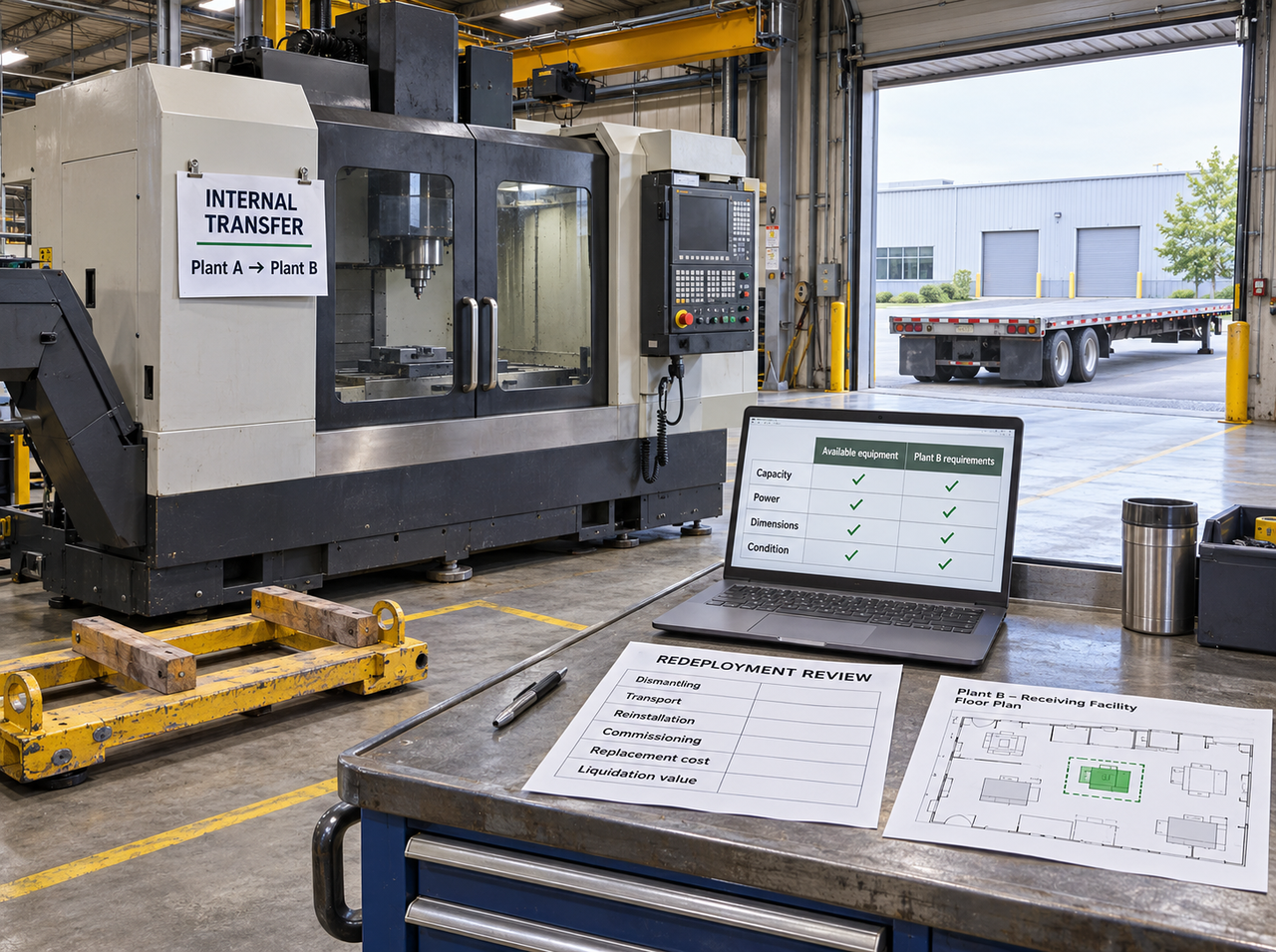
Before selling surplus machinery at one facility, manufacturers should assess its potential use at other locations. Equipment that is no longer needed at one plant may support production, replace aging machinery, or meet capacity needs at another.
Consolidated asset records help manufacturers identify equipment redeployment opportunities by comparing available machinery with operational needs across facilities. Review equipment specifications, condition, compatibility, and availability before deciding whether to transfer
Compare the costs of dismantling, transportation, reinstallation, and commissioning with the benefits of retaining the equipment, including avoided replacement costs. Factor in potential liquidation proceeds before approving transfers. Assets without a practical or financially justified internal use can then be considered for liquidation.
4. Assess the Market Value of Equipment at Each Facility

Equipment valuation helps manufacturers establish realistic recovery expectations across facilities. Assess machinery based on age, condition, specifications, maintenance history, and secondary-market demand.
Distinguish between book value, market value, and expected liquidation proceeds. Book value reflects an asset's recorded value after applicable depreciation, while market value depends on buyer demand and market conditions. Liquidation timelines, regional demand, and transportation costs can also affect the amount recovered from equipment sales.
Obtain professional equipment appraisals for high-value machinery, production lines, and other industrial assets. Use consistent valuation methods across facilities to compare asset values, support pricing decisions, and establish realistic recovery estimates.
5. Select the Right Liquidation Method for Different Industrial Assets
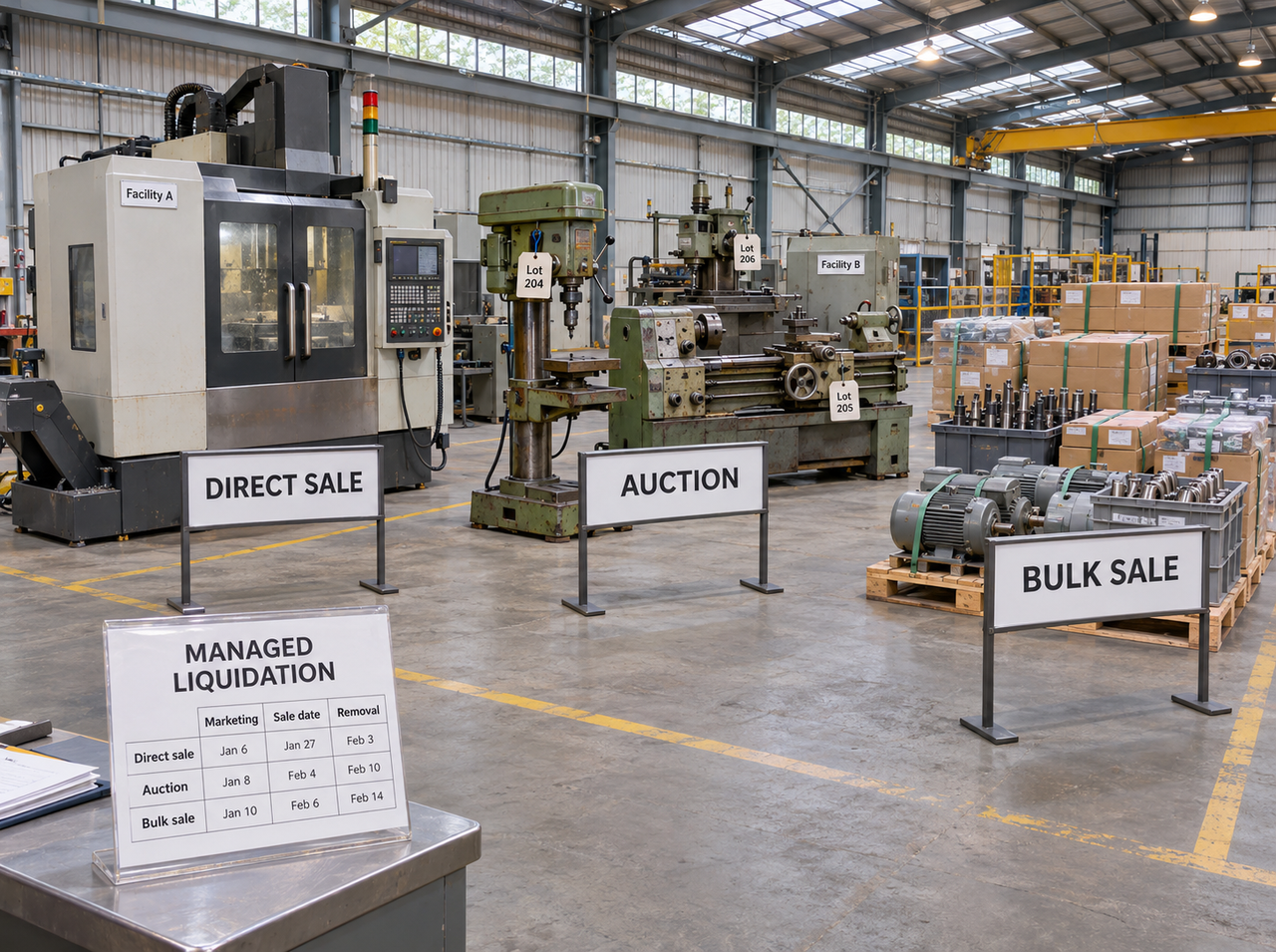
Manufacturers can use direct sales, industrial auctions, bulk sales, or managed liquidation arrangements depending on equipment type, condition, market demand, and selling deadlines. Each method offers different recovery potential and selling timelines.
Direct sales can reach qualified buyers for specialized machinery, while auctions can generate competitive bids for equipment with broader demand. Bulk sales can help clear large inventories quickly, while managed liquidation arrangements coordinate multiple sales activities. Across facilities, manufacturers can also group similar assets into coordinated sales to attract qualified buyers.
When selling equipment from closing facilities, consider how different sales channels affect buyer reach, marketing time, and equipment removal requirements. Facilities with urgent deadlines may require faster sales, while others can allow more time to market high-value machinery.
6. Coordinate Equipment Decommissioning, Removal, and Transportation

Across multiple facilities, equipment removal schedules must account for individual plant shutdown dates, production requirements, and buyer agreements. Establish clear procedures for managing decommissioned equipment and coordinate machinery disconnection, dismantling, rigging, loading, and transportation to meet removal deadlines.
Requirements vary based on equipment size, weight, and facility access. Large machinery may require specialized rigging, while restricted loading areas can increase removal costs. Early assessments help estimate expenses and clarify contractor responsibilities.
Coordinate contractors, transportation providers, and facility managers to prevent scheduling conflicts, particularly when specialized crews are needed at multiple sites. At plants that remain operational, equipment removal should minimize production disruptions and maintain safe working conditions.
7. Address Safety, Environmental, and Contractual Requirements

Plant liquidations across multiple facilities require site-specific safety and compliance planning. Before removing equipment, manufacturers should confirm hazardous-energy controls, contractor responsibilities, and safe dismantling procedures at each location.
Environmental planning should cover hazardous materials, waste disposal, equipment cleaning, and site restoration where required. At each facility, manufacturers must determine which waste is hazardous and follow applicable Environmental Protection Agency (EPA) hazardous waste management requirements for its handling and disposal. Maintain records of disposal activities and final inspections.
Verify equipment ownership, outstanding liens, leases, and contractual restrictions before approving asset sales or transfers. Resolving these obligations early helps prevent disputes, transaction delays, and unexpected liabilities. Maintain consistent asset transfer records across all facilities to document transactions and support facility handovers.
8. Track Liquidation Expenses and Measure Net Asset Recovery
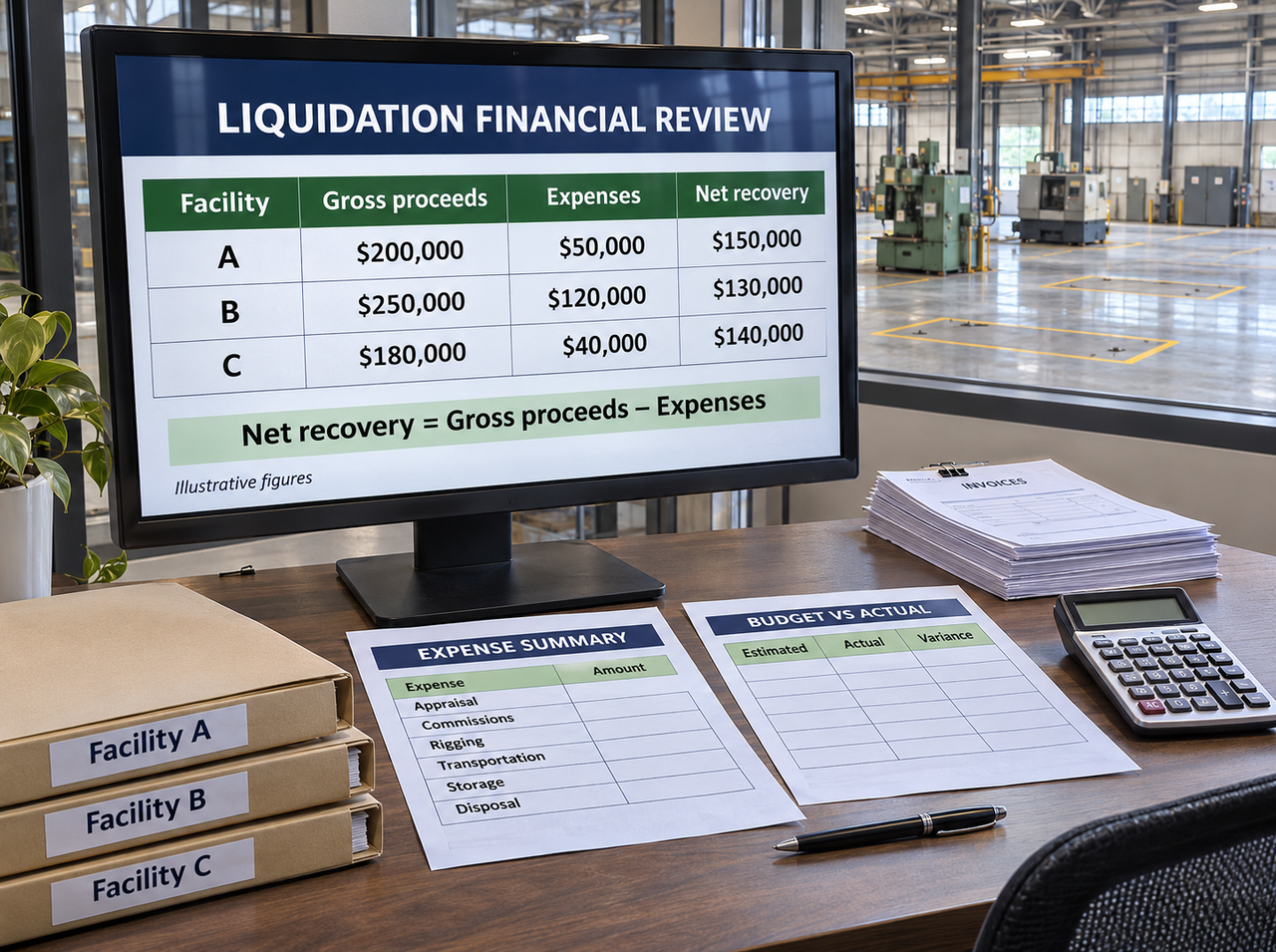
Track liquidation revenue and expenses separately for each facility to measure financial performance and identify differences in recovery costs across locations. Consolidate these records to evaluate the overall financial results of the multi-facility liquidation project.
Account for equipment appraisal fees, sales commissions, rigging, transportation, storage, and disposal costs. Calculate net asset recovery by subtracting these expenses from gross equipment sale proceeds. A facility generating high gross sales may still deliver lower net returns if removal and selling expenses exceed expectations.
Compare actual recovery with initial estimates and approved budgets to identify cost overruns or recovery shortfalls. Review financial performance across facilities to determine which assets, selling methods, and locations delivered the strongest net returns. Use these findings to improve cost control and guide future asset disposition decisions.
Conclusion
Managing plant liquidations across multiple facilities requires coordinated planning, accurate asset information, and careful scheduling to meet each location's operational and financial objectives.
From equipment redeployment and valuation to asset sales and removal logistics, each decision affects liquidation costs and overall recovery. Tracking financial performance across facilities helps manufacturers identify shortfalls and improve asset recovery outcomes.
The goal is to meet facility closure deadlines while controlling expenses and recovering maximum value from surplus industrial assets.
Manage Multi-Facility Plant Liquidations With Amplio
Managing equipment liquidation across several locations can be challenging when facilities have different timelines, machinery requirements, and removal schedules.
Amplio offers plant liquidation services to help manufacturers assess surplus equipment, manage asset sales, coordinate removal activities, and recover value from industrial assets.
Contact us to discuss your multi-facility liquidation requirements and learn how our team can support your project.