Service Parts Management: What It is and How to do it

Service parts are central to keeping industrial operations running at expected performance levels. When a critical component is unavailable, maintenance slows, production schedules slip, and downtime costs escalate quickly across manufacturing, field service, and other asset-intensive environments.
Many organizations still face gaps in service parts inventory management. Stockouts interrupt essential repairs. Excess inventory locks up working capital. Disconnected systems create uncertainty about what is actually available across sites. These issues continue to widen the gap between operational needs and the capabilities of existing spare parts processes.
In this article, we explain why service parts management has become a key focus for modern industrial teams, the challenges involved, and what it takes to manage parts with accuracy, speed, and control.
What Is Service Parts Management?

Service parts management is a subset of MRO management that focuses on planning, storing, controlling, and disposing of the components needed to maintain or repair equipment. It helps ensure the right replacement part is available at the right time so maintenance work can move forward without unnecessary delays.
Service parts operate very differently from production inventory. Production materials typically move in more predictable cycles tied to demand and scheduled output, while service parts are consumed irregularly and often in response to equipment failures. Demand can also vary widely across sites and equipment types, which makes spare parts management for maintenance more complex than managing production materials.
Because unplanned failures can halt entire operations, maintenance spare parts management requires stronger forecasting, tighter visibility, and more disciplined replenishment rules. Even a single missing component can cause downtime that is far more expensive than the part itself.
Why Is Service Parts Management Important?
Service parts management is important because equipment uptime often depends on having the right component available when maintenance or repairs are needed. Reliable service parts availability helps maintenance teams respond faster, reduce repair delays, and avoid extending equipment downtime while waiting for replacement parts.
The cost of unplanned downtime can be high. National Institute of Standards and Technology (NIST) estimated that maintenance-related unplanned downtime cost U.S. discrete manufacturers $18.1 billion in 2016. While parts availability is only one factor that affects downtime, keeping critical parts accessible helps maintenance teams respond to equipment failures without unnecessary sourcing delays.
Effective service parts management also helps reduce inventory carrying costs. Holding too many parts ties up working capital, consumes storage space, and increases the risk that components will become obsolete before they are used. These risks highlight the need for spare parts management that balances availability with actual maintenance requirements.
Core Challenges in Service Parts Management
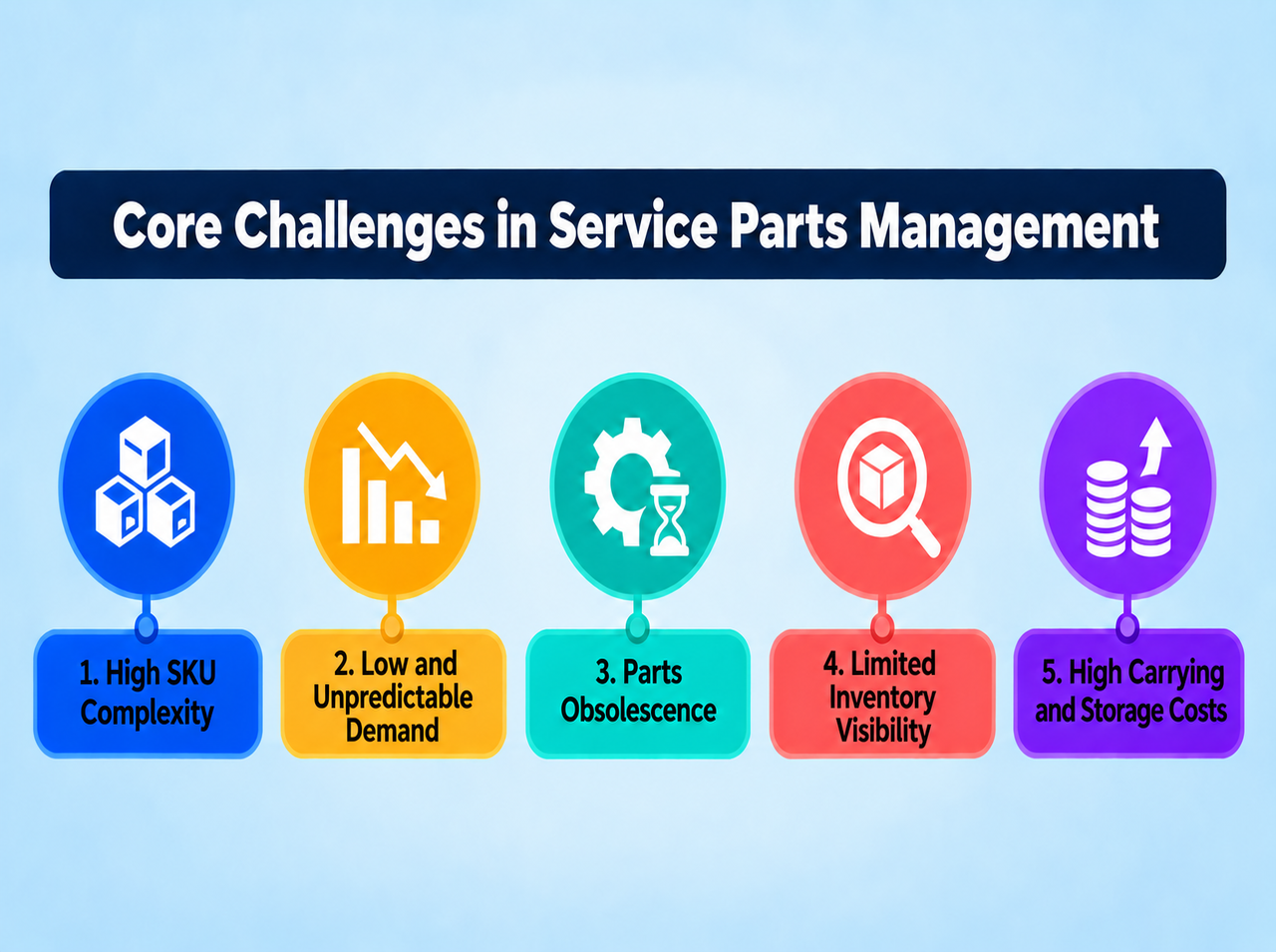
The management of spare parts may look simple on paper, but it becomes more difficult in real operations. Before improving spare parts performance, it is important to understand the challenges that commonly lead to poor inventory control and mismanagement.
1. High SKU Complexity
Spare parts management involves thousands of SKUs across multiple equipment models, asset ages, and manufacturers.
Unlike production inventory, service parts often include variations, revisions, and legacy components that remain in use long after the original equipment is discontinued.
This complexity makes it difficult to maintain accurate records, plan demand, and set appropriate stocking levels. It can also make it harder to identify duplicate, interchangeable, or obsolete parts across locations.
2. Low and Unpredictable Demand Patterns
Service parts do not follow steady consumption trends. Many items may move slowly for months or even years, then spike unexpectedly when equipment fails.
This makes forecasting difficult, especially for long-life equipment, aging assets, or parts with irregular failure patterns.
When demand is unpredictable, teams may overstock to avoid shortages, increasing the risk of excess and obsolete inventory. Understocking creates the opposite problem, leaving maintenance teams without the parts they need when failures occur.
3. Obsolescence of Service Parts
Service parts often become obsolete when equipment reaches end-of-life, manufacturers discontinue components, or newer versions replace existing parts.
Without proper parts obsolescence management, outdated components can remain in inventory long after they are no longer useful.
This ties up working capital, consumes storage space, increases stock complexity, and leaves maintenance teams with parts that no longer support current equipment needs.
4. Limited Visibility Across Systems
Service parts are often spread across multiple ERP platforms, maintenance systems, and facility-level spreadsheets.
When data is fragmented, inventory visibility suffers. Teams lack a clear view of what parts are available, where they are stored, and what condition they are in.
Poor inventory visibility can slow maintenance work, increase duplicate purchasing, and make it harder to plan replacements or identify excess and obsolete stock across locations.
5. High Carrying and Storage Costs
Spare parts often move slowly, yet they still require warehouse space, controlled storage, periodic inspections, and, in some cases, climate-controlled handling.
These carrying and storage costs can add up quickly, especially when companies hold more inventory than maintenance operations actually require.
Excess stock also ties up working capital and consumes warehouse capacity that could be used for active inventory. The longer slow-moving parts remain in storage, the greater the risk that they will lose value or become obsolete before they are needed.
How To Do Spare Parts Management Effectively
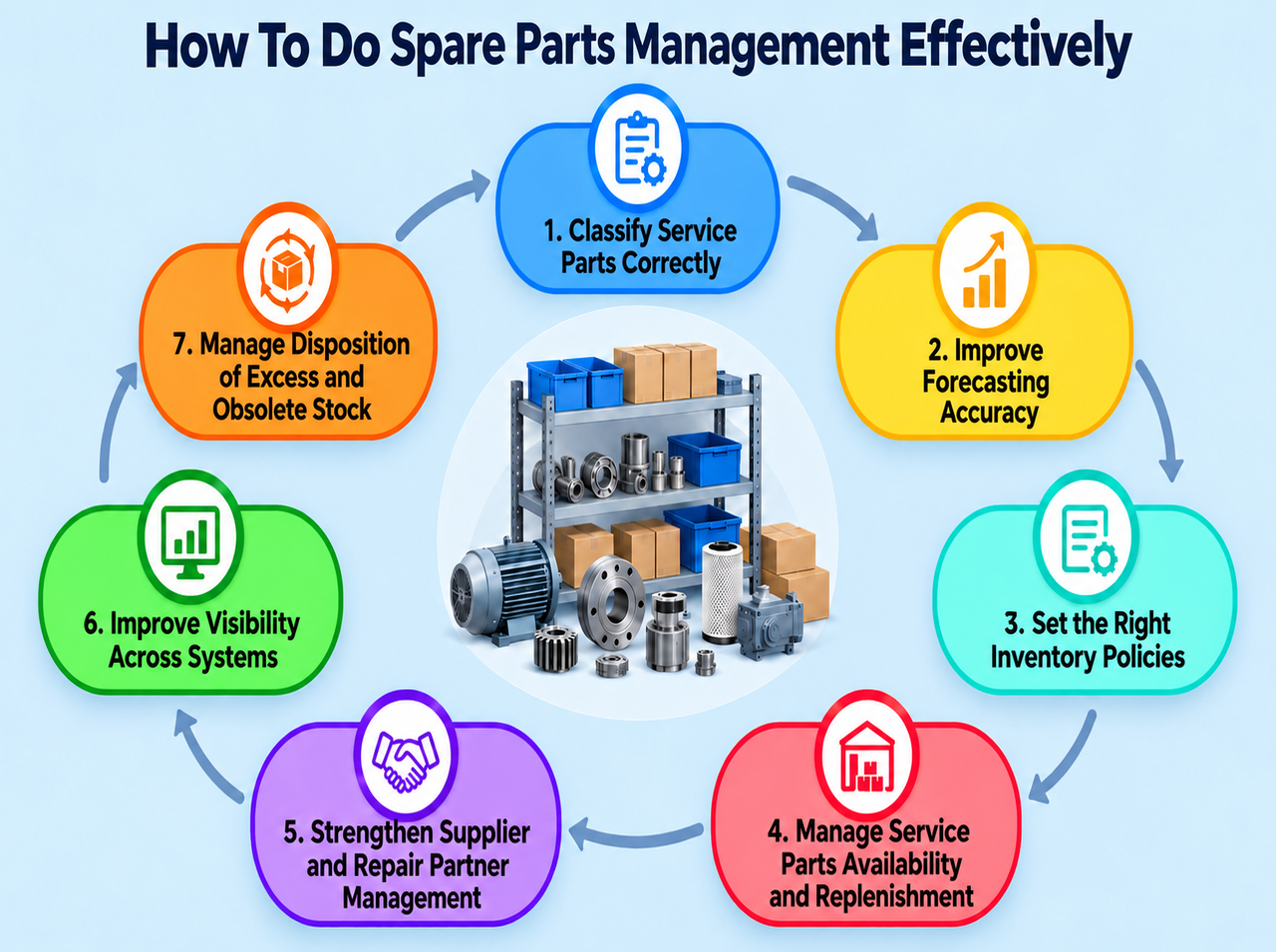
Managing spare parts effectively starts with understanding what drives parts availability and equipment reliability. A well-defined spare parts management process helps maintenance and supply chain teams manage service parts inventory more effectively and respond faster to equipment needs. The following methods form the foundation of an efficient system.
1. Classify Service Parts Correctly
Accurate classification is the foundation of effective service parts management. When parts are categorized properly, teams can plan stocking levels, track consumption, and prioritize maintenance work with far greater confidence.
Start by grouping service parts based on attributes such as criticality, usage frequency, lead time, and unit cost. This helps you understand which parts must stay available at all times and which can be ordered when needed.
For example:
• Critical spares should be classified separately because they protect against unplanned downtime.
• Fast-moving consumables may require higher stocking thresholds.
• Long-lead components need proactive planning to avoid delays.
• Non-critical or low-value items can often be sourced on demand.
2. Improve Forecasting Accuracy
Accurate forecasting is one of the most important parts of effective service parts management. Better forecasts reduce stockouts, prevent over-ordering, and give maintenance teams the parts they need when equipment fails. Strong service parts planning also helps teams prepare for future demand without carrying unnecessary inventory.
Here is how to strengthen forecasting for service and maintenance parts:
i) Use historical consumption
Review past usage patterns to identify which parts move consistently and which behave unpredictably. This helps set more realistic expectations for future demand.
ii) Apply maintenance schedules
Link forecasts to planned maintenance activities. Preventive and predictive maintenance can create more predictable periods of parts demand, and aligning inventory with these schedules reduces last-minute purchasing.
iii) Consider equipment age and failure patterns
As equipment ages, maintenance needs and parts demand can change. Understanding where each asset sits in its lifecycle helps teams forecast the likelihood of future service events.
3. Set the Right Inventory Policies
Strong inventory policies create balance in service parts inventory management. They help you avoid stockouts, reduce excess, and keep maintenance running without unnecessary inventory costs.
The table below outlines the core policies every operation should define.
A spare parts management system can help teams apply these policies consistently by monitoring stock levels, reorder points, safety stock, and part availability across locations.
4. Manage Service Parts Availability and Replenishment
Service parts availability management helps ensure critical components are accessible when maintenance teams need them. The goal is to support timely repairs without maintaining more inventory than operations require.
Effective service parts replenishment depends on factors such as supplier lead times, usage patterns, part criticality, and current stock availability. Critical or long-lead components may need to be replenished earlier, while lower-priority items can often wait until inventory reaches a defined reorder point.
Teams should review replenishment requirements as equipment usage, maintenance schedules, and supplier performance change. This helps maintain parts availability while keeping inventory aligned with actual service needs.
Case Study
NCR needed 500 components to complete an ATM repair order, but the parts were unavailable through its normal authorized channels. Amplio sourced all 500 components through its secondary-market network, giving NCR access to the parts needed to move the repair order forward. The components were also sourced at $150 less per unit than the alternatives NCR had found, resulting in $75,000 in procurement savings.
5. Strengthen Supplier and Repair Partner Management
Strong supplier and repair partner management is crucial for maintaining service parts availability and controlling costs.
Strong supplier relationships can improve pricing consistency, parts availability, and visibility into delays or product changes. Effective MRO sourcing strategies can further reduce supplier risk, improve access to critical parts, and help avoid urgent, high-cost orders.
Knowing how long new or replacement parts will take to arrive also helps teams size safety stock correctly and keep inventory aligned with actual demand.
Repair partners can further support cost control by rebuilding or refurbishing parts that do not need to be replaced. Effective service parts repair and exchange management helps teams decide when a component should be repaired, exchanged, or replaced instead of automatically purchasing a new one.
Together, these partnerships help maintain a steady flow of critical parts, reduce emergency spending, and strengthen the reliability of your overall parts management program.
6. Improve Visibility Across Systems
Improving visibility across systems is one of the most important steps in service parts management. When data is spread across ERP platforms, maintenance logs, procurement systems, and spreadsheets, teams struggle to see what parts they have, where they are stored, and how they are being used. This lack of clarity leads to duplicate purchases, excess inventory, and delayed maintenance.
Linking these systems or centralizing data through a service parts management solution creates a centralized view of service parts data. Maintenance teams can see real-time stock levels, procurement can track open orders, and operations can monitor usage trends. Better visibility also helps identify slow-moving or obsolete parts early, making it easier to redeploy them or prepare them for disposition.
With accurate, shared data, decision-making becomes faster and more precise. It reduces unnecessary spending, improves asset uptime, and strengthens control over parts that often go overlooked.
7. Manage Disposition of Excess and Obsolete Stock
Managing the disposition of excess and obsolete spare parts stock is an important but often overlooked part of effective service parts management. When excess and obsolete spare parts sit unused for long periods, they absorb storage space, tie up working capital, and often lose value. Many organizations avoid dealing with this inventory, which leads to long-term buildup and hidden carrying costs.
A clear disposition process helps prevent these issues.
Start by identifying slow-moving items, obsolete SKUs, and parts that no longer match current equipment standards. Once flagged, choose the most appropriate equipment disposition strategy, whether that means redeploying items internally, returning them to suppliers, refurbishing them, or selling them through secondary markets. This helps reduce parts wastage while recovering value from inventory that would otherwise be lost.
Regular disposition reviews keep inventory lean and relevant. They support stronger financial control, improve warehouse efficiency, and ensure your service parts strategy reflects real operational needs rather than outdated stock.
How Amplio Supports Responsible Disposition of Excess Service Parts
AI-Supported Visibility and Classification
Amplio helps teams gain clearer visibility into service parts across sites by reviewing inventory data across ERP and other operational systems. Its AI-supported appraisal and classification process reviews inventory at scale, identifies duplicates, flags obsolete or superseded items, and highlights parts that may be suitable for redeployment or resale.
Private Marketplace for Controlled Disposition
Amplio also hosts a private liquidation marketplace that connects you with accredited buyers who understand industrial equipment. This controlled channel ensures proper documentation, fair pricing, and reliable recovery opportunities—far more efficient than relying on traditional liquidators or unverified online platforms.
If you want to improve visibility, reduce excess parts, and recover value from unused inventory, our service parts management services can help you bring greater control to surplus inventory and make better recovery decisions.
Contact us to learn how Amplio can support your service parts management strategy.
FAQs
What are the core components of effective service parts management?
The core components include part classification, demand forecasting, inventory control, replenishment planning, supplier coordination, and visibility across systems.
How can you improve efficiency in service parts management processes?
You can improve efficiency by centralizing inventory data, setting clear stocking rules, improving forecasting, and regularly reviewing slow-moving or obsolete parts.
How do you decide which spare parts should be kept in stock?
Prioritize parts based on equipment criticality, failure impact, supplier lead time, demand history, and how quickly a replacement can be sourced.
How can you reduce spare parts inventory without increasing downtime risk?
Focus on removing duplicate, slow-moving, and obsolete stock while protecting critical and long-lead parts with appropriate safety stock and replenishment rules.