Semiconductor Obsolescence: What It Is and How to Manage It

Obsolete semiconductors are among the hardest supply chain risks to plan for in modern electronics. A semiconductor becomes obsolete when the original manufacturer stops producing or supporting it, often after issuing an end-of-life (EOL) notice. The part may remain fully functional, but once it is discontinued, buyers can no longer depend on the manufacturer for continued supply.
The financial impact of semiconductor obsolescence is significant. According to research from the University of Maryland, prices for obsolete chips typically rise to 10 or 15 times their original value. For instance, a component that sold for $3 during its production life can cost $30 or more once it becomes obsolete.
In this article, you will learn what semiconductor obsolescence is, what happens when a semiconductor is discontinued, and which practical steps can help you manage the risk.
What Is Semiconductor Obsolescence?
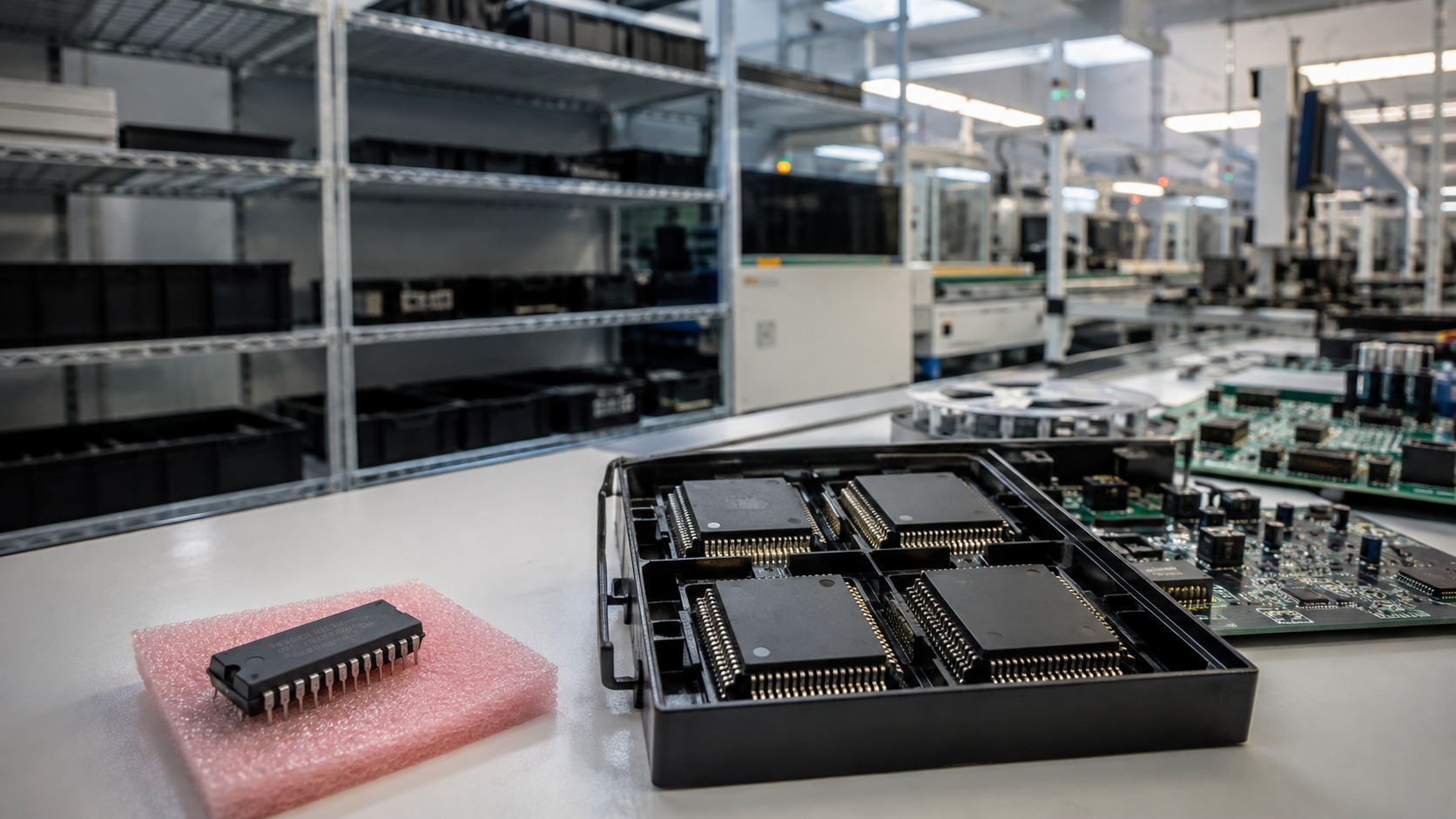
Semiconductor obsolescence occurs when the original component manufacturer permanently discontinues production or support for a specific electronic component or chip. Once production ends, obsolete components may become difficult to obtain through regular distribution channels, directly affecting your procurement strategy and production schedule.
Obsolescence can be announced or unannounced. In announced cases, component manufacturers issue a Product Discontinuance Notice (PDN) or End-of-Life (EOL) notice, giving buyers a final period to place last-time-buy (LTB) orders before production ends entirely. This advance notice gives you time to secure alternative sources, qualify replacement components, or purchase enough inventory to meet future demand.
Unannounced obsolescence, however, occurs when production or support ends with little or no warning. It may result from a manufacturer shutdown, factory closure, sudden product-line cancellation, or another permanent loss of supply, leaving procurement teams with limited time to adjust their sourcing strategy.
Causes of Semiconductor Obsolescence
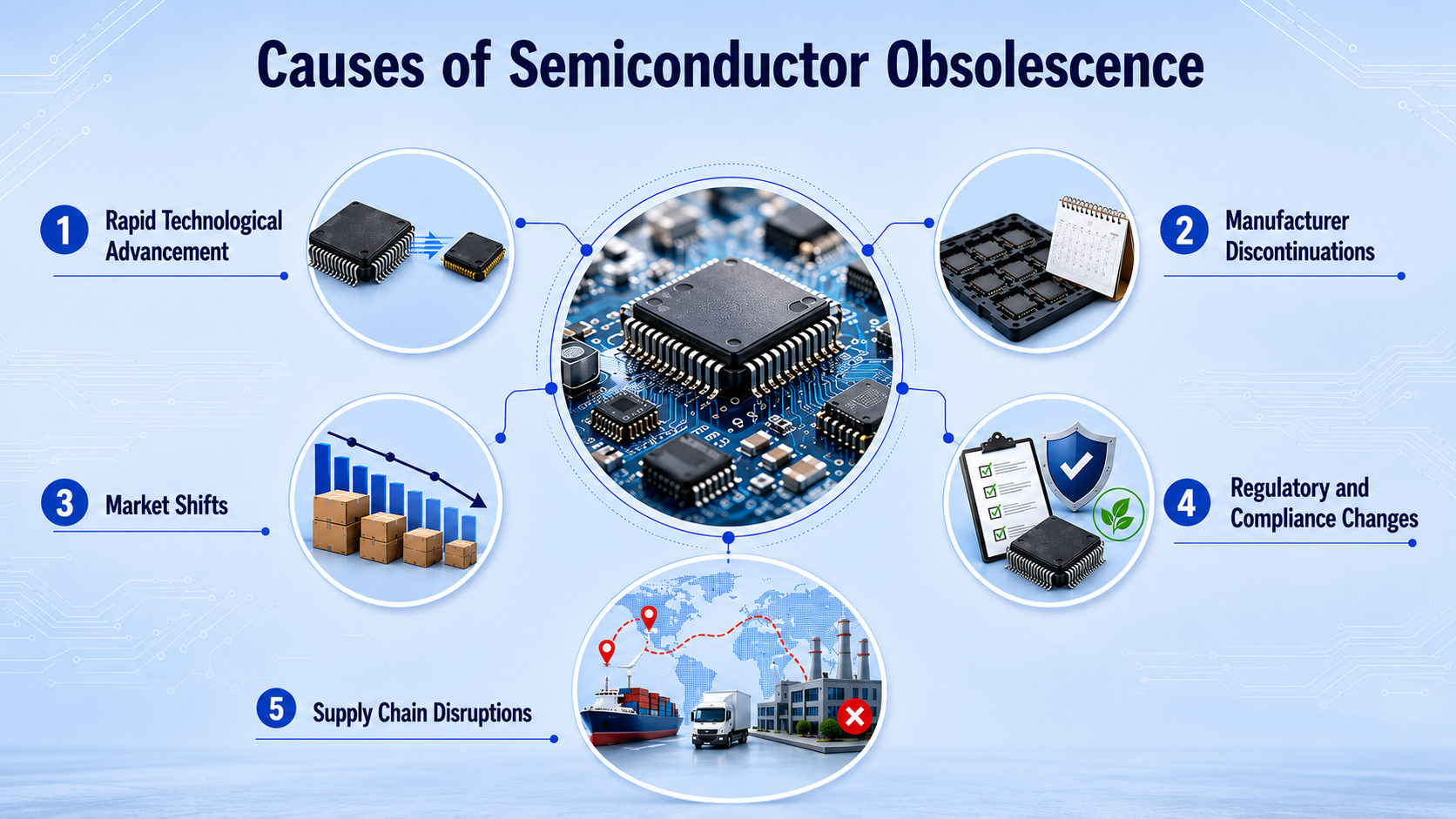
Understanding the factors contributing to semiconductor obsolescence can help you identify risks earlier and plan before supply becomes limited. Several key factors drive components toward obsolescence, impacting your procurement strategy and operational continuity.
1. Rapid Technological Advancement
Technological innovation in the semiconductor industry leads to the regular release of smaller, faster, and more energy-efficient chips. Semiconductor manufacturers discontinue older components to focus resources on next-generation products. As a result, original equipment manufacturers (OEMs) may struggle to support equipment that remains in service after the chips it relies on become obsolete.
2. Manufacturer Discontinuations
Manufacturers periodically discontinue semiconductor components through formal Product Discontinuance Notices (PDNs) or End-of-Life (EOL) announcements. These notifications specify timelines after which production and official support cease, creating urgency in your procurement processes. Failure to respond promptly can disrupt production schedules, reduce procurement efficiency, force costly redesigns, or lead to difficult sourcing from secondary markets.
3. Market Shifts
When market demand for specific semiconductor components declines, manufacturers may discontinue parts that are no longer commercially viable to produce. As available inventory decreases, these components can become harder and more expensive to source, putting pressure on your procurement team to identify and qualify suitable replacements before limited supply causes production delays.
4. Regulatory and Compliance Changes
Regulatory updates, such as new RoHS, REACH, or environmental compliance standards, frequently result in semiconductor obsolescence. Components unable to meet updated regulations are phased out, forcing your procurement team to rapidly source compliant alternatives or adapt product designs to remain operational and avoid penalties.
5. Supply Chain Disruptions
Disruptions in the supply chain, including geopolitical conflicts, natural disasters, or unexpected economic events, can cause a semiconductor shortage that restricts access to critical components. If these events lead to permanent factory closures, production shutdowns, or product discontinuation, your procurement team may have limited time to secure alternatives and prevent delays to your production schedule.
What Happens When a Semiconductor Is Discontinued?
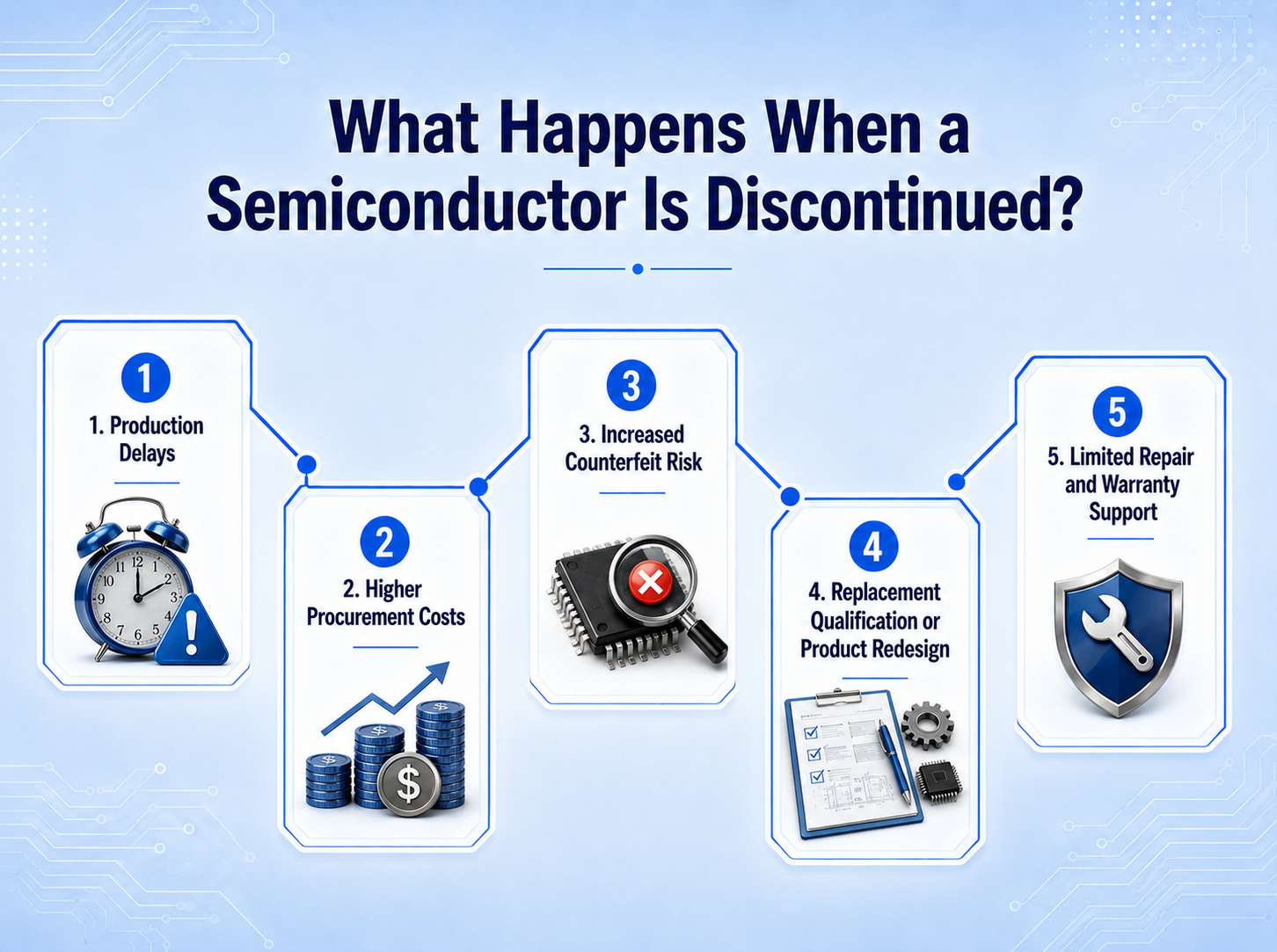
Even a single discontinued device within a product design can create sourcing, production, and product support challenges for a business. Below are the main issues that may arise after regular production ends.
1. Production Delays
Reduced component availability can disrupt manufacturing schedules and make production planning less predictable. Procurement teams may struggle to secure the required quantities, which can extend lead times, slow production, and delay customer orders.
2. Higher Procurement Costs
Scarce inventory often comes at higher costs as authorized supply declines. Buyers may face increased unit costs, added supplier charges, and extra expenses for inspection, testing, and verification when sourcing from secondary-market suppliers.
3. Increased Counterfeit Risk
Counterfeit risk rises as legitimate inventory becomes harder to find. Counterfeit parts may be remarked, recycled, or misrepresented as genuine components, increasing the likelihood of quality failures and compromising product integrity.
4. Replacement Qualification or Product Redesign
Qualifying a replacement can require extensive engineering review and testing. Teams must assess electrical performance, package compatibility, reliability, and product requirements. When no approved drop-in replacement exists, the circuit board or product may need to be redesigned before production can continue.
5. Limited Repair and Warranty Support
Repair and warranty obligations become harder to meet as discontinued semiconductors become less available. Service teams may struggle to source the exact components required for maintenance and field repairs, resulting in longer turnaround times, higher service costs, and reduced support for older products.
Strategies for Managing Obsolete Semiconductors
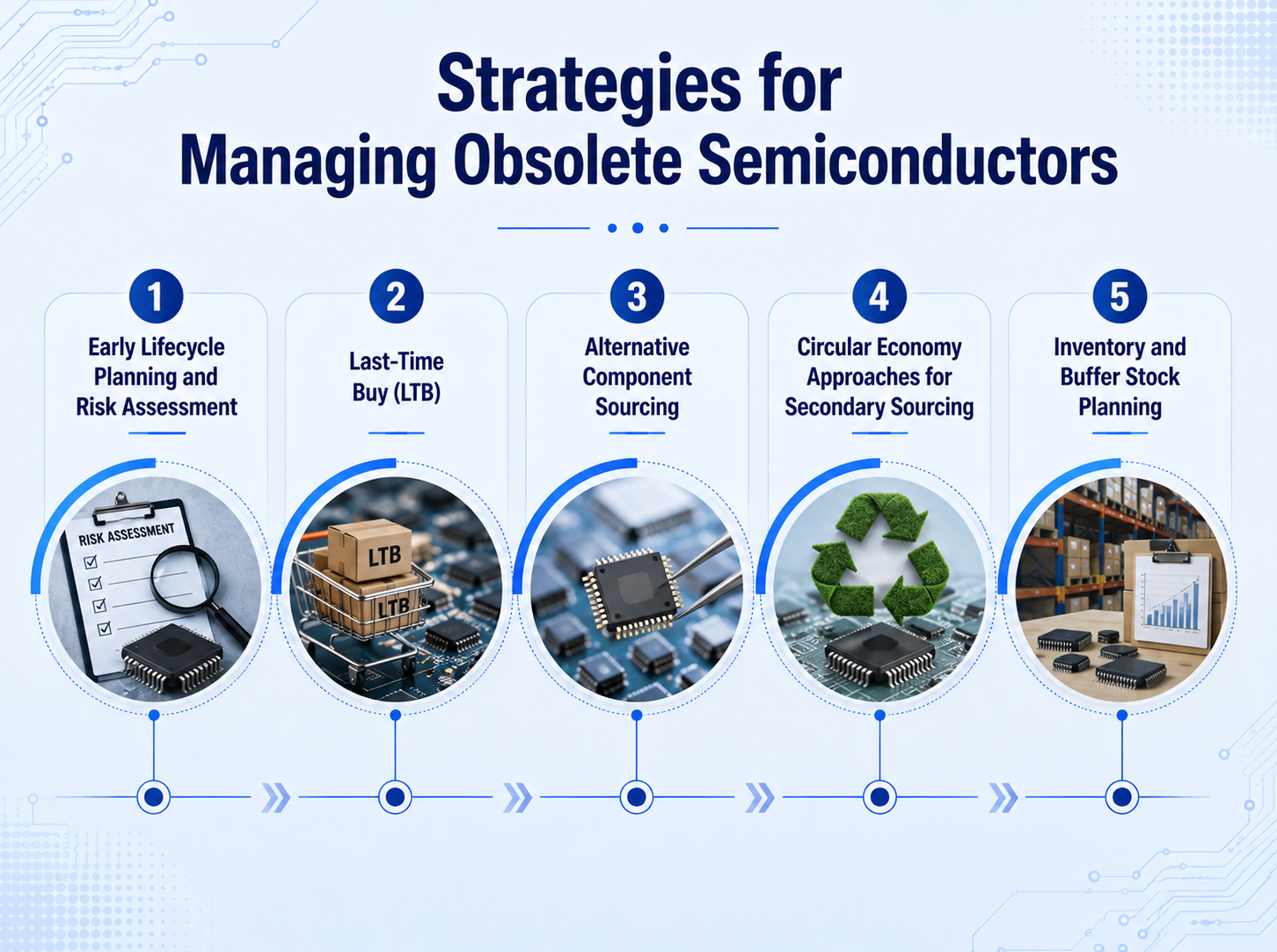
Effectively managing semiconductor obsolescence requires a proactive approach to anticipate and mitigate supply chain disruptions. By implementing structured approaches, your team can maintain production continuity and minimize financial risks.
1. Early Lifecycle Planning and Risk Assessment
Proactive lifecycle management enables you to identify obsolescence risks early, giving you more time to prepare an effective response. Regularly reviewing your Bill of Materials (BOM) helps identify sole-source components and other at-risk parts, allowing your team to plan before supply becomes limited. For products with complex BOMs, semiconductor risks should be tracked as part of a broader electronic component obsolescence program.
Lifecycle forecasting tools can also provide visibility into component status, availability indicators, and relevant market trends, supporting informed sourcing decisions and timely replacement planning.
2. Last-Time Buy (LTB)
A last-time buy (LTB) is your final opportunity to purchase a discontinued semiconductor before it becomes unavailable. Execute an LTB when the manufacturer issues an official End-of-Life notice and provides a closing window for orders. Early action is critical—delaying this decision can leave your production exposed to costly gaps.
To determine the right purchase quantity, analyze historical usage, production forecasts, and any contractual service obligations. Consider potential design changes or shifts in customer demand that could affect your needs. Proper inventory management is essential; store components under optimal conditions to preserve reliability and minimize degradation-related losses.
3. Alternative Component Sourcing
When original components are no longer available, alternative sourcing helps protect your production schedule and maintain product reliability. Start by identifying cross-referenced parts or functional equivalents that meet your technical and compliance requirements. Engage with authorized distributors and trusted suppliers to verify availability and authenticity before making a selection.
In cases where exact substitutes are unavailable, evaluate minor redesigns to accommodate similar components. Document all qualification steps to ensure quality and traceability. Establishing relationships with multiple suppliers reduces the risk of future shortages and improves long-term availability for critical components.
4. Circular Economy Approaches for Secondary Sourcing
Adopting circular economy practices allows you to secure obsolete semiconductors from secondary sources, including surplus inventory, certified resellers, industrial liquidators, and asset recovery partners. This strategy supports the development of a resilient secondary supply chain, ensuring continued access to discontinued components while promoting cost efficiency and sustainability.
To minimize potential risks, partner with reputable suppliers and industrial liquidators who offer traceability and rigorous quality assurance. Integrating circular economy channels into your sourcing approach strengthens supply chain resilience and helps maintain operational continuity when primary sources are no longer available.
How Amplio Helped NCR Resolve a Critical Component Shortage
NCR needed 500 Allegro MOSFETs for an ATM repair order, but the components were unavailable from Allegro and major distributors until 2024. Brokers were also quoting prices 10 times higher than usual. Through its trusted secondary network, Amplio sourced quality-tested units with +22 date codes that met NCR’s requirements. The components cost $150 less per unit than the options NCR had received, saving the company $75,000 on the first order. A second order later brought NCR’s total savings to $150,000.
5. Inventory and Buffer Stock Planning
Strategic inventory planning helps you maintain reserves of critical or high-risk semiconductors and manage the uncertainty of obsolescence. By building a buffer stock, you ensure continuity in production even when supply becomes unpredictable or components are discontinued.
Successful buffer stock planning requires a clear understanding of your usage patterns, lead times, and product life cycles. Regularly review your inventory levels and update forecasts to account for market volatility and changing component demand. It's important to balance the costs of carrying additional inventory against the risk of production delays or shutdowns. Invest in secure storage and implement strong inventory controls to prevent loss, degradation, or obsolescence of stocked components.
How Amplio Can Support Your Semiconductor Obsolescence Management
Amplio offers specialized support for organizations facing semiconductor obsolescence. Our platform connects you to a global network of qualified buyers and suppliers, streamlining the sourcing of critical components and the management of inventory at every stage of the product lifecycle.
Amplio’s AI agents analyze inventory data, market demand, and pricing signals to help identify sourcing and asset recovery options. This use of artificial intelligence, combined with expert review, helps your team make informed decisions and maintain operational continuity. If you need to liquidate obsolete assets, our turnkey solutions ensure secure, compliant, and efficient asset recovery.
Contact us now to enhance your obsolescence management strategy and safeguard your production against supply chain disruptions.