Surplus Asset Disposition: What It Is and How To Do It
Introduction
As manufacturers and industrial companies place more focus on asset management, surplus asset disposition has become a key part of lifecycle control. Equipment, materials, lab equipment, vehicles, and other surplus assets may still hold value after they stop supporting current operations.
However, holding on to those assets comes at a cost. According to the Investment Recovery Association, the average holding cost for surplus assets and store inventories runs at 20% of their fair market value each year. Unused assets can tie up capital, take up valuable space, increase maintenance costs, and lose fair market value before the business decides on redeployment, sale, recycling, donation, or disposal.
This guide explains what surplus asset disposition means, how the process works, and how your business can identify, value, manage, and recover value from surplus assets with stronger control.
What Is Surplus Asset Disposition?

Surplus asset disposition is the structured process of identifying, valuing, redeploying, selling, donating, recycling, or disposing of assets your business no longer needs. The goal is to recover capital, free valuable space, reduce risk, and stay compliant with internal policies and external regulations.
These surplus assets may include idle machinery, lab equipment, vehicles, raw materials, excess inventory, spare parts, and decommissioned equipment. They may no longer support current operations, but they can still hold fair market value.
Rule of Thumb to Flag “Surplus”
To manage surplus assets effectively, you need clear criteria to determine when an item stops adding value and starts creating cost. Here are practical thresholds that help identify surplus early, before carrying costs escalate or recovery value declines.
1. Inactivity / Aging
If an asset or SKU has an idle time of 6 months or more, it is no longer productive. Every additional day it sits, carrying costs increase, and recovery value decreases. Review inactive items and equipment systematically, and decide whether to dispose of any surplus assets.
Note: Of course, not all idle parts are waste — rare or safety-critical components may sit unused for months or even years, and that’s okay. Their value lies in readiness, not turnover, and keeping them on hand can prevent costly downtime when an unexpected failure occurs.
2. Low Utilization
When equipment or inventory is used less than half of its planned capacity, it signals underutilization. Low utilization means resources are tied up without generating expected returns and reduces operational efficiency across your business. At this stage, assess surplus asset disposition alternatives.
3. No Planned Demand / Program End
If a product has no forecasted demand or an associated program has ended, it has no future in your operations. Holding on only adds cost. Surplus tied to discontinued programs is an indication to identify resale opportunities before market interest fades.
4. Decommissioned or Out of Spec
Assets that are removed from service or fail to meet quality standards are no longer viable for production. In many cases, repair or recertification isn’t cost-effective. As a result, they should be flagged as surplus, making disposition the most efficient option to recover remaining value and minimize further financial losses.
5. Regulatory or Safety Block
Assets that are restricted due to compliance, certification, or safety issues should be flagged as surplus immediately. If left unmanaged, they carry significant risks, including regulatory penalties, fines, and potential damage to your company's reputation.
6. Excess Cost-to-Hold
If the cost of storing, insuring, and maintaining an asset surpasses its expected recovery value, it quickly turns into a financial liability. This threshold is often overlooked, but it’s crucial to identify before it impacts your bottom line. Assets that continuously incur carrying costs without generating sufficient return should be flagged for disposition to prevent unnecessary financial drain and optimize capital allocation.
Why Surplus Asset Disposition Matters
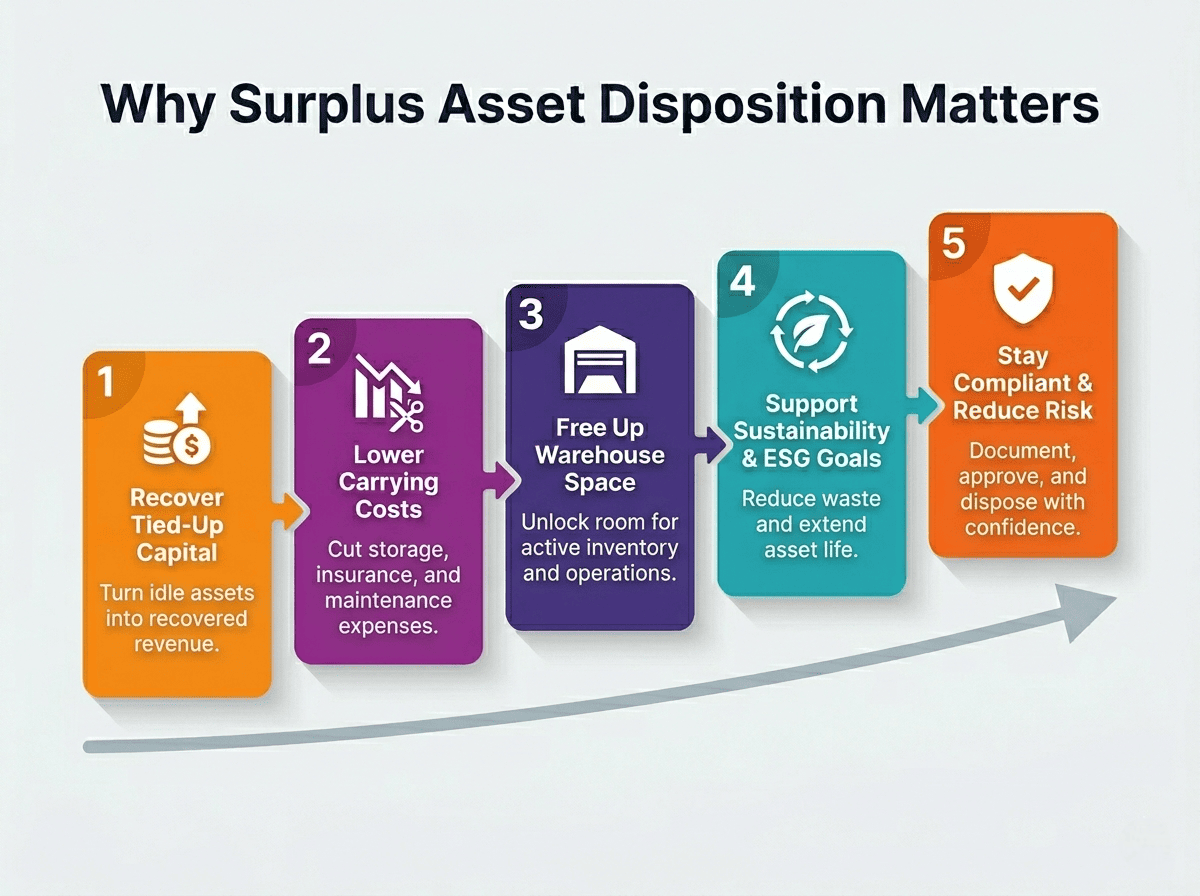
Surplus assets often sit in the background until they become a financial drain. A structured process for managing surplus assets turns them back into a source of value.
1. Recover Tied-Up Capital
Surplus assets often still hold fair market value. Machinery, spare parts, and excess inventory may no longer fit your operations, but potential buyers may still need them.
A structured disposition process helps your business recover capital from unused assets. This is part of a broader asset recovery approach that gives finance and procurement teams a clearer way to generate revenue from equipment, materials, and other surplus property.
2. Lower Carrying Costs
Holding surplus assets is expensive. Storage fees, insurance, maintenance costs, security, and depreciation add up month after month. The longer assets sit, the more they reduce recovery value.
A disciplined disposition process helps remove those costs at the source. By acting early, your business can cut maintenance costs and stop paying to store items that no longer support current operations.
Case Study
A global paper and forest products manufacturer partnered with Amplio after identifying more than $30 million in excess MRO inventory across dozens of sites. The unused inventory was creating a major carrying-cost burden. Amplio assessed secondary-market pricing and demand, assigned each SKU to the right disposition path, and prioritized sites for inventory removal. The program cleared capital equipment and MRO inventory from 20 sites and removed about $3 million in quarterly carrying costs.
3. Free Up Warehouse Space
Warehouse space is one of the most expensive resources in any industrial operation. When surplus assets occupy that space, they limit room for fast-moving inventory, active equipment, and materials needed for current operations.
Clearing surplus through disposition opens valuable space for production, fulfillment, and high-priority stock. The result is better workflow and enhanced operational efficiency across your facilities.
4. Support Sustainability and ESG Goals
Disposition shapes your environmental footprint. Sending surplus assets to landfill wastes materials and adds to disposal costs.
Surplus asset disposition reduces waste by keeping useful equipment, materials, and other valuable resources in circulation. These channels extend asset life, lower environmental impact, and contribute to ESG reporting.
5. Stay Compliant and Reduce Risk
Some surplus assets carry compliance, safety, data, or environmental risks if they are not managed correctly.
A controlled disposition process keeps your business aligned with internal policies and external regulations. It helps you document ownership, secure approvals, follow disposal rules, and reduce risk before assets leave your facility.
Methods of Surplus Asset Disposition
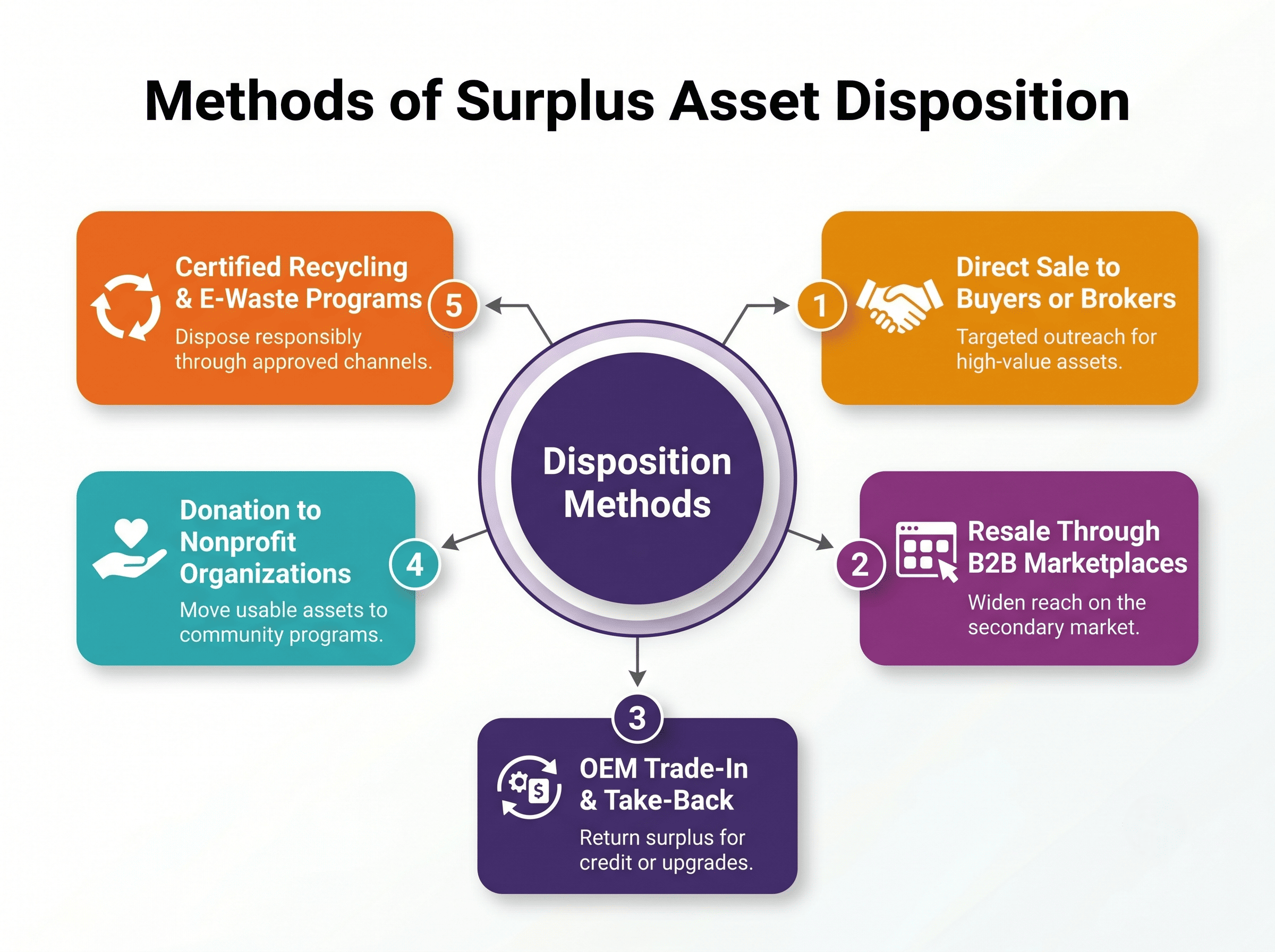
1. Direct Sale to Buyers or Brokers
Direct sale connects your business with buyers or brokers who understand the value of specific surplus assets. This method works well for high-value machinery, specialized equipment, vehicles, or materials where targeted outreach can support stronger bids, clearer terms, and greater control over the sale process.
2. Resale Through B2B Marketplaces
B2B marketplaces connect your business with verified buyers looking for surplus machinery, equipment, materials, and spare parts. This method widens your reach beyond local networks, helps you secure the best deal, and balances speed with recovery value for assets that have demand in the secondary market.
3. Original Equipment Manufacturer Trade-In and Take-Back
Original Equipment Manufacturer (OEM) trade-in and take-back programs let your business return surplus equipment to the original manufacturer in exchange for credit, discounts, or upgraded models. This method works best when planned during procurement, with terms agreed on in the original purchase contract.
4. Donation to Nonprofit Organizations
When you donate surplus assets to nonprofit organizations, your business moves usable equipment to schools, charities, training centers, or community programs instead of sending them to disposal. This method reduces waste, supports local communities, and may provide tax benefits when your finance team documents the donation correctly.
5. Certified Recycling and E-Waste Programs
Certified recycling and e-waste programs are the right fit when surplus assets have little or no resale value. This method helps your business reduce waste, meet environmental and safety regulations, maintain disposal records, and protect brand reputation through approved recycling channels.
How To Conduct A Surplus Asset Disposition
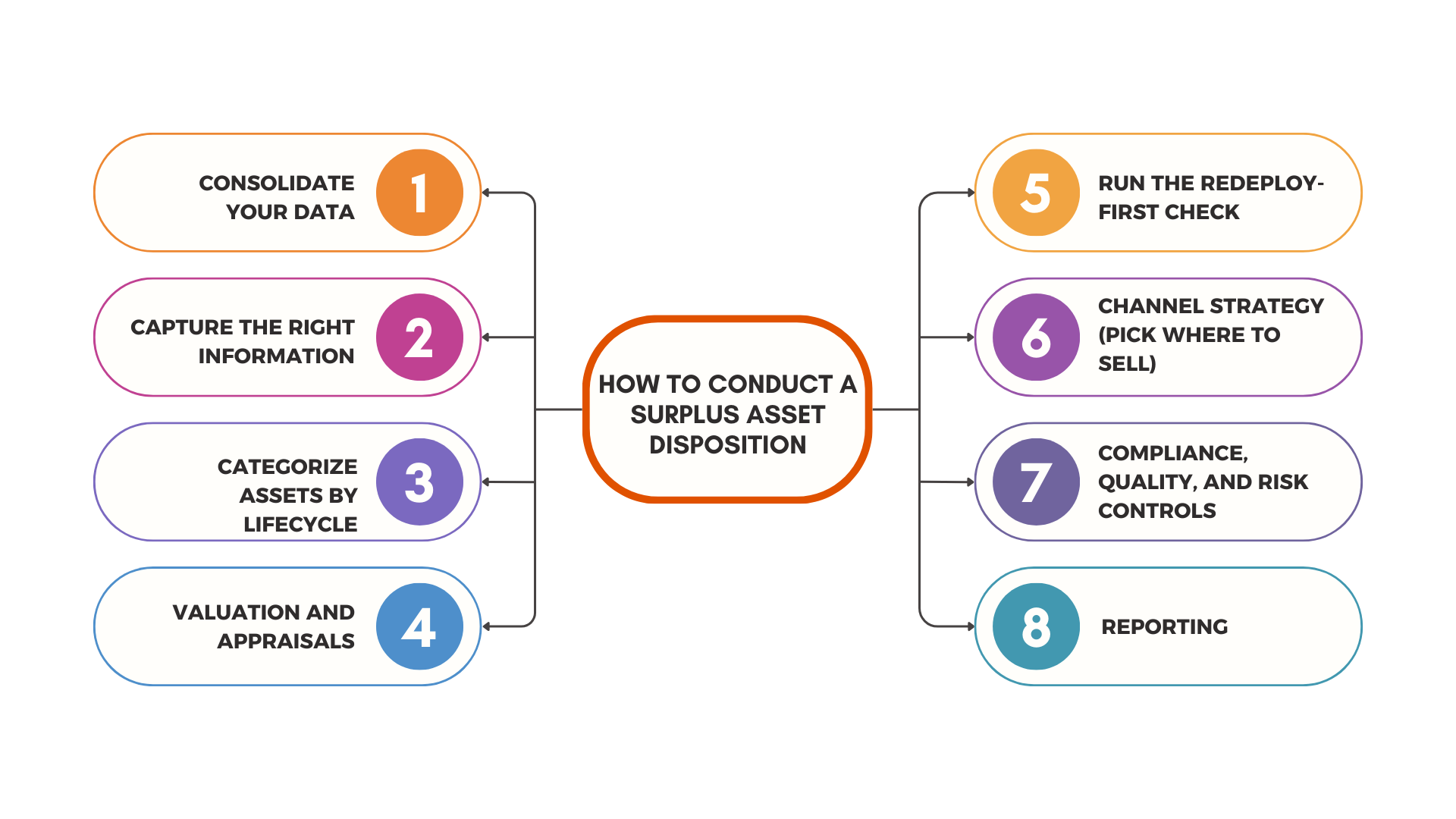
Step 1 — Consolidate Your Data
Strong surplus asset management starts with clean data. Begin by pulling asset details from your source-of-truth systems. This keeps every team working from one accurate list:
- ERP (Enterprise Resource Planning) or WMS (Warehouse Management System) for inventory levels, lot numbers, and locations.
- CMMS (Computerized Maintenance Management System) for maintenance history and utilization data.
- Fixed asset register for book values, depreciation, asset IDs, and ownership details.
Step 2 — Capture the Right Information
For each asset, collect a minimum set of details to support valuation and decision-making:
- Age and usage history
- Location and quantity
- Condition grading with photos
- Serial numbers, tags, or lot IDs
- Regulatory status, including certifications, recalls, or hazardous material classification
- Supporting documents like manuals, service logs, and safety data sheets
This gives your team the information needed to determine market value and compare recovery options with confidence.
Step 3 — Categorize Assets by Lifecycle
Classify assets consistently so they can be compared and prioritized:
- Active: Assets performing as planned and supporting current operations
- Slow-moving: Assets with reduced turnover or declining usage rates
- Excess: Assets held in quantities above forecasted demand
- Inactive: Assets with no usage within a defined time window
- Obsolete: Assets with no current operational use and limited market value due to age, technology shifts, or program end.
This framework gives you a clear picture of what to act on first.
Step 4 — Valuation and Appraisals
Before selecting a disposition channel, it is critical to establish the true value of your surplus assets.
Start by reviewing current market comparables. Look at what similar equipment, inventory, or tooling is selling for across secondary marketplaces, auction results, and broker listings.
For high-value machinery or specialized assets, independent appraisals often provide a more accurate benchmark. This helps when executives need third-party validation for financial reporting, compliance, or approval before sale.
Step 5 — Run the Redeploy-First Check
Before moving forward with a sale, recycling, or disposal decision, evaluate whether the asset can still create value within your organization through redeployment.
Start by assessing whether it can be transferred to another plant, warehouse, or department where it fills an immediate need.
Look for cross-site demand, such as upcoming work orders, purchase requests, or projects that could use the asset without the cost of a new purchase. As Trey Closson, CEO of Amplio, explains, "If the item has value internally across other facilities, redeployment comes first since that's a dollar-for-dollar recovery with no transaction cost."
Consider the financial trade-off as well. If redeployment costs less than buying new equipment or parts, internal transfer is the smarter move.
Note: In many cases, this redeploy-first practice maximizes asset life, reduces unnecessary spending, and delays capital expenditure.
Step 6 — Channel Strategy (Pick Where to Sell)
Once an asset is flagged for disposition, the next decision is choosing the right channel. This choice is not one-size-fits-all. It depends on several factors, including transaction speed, price recovery, compliance requirements, buyer access, and brand control.
Implementing a structured channel strategy helps your business move surplus assets through the right channel, from resale and consignment to donation, recycling, or disposal. It also helps you maximize recovery value, reduce risk, and protect your organization’s reputation.
Step 7 — Compliance, Quality, and Risk Controls
When disposing of surplus assets, compliance is not optional. It’s a safeguard for your business, brand, and bottom line. Every surplus asset that leaves your organization should undergo strict quality and risk control checks to ensure safety, regulatory compliance, and protection of your reputation.
- Export Controls & Sanctions Screening
Always confirm that assets comply with trade laws. This prevents violations tied to restricted buyers, sanctioned regions, or controlled technologies.
- Safety & Recall Checks
Verify that equipment is not subject to recalls and that calibration records and certifications are current. This ensures buyer safety and protects your organization from liability.
- Data Sanitization for IT Assets
For IT hardware, wiping or destroying data is critical to prevent breaches, regulatory violations, and reputational damage. Certified data sanitization methods should be non-negotiable.
- Brand Protection
Guard your reputation by vetting buyers, setting territory limits, and enforcing channel restrictions. This avoids gray markets, counterfeit risks, and misuse of branded assets.
Step 8 — Reporting
Close the loop with clean, auditable records. Book the sale, retire the asset in your fixed asset register, and update ledgers to reflect proceeds, write-downs, and disposal costs. Tie each transaction to supporting documents such as photos, invoices, certificates, and chain-of-custody records so finance, audit, and compliance teams have a single source of truth.
Here are some KPIs to report
- Recovery rate (% of original or net book value)
- Time-to-cash (days from listing to funds received)
- Carrying cost reduction (storage, insurance, depreciation avoided)
- Space freed (sq. ft. or pallet positions released)
- Landfill diversion (% reused, redeployed, or recycled)
Pro-Tip: Run a brief post-mortem. Identify what worked, where cycle time stalled, and which channels delivered the best value. Update policy and thresholds (aging windows, utilization cutoffs, cost-to-hold triggers) to accelerate the next cycle and improve outcomes.
How Amplio Supports Surplus Asset Disposition
Help With Internal Redeployment
Amplio's AI-powered centralized inventory management tool aggregates data across ERP, WMS, CMMS, and site systems into a single view. This gives your team the ability to see where surplus exists, identify internal demand, and redeploy assets to the right plant, line, or distribution center before considering a sale.
Direct Access to Qualified Buyers
When redeployment isn’t viable, Amplio’s online platform helps you to reach a curated network of vetted industrial buyers. This targeted marketplace accelerates transactions, improves recovery values, and shortens time-to-cash.
Amplio provides surplus asset disposition services to turn unused equipment into cash and free up valuable space.
Contact us now.